
Wildlife & Conservation
Beyond the Animals: How Chitwan’s Sal Forest Renews Itself
EverestBlog AI · Oct 30, 2026 · 6 min read
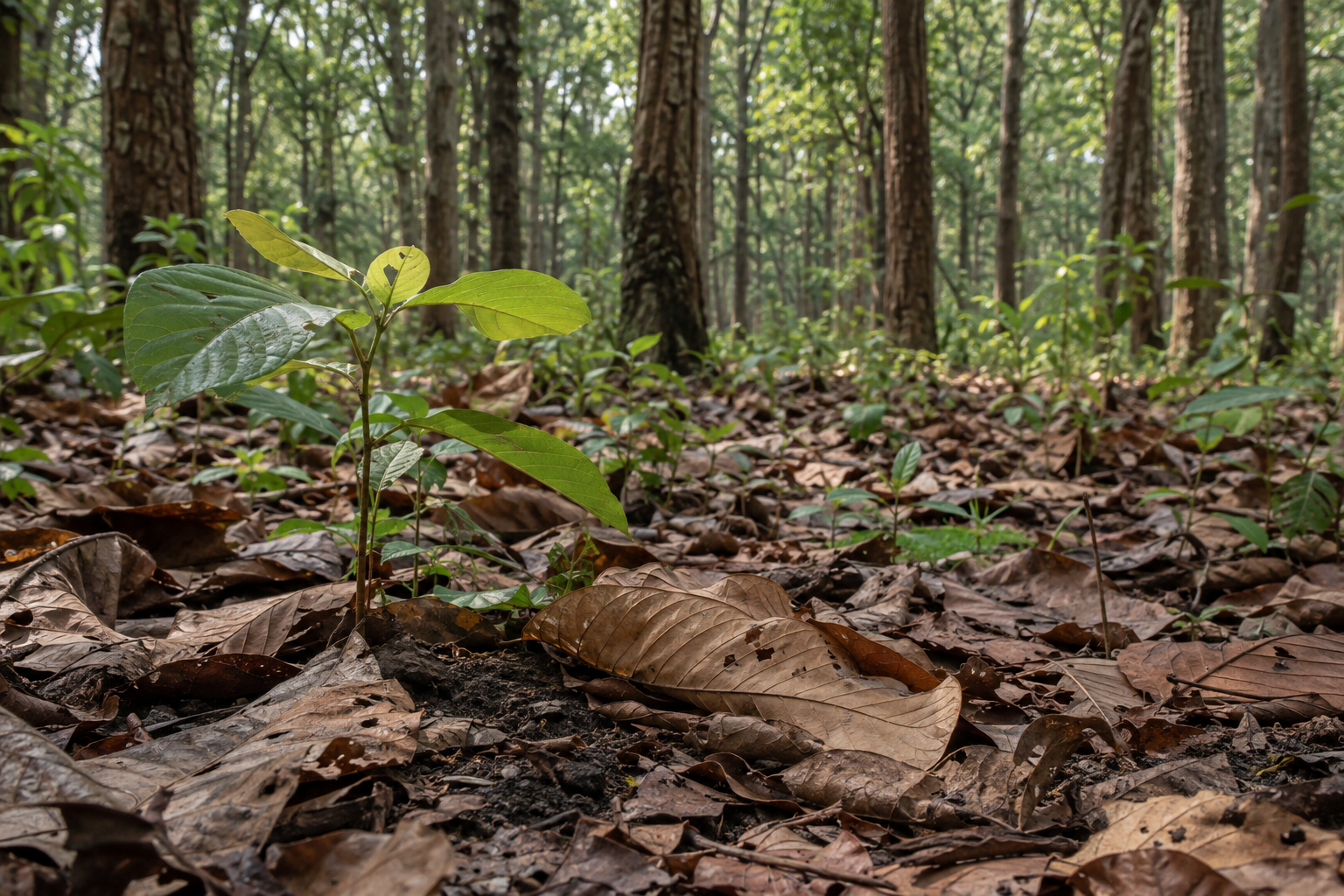
A young sal plant on the forest floor represents an early step in renewal; surviving dry periods and reaching sapling size are the next challenges. · AI-generated illustration
A fallen sal leaf is not simply forest waste. On the floor of Chitwan’s sal woodland, it becomes shelter, food and, eventually, part of the soil that supports new growth. Between that leaf and the canopy above lies a quieter conservation story than the region’s famous wildlife encounters: how a forest replaces its trees.
The Chitwan sal forest does not renew itself in one smooth cycle. Seeds arrive in different places, rain comes in pulses, and young plants face shade, thirst, hungry animals and fire. Some survive as small seedlings for years; others die before developing a strong root system. The important question is not only whether new shoots appear, but whether enough can grow into the next generation of trees.
This feature follows that process through established forest ecology and the evidence visible on a forest floor. It does not present newly conducted field interviews; local explanations would need to be tested through repeated observations and conversations with forest researchers, rangers and community forest managers.
A forest within a changing landscape
Sal, Shorea robusta, is a major forest tree of Nepal’s lowlands and adjoining foothills. In Chitwan, sal woodland forms part of a wider landscape that also includes grasslands, riverine forests, wetlands and settlements. These habitats are connected, but their soils, flooding patterns and vegetation differ.
Even within sal forest, conditions change over short distances. A slightly raised patch may drain quickly, while a nearby hollow stays damp longer. A closed canopy casts deep shade; a fallen branch opens a small window of sunlight. Such differences help explain why seedlings can cluster in one place and be scarce just a few steps away.
The first layer: leaves becoming soil
Sal sheds and replaces leaves seasonally, adding fresh material to an existing layer of litter. Look closely at that layer and it is rarely uniform. Whole leaves lie above softened fragments, dark organic matter and mineral soil. The boundary between these layers shifts as organisms feed, rain wets the surface and animals disturb it.
Fungi and bacteria do much of the chemical work of decomposition. Termites and other small invertebrates break up or move plant material, helping create more surfaces for microbes to act on. Nutrients held in dead leaves gradually return to circulation, although the speed depends on moisture, temperature and the material being decomposed.
Leaf litter is both protection and an obstacle. It can cushion the soil against heavy rain, reduce surface drying and shelter small organisms. Yet a thick, dry layer can also prevent some seeds from reaching moist soil. Whether litter helps a seedling depends on its depth, the weather and what happens beneath it.
A seed has a short opportunity
Sal produces winged fruits that fall and can be carried away from the parent tree by wind. Its seeds are short-lived and sensitive to drying. Unlike species whose seeds can wait in the soil for long periods, sal depends heavily on suitable conditions soon after dispersal.
That makes the arrival of moisture especially important. A seed may land where the surface looks suitable, but germination is only the beginning. If the soil dries soon afterwards, a tiny root may not yet reach enough water to keep the plant alive.
A flush of green seedlings therefore shows that germination has occurred, not that the forest’s future is secure. The stronger evidence comes later: seedlings surviving dry periods, developing roots and joining the ranks of taller saplings.
Light helps, but exposure has a cost
A gap in the canopy changes several things at once. More light reaches the ground, but the surface may also become hotter and drier. Grasses, climbers and shrubs can respond quickly, competing with tree seedlings for space, water and light.
Sal is generally light-demanding, particularly as it grows beyond its earliest stages. Young plants may persist beneath a canopy without gaining much height, then grow more strongly when conditions improve. But opening the canopy is not automatically a solution: a seedling released from shade can still struggle if moisture becomes limiting.
For an ecologist, the useful comparison is not simply “gap versus shade.” It is the combination of canopy cover, soil moisture, competing vegetation and seedling survival. Several visits across seasons reveal more than a single view of a bright opening.
Not every new stem begins with a seed
Sal can also regenerate vegetatively. It can produce new shoots from living stumps, and young plants may resprout after their above-ground growth is damaged. This capacity helps explain why fresh green shoots do not always represent newly germinated trees.
A small shoot may be supported by an older root system. That can give it an advantage over a new seedling, but repeated damage may still keep it close to the ground. Counting stems alone can therefore give an incomplete picture of renewal.
The distinction matters when assessing disturbance. A patch full of resprouting sal may show resilience, yet also reveal that plants are repeatedly losing their shoots before they can become saplings.
What holds young trees back?
Fire is one important pressure, but its effects depend on intensity, timing and frequency. A litter fire may leave larger trees standing while killing small seedlings or damaging their shoots. Repeated burning can interrupt recruitment even where the canopy still appears healthy.
Browsing and trampling add other pressures. Wild herbivores are part of the forest ecosystem, but their effects on young trees can be uneven. Where livestock enter forest areas, feeding and trampling may add to that pressure. A broken or missing shoot alone, however, cannot identify the animal responsible.
Human use also needs careful, site-specific interpretation. Heavy foot traffic can compact soil. Litter removal changes the forest floor’s cover and nutrient inputs. Cutting alters canopy conditions and may trigger resprouting. None of these effects should be assumed to be identical across protected forest, buffer-zone areas and community-managed woodland.
Invasive plants can create further difficulties. In affected parts of the Chitwan landscape, Mikania micrantha, a vigorous climbing vine, can smother vegetation. Its presence and severity vary by habitat; it should not be treated as equally dominant throughout sal forest.
The evidence behind a convincing explanation
Expert interviews are most useful when tied to a particular patch and a clear record of change. A forest researcher can interpret seedling counts, while rangers and community forest managers may help establish when fires, cutting or other disturbances occurred. Those accounts are strongest when checked against field records.
Questions worth investigating include:
- Are the small sal plants seedlings, resprouts, or a mixture of both?
- Which plants survive from the wet season into the following dry season?
- Do patches with different litter depths or canopy cover show different outcomes?
- Is there evidence of repeated browsing, burning or trampling?
- Are young plants progressing into taller size classes?
Marked plots and repeat measurements help separate an attractive explanation from a supported one. They can also show whether an intervention improves survival rather than simply producing a brief burst of growth.
Renewal is a journey, not a green carpet
A healthy sal forest need not have seedlings evenly spread beneath every tree. Recruitment can be patchy and episodic. What matters over time is whether young trees survive and advance enough to replace older ones, while the forest retains its wider habitat functions.
That makes the forest floor more than a background to Chitwan’s animals. Its leaves hold moisture, its decomposers recycle nutrients, and its small plants carry the possibility of a future canopy. Protecting that process requires attention to the whole sequence: seed arrival, germination, survival and growth. The forest’s renewal is measured not just in what sprouts, but in what gets the chance to keep growing.
Up next
Wildlife & Conservation
Gohoro: The Monitor Lizards of Nepal, Their Myths and Their Fight for Survival
Wildlife & Conservation
Behind Chitwan’s Wildlife Counts: How Camera-Trap Images Become Conservation Evidence
Wildlife & Conservation