Wildlife & Nature
The Colourful World of Butterflies in Chitwan National Park: A Beginner’s Identification Guide
EverestBlog AI · Oct 30, 2026 · 14 min read
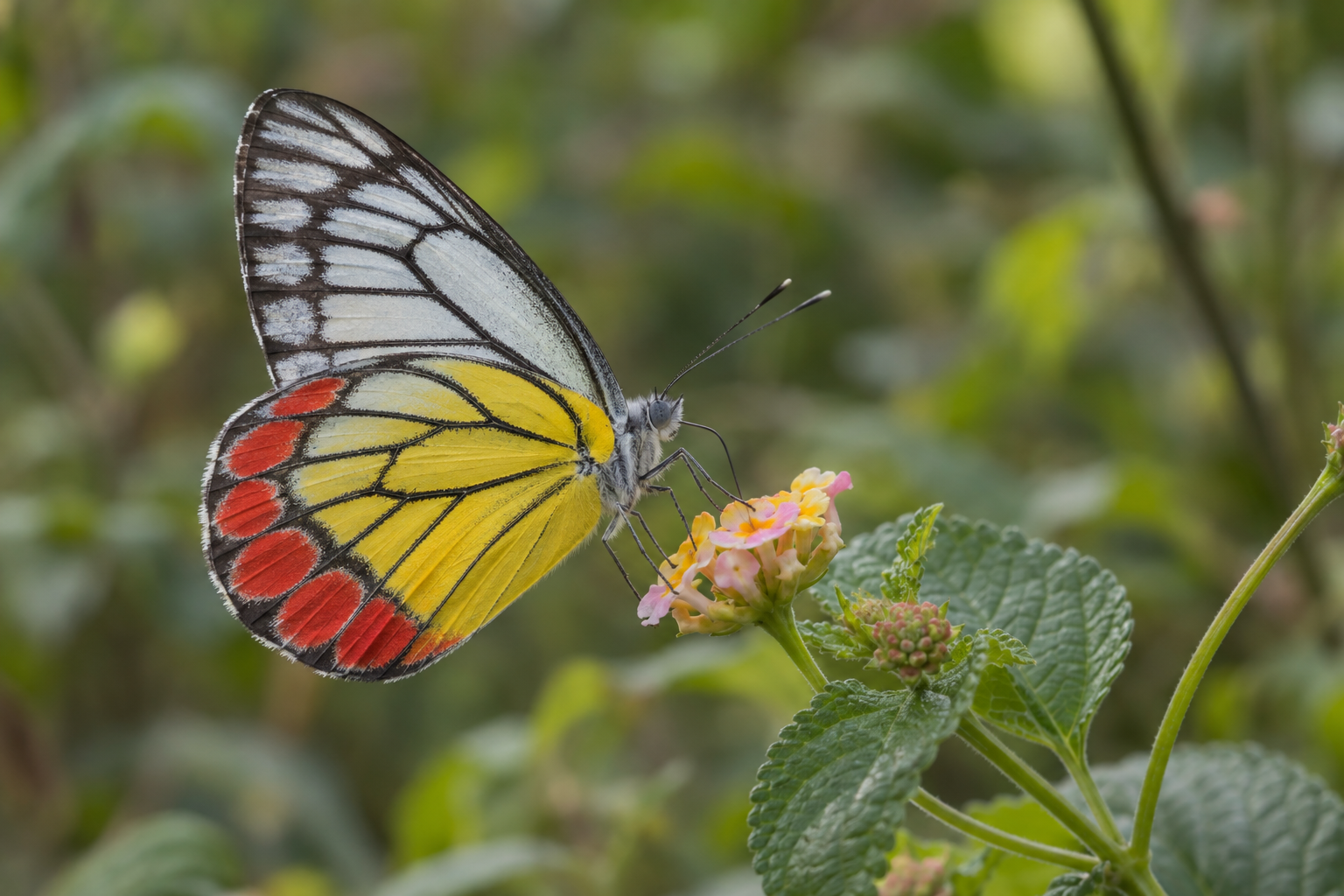
A Common Jezebel’s colourful underside shows why a side view can be more useful than a glimpse in flight. · AI-generated illustration
A yellow butterfly crosses a forest track, a dark swallowtail settles beside a puddle, and something patterned like a dead leaf disappears against the ground. Watching butterflies in Chitwan National Park is an exercise in noticing small differences. Colour catches your attention first, but shape, posture and the arrangement of markings usually tell you more.
Chitwan’s lowland forests, grasslands, riverside vegetation and surrounding gardens offer many different places to look. You do not need to recognise every butterfly to enjoy them. Start with a few familiar forms, learn which features remain useful when the wings close, and allow uncertain sightings to stay uncertain.
This guide introduces butterflies recorded in the Chitwan area, with an important distinction: a record from the wider district or buffer zone does not automatically prove a sighting inside the national park. For a formal park checklist, confirm the locality in the original record.
Start with local records, not a national checklist
Nepal’s butterfly fauna spans tropical lowlands and high mountains. A species appearing in a Nepal field guide is therefore not necessarily a sensible identification for Chitwan. Locality, habitat and elevation help narrow the possibilities before you compare individual spots.
The butterflies introduced below are documented from the Chitwan landscape. They include familiar lowland swallowtails, whites and yellows, milkweed butterflies and pansies. This is a selective beginner’s guide, not a complete inventory or a promise that every species will appear during your visit.
When checking a name, favour published local surveys, museum or research records with locality details, and clear photographs reviewed by knowledgeable identifiers. An online observation labelled only “Chitwan” may refer to a village, garden or another location outside the park.
Ask a local naturalist which records apply to the exact site you are visiting. Keep park, buffer zone and district observations separate in your own notebook; that small habit makes your sightings much more useful.
Read a butterfly in a consistent order
Begin with overall shape. Are the forewings long and pointed, or broad and rounded? Do the hindwings carry tails? Is the body thick and sturdy, or relatively slender? These questions often place a butterfly in a useful group before its colours become clear.
Next, look for the biggest pattern: a pale band crossing dark wings, a row of eyespots, black veins on orange, or scattered light spots. Finally, examine smaller details such as the colour of the abdomen and the position of a particular marking.
Record size cautiously. A butterfly close to your face can seem much larger than one across a path. Compare it with a nearby leaf only when both are at roughly the same distance.
Do not make one feature carry the whole identification. A missing tail might indicate a different species, but it might simply be damage. Two or three matching features provide a much stronger starting point.
Open wings and closed wings tell different stories
The upper wing surface is called the upperside; the lower surface is the underside. These can look so different that a beginner might mistake one butterfly for two species. Pansies provide especially striking examples: bold eyespots above can give way to subdued, leaflike markings below.
Watch what happens after landing. Some butterflies bask with their wings spread, while others keep them upright together. A butterfly feeding with closed wings may briefly open them when disturbed by another insect, offering a second view without any interference from you.
Resting posture is a clue, not a fixed rule. Temperature, sunlight, feeding and alertness all influence it. Avoid identifying a butterfly solely because it sits with open or closed wings.
For photographs, try for one view from above and another from the side. If only one is possible, record which surface you saw. That information prevents confusion when comparing your photograph with an illustration.
Lime Butterfly: a tailless swallowtail
The Lime Butterfly, Papilio demoleus, is a good introduction to the swallowtails recorded around Chitwan. Its wings carry a busy cream or pale yellow pattern against black, with coloured markings near the inner part of the hindwing.
Despite belonging to the swallowtail family, it lacks the long hindwing tails that many people expect. That combination of a strongly patterned dark background and no tails is a useful first clue. Check both hindwings, however, before deciding that a butterfly is naturally tailless rather than worn.
Lime Butterflies can visit flowers and may occur around cultivated areas where citrus grows. Their caterpillars use citrus and other plants in the rue family, linking observations in gardens with the surrounding landscape.
Compare the whole cream pattern rather than a single coloured spot. A blurred photograph can turn separate patches into a continuous band. A clear upper view is especially helpful when separating this species from other patterned swallowtails.
Common Mormon: one species, several appearances
The Common Mormon, Papilio polytes, shows why butterfly identification is not always a matter of matching one picture. Males and females can differ, and females occur in different forms. Some females resemble distasteful rose swallowtails rather than looking like the male.
A typical male is mostly black above, with a pale band across the hindwing and hindwing tails. Certain females show pale and red markings that can send beginners towards the Common Rose. Do not assume that every dark butterfly with red on its wings is a rose swallowtail.
Examine the body as well as the wings. The Common Mormon has a predominantly dark body, whereas the Common Rose has conspicuous red body colouring. A side photograph can reveal this distinction better than a distant upper view.
Wear, shadow and the angle of the abdomen can hide body colour. If those details are missing, “Common Mormon or rose swallowtail” is a reasonable provisional note.
Common Rose: look beyond the red wing markings
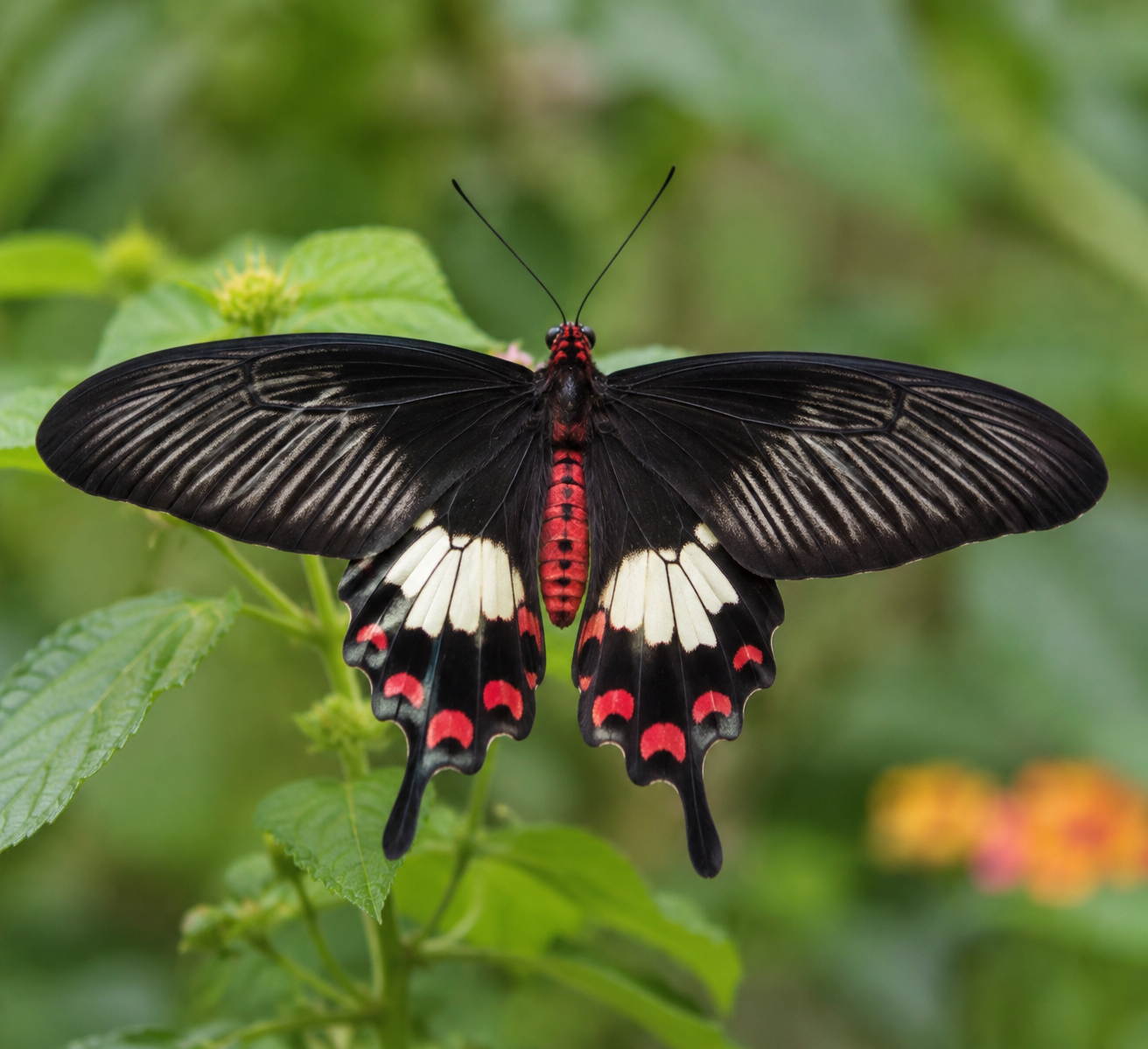
The Common Rose, Pachliopta aristolochiae, is a dark, tailed swallowtail with pale hindwing patches, red marginal markings and a conspicuously red abdomen. Its slender outline and contrasting colours make it an attractive subject, but the body remains an important identification feature.
When it lands, look for the arrangement of pale patches within the hindwing and the red markings nearer the edge. Then check whether the red you noticed belongs to the wing, the body, or both. This separates an actual observation from a general impression of a “black and red butterfly.”
Its caterpillars feed on pipevines, plants in the genus Aristolochia. Chemicals acquired from their host plants help explain the warning colours and the resemblance shown by some Common Mormon females.
Do not handle a butterfly to inspect its abdomen. Wait for a side view or let the identification remain incomplete. A naturally obtained photograph is both safer for the insect and more informative about its behaviour.
Common Jezebel: the underside gives it away
The Common Jezebel, Delias eucharis, offers a memorable lesson in looking at both wing surfaces. From above it is mainly pale, with dark veins and borders. From below, the hindwing shows a bright yellow area and red markings towards the outer edge, divided by dark lines.
A distant flying individual may register only as a white butterfly. Once it settles with the wings together, the vivid underside becomes the main attraction. Look for the organised, vein-divided pattern rather than simply noting red and yellow.
Common Jezebels may feed at flowers above easy viewing height. If one remains high, binoculars can be more useful than trying to enlarge a tiny phone photograph.
Other jezebels occur in the broader region, so colour alone is not enough for every possible encounter. Compare the extent of yellow, the arrangement of red markings and the dark borders with a reliable regional reference before naming an unfamiliar individual.
Common Emigrant: pale wings, pointed outline
The Common Emigrant, Catopsilia pomona, is a larger, strong-flying member of the whites and yellows. Individuals can look pale greenish, whitish or yellowish, and variation between sexes and forms makes a single colour description unreliable.
Notice its relatively pointed forewing and clean, angular outline when settled. With the wings closed, the underside can appear surprisingly plain. In flight, a pale emigrant may flash across your view too quickly for useful pattern details.
The Mottled Emigrant, Catopsilia pyranthe, is another Chitwan-area butterfly worth comparing. Its underside generally carries more fine, mottled markings. However, wear, lighting and variation can make the distinction less obvious than field-guide illustrations suggest.
Photograph the closed hindwing in good light and compare the fine markings, not just overall yellowness. When the insect never settles, recording an emigrant without choosing a species is often the most defensible result. Flight speed alone does not settle the question.
Common Grass Yellow: small does not mean simple
The Common Grass Yellow, Eurema hecabe, brings bright yellow flashes to low vegetation. It is smaller and generally more rounded in outline than an emigrant. The upperside has dark borders, while the closed underside is yellow with smaller markings.
That description also fits other grass yellows surprisingly well. Several species in this group can be difficult to separate without clear views of particular underside spots and the shape of the upper dark border.
Start by recognising “grass yellow” confidently. Then photograph the underside of the forewing as well as the hindwing, keeping the wing base visible if possible. Do not force a Common Grass Yellow identification just because it is a familiar name.
Individuals often move among low flowers and may settle briefly on leaves. Wait beside a productive patch rather than pursuing every yellow flash. A settled butterfly usually provides more useful evidence than several hurried photographs of one in flight.
Plain Tiger and Striped Tiger: follow the veins
The Plain Tiger, Danaus chrysippus, and Striped Tiger, Danaus genutia, are orange butterflies with dark borders and white markings. Both are recorded in the Chitwan landscape, and their shared colour scheme makes them a useful beginner’s comparison.
On a Plain Tiger, much of the orange wing area looks relatively open and uncluttered. The forewing tip is dark with white spots. On a Striped Tiger, strong black veins divide the orange into a more visibly striped or windowed pattern.
Look across the centre of the wings rather than concentrating only on the dark tip. Ask whether the veins create a bold black framework throughout the orange area. This is more useful than judging which butterfly appears darker overall.
Backlighting can strengthen the apparent veins, while worn wings may lose their rich colour. Compare several features, including the border and white spots. A clear side view often preserves enough information to make the distinction.
Blue Tiger and Common Crow: read the pale pattern
The Blue Tiger, Tirumala limniace, has dark wings covered with pale bluish markings. These include elongated streaks as well as spots, giving it a very different appearance from the orange tigers despite their relatedness.
The Common Crow, Euploea core, looks more uniformly dark brown, with pale spots concentrated towards the wing margins. In strong sunlight it may look lighter than its name suggests. Its broad, rounded wings help create a recognisable outline.
For a first comparison, ask whether pale markings fill much of the wing or sit mainly near its edge. Extensive pale streaking suggests a blue tiger type; a plainer dark centre suggests a crow type.
Related species can complicate both groups, so this comparison is a starting point rather than a complete identification key. Photograph the arrangement of streaks and spots carefully. A relaxed-looking flight or a shared feeding flower does not provide enough evidence on its own.
Lemon Pansy: eyespots on a warm brown canvas
The Lemon Pansy, Junonia lemonias, often rewards patient watching near sunny, open ground. Its upper wings are brown with pale markings, wavy lines and conspicuous eyespots. The pattern is busy, but those rounded eye-like marks give beginners a clear place to start.
When it spreads its wings, note the number, size and position of the prominent eyespots. Also look at the lighter markings near the forewing tip. Together, these details are more dependable than describing it simply as a brown butterfly.
With the wings closed, the same individual becomes less obvious. Seasonal variation can change the underside’s appearance, and leaflike camouflage may conceal much of what made the open wings distinctive.
Watch without stepping closer immediately after it lands. Pansies may reopen their wings to bask, letting you compare the subdued underside with the stronger upper pattern. That transition is one of the easiest ways to learn a butterfly through direct observation.
Peacock and Grey Pansies: similar structure, different emphasis
The Peacock Pansy, Junonia almana, has a rich orange upperside dominated by large eyespots, especially on the hindwings. The Grey Pansy, Junonia atlites, is much paler, with greyish wings crossed by fine darker lines and a series of smaller eyespots.
Both occur in the Chitwan landscape. Viewed well with open wings, they are usually easier to separate from each other than many grass yellows or emigrants. The challenge comes when wings are closed, light is poor or only part of the butterfly is visible.
Use the complete design: warm orange and oversized eyespots for Peacock Pansy; a pale grey ground colour with repeated smaller eyespots for Grey Pansy. Do not rely on one spot glimpsed behind a leaf.
As with Lemon Pansy, seasonal forms can alter the underside. A photograph of the open wings is especially helpful, but obtaining it should never involve touching or prodding the butterfly.
Common Evening Brown: a lesson in camouflage
The Common Evening Brown, Melanitis leda, shifts attention from flowers to shaded ground and low vegetation. Its closed wings resemble dry leaves, with an angular outline and brown markings that can blend remarkably well with litter.
It is often active in low light, including around dawn and dusk, although individuals may be disturbed during the day. The common name describes a tendency, not a rule that every sighting must follow.
Seasonal forms differ substantially. Some show clearer underside eyespots, while others look more strongly leaflike with reduced markings. This variation can make photographs of the same species seem inconsistent.
Look at wing shape, the arrangement of any visible eyespots and the overall underside pattern together. Related evening browns require care, so a brown butterfly flushed from shade should not receive an automatic species name. If it settles again, remain still and let your eyes find the outline before approaching.
Use habitat and behaviour as supporting clues
A butterfly’s surroundings help explain what you see, but they should support identification rather than replace visible features. A pansy basking on exposed ground is behaving plausibly; that does not prove which pansy it is.
Flowering edges may bring several groups together. Damp soil can attract butterflies taking up dissolved salts and other substances, a behaviour called puddling. Such gatherings can offer excellent comparisons of wing shape and body colour, especially among swallowtails and whites.
Shaded leaf litter suits a different search image: closed wings, browns and broken outlines rather than bright flowers. Around host plants, watch for egg-laying behaviour, but do not assume that every butterfly resting on a plant uses it as caterpillar food.
Sunshine, rain and seasonal vegetation influence activity. There is no guaranteed daily timetable for every species. Ask about recent conditions and flowering patches; check locally rather than relying on a fixed claim about the “best” month or hour.
Make photographs that answer identification questions
A useful identification photograph does not need a dramatic background. It needs visible features. Keep the wing edges, body and antennae in the frame where possible, and focus on the butterfly rather than the flower in front of it.
A slightly wider, sharp photograph is often better than an extremely close, blurred one. Avoid pushing colours so strongly during editing that cream becomes yellow or brown becomes black. Keep the original file for reference.
- Record the date, precise locality and whether you were inside the park or elsewhere in the Chitwan landscape.
- Note habitat, wing posture and behaviour, including whether the butterfly was feeding, basking or puddling.
- Save complementary upper and side views when available, and mark uncertain identifications as provisional.
Do not capture, bait, handle or move butterflies to improve a picture. Stay on permitted routes and follow local access rules. If a butterfly repeatedly flies away as you approach, stop following and wait for another opportunity.
Build confidence one careful observation at a time
Begin with the strongest contrasts: Lime Butterfly against tailed swallowtails, Plain Tiger against Striped Tiger, and the orange Peacock Pansy against the pale Grey Pansy. Then return to more variable groups with better photographs and a regional guide.
Compare your notes with locally verified records, not just the first similar image returned by a search. If a proposed identification would be unusual for Chitwan, seek expert review before treating it as confirmed.
The pleasure of watching butterflies in Chitwan National Park lies partly in this gradual sharpening of attention. A yellow flash becomes a pointed wing; a brown leaf reveals eyespots; a dark swallowtail turns sideways and shows a red abdomen. Learning those details makes even a short, quiet observation feel like a discovery.