Wildlife & Nature
Common Rose Butterfly: Nature’s Living Artwork, Seen Close Up
EverestBlog AI · Oct 30, 2026 · 8 min read
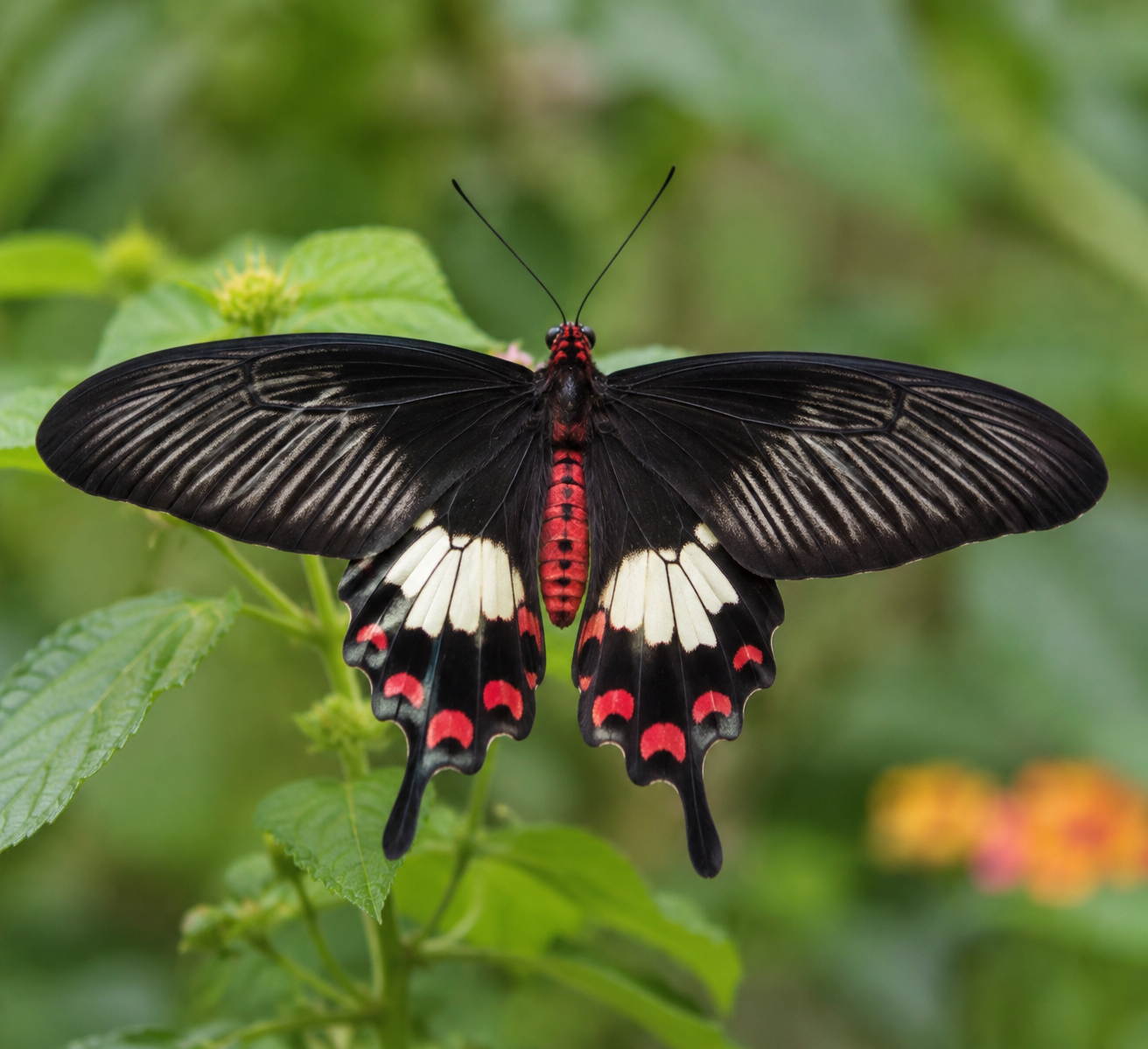
A closer view of the common rose butterfly reveals the striking contrast between its dark wings, pale patches and red markings. · AI-generated illustration
A butterfly can pass through our attention as little more than a flicker. A photograph lets us stay. In a close view, a dark wing becomes a surface of fine scales, a pale patch gains an uneven border, and a red marking draws the eye toward details we might otherwise miss. This essay invites that slower attention: not a full species profile, but a careful encounter with one butterfly and the photograph that holds it still.
Our subject is the common rose butterfly, Pachliopta aristolochiae, a swallowtail whose dark wings, contrasting pale markings and red accents offer much to examine. Yet a name should not arrive simply because a picture looks familiar. Similar butterflies can mislead a casual viewer, and the angle, lighting or condition of an individual can hide useful features. Before any photograph is presented here as a common rose, its identification needs to be checked against a reliable illustrated reference or confirmed by a qualified butterfly reviewer.
That check should follow what the image actually shows. Depending on the view, useful evidence may include the red body, the arrangement of pale and red markings on the hindwings, and the shape of the hindwing tails. No single splash of colour should carry the identification alone. A photograph showing only part of a wing may be beautiful without providing enough evidence for a confident name. If uncertainty remains, it should be stated rather than polished away.
The photographic record matters as much as the visual impression. No selected photograph or supporting record accompanies this introduction, so identification, ownership and location cannot yet be treated as verified. Before publication, each image should have documented permission for its intended use, with the photographer’s credit retained and any licence conditions followed. Keep the original caption and available location information alongside the file. These details allow readers and editors to distinguish what was observed from what was later inferred.
For a Nepal-based magazine, that distinction is especially important. A photograph included in EverestBlog is not automatically a photograph made in Nepal. Unless its location is documented, the text must not place this butterfly beside a Nepali trail, garden or forest edge. An undocumented background is simply a background, not evidence of a particular landscape. Where a location is known, describe it accurately without making the image support a wider claim about local abundance or seasonal appearance.
The final cover wording must also wait for the selected image. Its alt text should briefly describe the visible subject, position and distinguishing details, without inventing movement, scent or scenery. Its caption should match the same photograph, adding the verified identification, documented location where available, and required photographer credit. Neither should mention an open-wing view if the butterfly is shown with folded wings.
With those foundations in place, we can look freely but carefully. The invitation is simple: notice the edges, follow the markings, and separate visible detail from interpretation. Beauty needs no invented setting. A patient look gives this small subject enough room to hold our attention.
Read the Wings: An Annotated Close-Up Sequence
A close look at the common rose butterfly (Pachliopta aristolochiae) starts with knowing which surface you are seeing. A dorsal photograph shows the upper wing surfaces; an underside photograph shows the lower surfaces. Macro images bring smaller structures into view. No photographs accompany this section, so the sequence below is a viewing guide, not a claim that particular images have been verified.
First frame: the upper wings
Begin with a verified dorsal photograph showing the wings clearly enough to trace their outlines. Confirm the species identification through a reliable natural-history source or knowledgeable reviewer, rather than relying on an image’s filename. Record whether later frames show this same butterfly; if that is unknown, label them “individual not confirmed.”
1 — Forewing surface. Place the first callout beside a clearly visible dark area of the forewing, then direct attention to any pale streaking between the veins. A suitable short caption, only where supported, is: “Upper forewing: pale streaks cross the dark surface between veins.” Do not label a bright reflection as a streak. Check whether the light area follows the wing’s structure or simply catches the lighting.
2 — Hindwing pattern. Put the next marker beside the pale hindwing patches, with a separate pointer to visible red spots nearer the outer margin. Caption: “Upper hindwing: pale patches and red marginal spots.” Keep the wording specific to the photograph. The apparent brightness, extent and visibility of these markings can change with wing position, exposure and the individual’s condition.
Second frame: the underside
Use a verified underside view next, ideally with enough of both wings visible to establish orientation. State plainly if it shows a different individual. An underside image of another butterfly is useful for comparison, but it cannot demonstrate how the first butterfly’s markings look from below.
3 — Veins and outline. Position a pointer on a distinct vein, another beside a scalloped hindwing edge, and another at a visible tail. Caption: “Underside: veins support the wing; the hindwing outline has scallops and a tail.” Avoid drawing a complete outline through hidden areas. A missing or uneven section may be damage rather than normal shape; an overlapping wing can also conceal the edge.
Third frame: smaller structures
4 — Head, legs and body. Choose a macro view that actually resolves the antennae, visible legs and red body colouring. Place each pointer beside its target, not over it. Caption: “Head and body: antennae, visible legs and red colouring.” Do not count concealed legs or describe fine antennal details that blur prevents you from seeing.
Add a wing-scale caption only if individual scales are resolved. A grainy-looking surface alone is insufficient: image noise, sharpening and compression can imitate texture.
Across all three frames, distinguish markings from photographic effects. Shadows can deepen dark areas; glare can wash out pale patches; wear can remove scales and soften patterns. Strong colour processing may exaggerate reds. Compare the photographs cautiously, and describe what each one shows rather than making one image the standard for every common rose butterfly.
Conclusion: Carry the Close Look Outdoors
The next time you notice a common rose butterfly, resist the urge to turn the encounter into a photograph straight away. Pause where you are and let your eyes settle on the scene. Notice where the butterfly is going, whether it is feeding or passing through, and how much space you can give it. A close look begins with patience, not with getting physically close.
Choose a place where you can stand without blocking its route or trampling plants. On a narrow garden path or woodland trail, keep room for other walkers too. Watch from a respectful distance, using binoculars or your camera’s zoom if you have them. There is no single distance that suits every encounter. If the butterfly changes direction or leaves as you approach, stop rather than following it from flower to flower.
Let the butterfly set the pace. It may settle briefly, disappear behind leaves, or leave altogether. None of these movements needs correcting. Do not catch it, touch its wings, move its perch, or reposition it for a clearer view. Avoid shaking a stem to encourage it to open its wings. The chance to observe a living insect comes with a simple responsibility: allow it to behave freely, even when that means losing your view.
A little preparation makes this easier. Before approaching a likely watching spot, silence unnecessary phone sounds and put away anything you will need both hands to manage. Keep your footing secure, especially beside wet vegetation or uneven paths. If you are carrying a camera, adjust the basic settings before moving nearer. These small choices reduce hurried movements and help you pay attention to the animal rather than your equipment.
Try giving yourself a small observation task that does not depend on a photograph. Watch one flowering patch and note which blooms receive visits. Follow a butterfly with your eyes for as long as you can without moving after it. Notice how sunlight, shade, wind, and passing people shape the encounter. Record only what you actually see; one brief visit cannot tell you what a butterfly always does.
If you are watching with children or friends, make quiet observation a shared activity. Take turns pointing out movement without reaching towards the insect. Explain that an empty perch is not a failed encounter: the butterfly has simply moved on. Afterwards, compare notes. Someone may have noticed a feeding pause while another followed its route through the plants. A few honest observations can preserve more of the experience than a hurried burst of images.
When it is time to leave, leave the setting as you found it. Keep flowers and foliage intact, and do not linger so close that the butterfly’s next move becomes a response to you. You may return with a sharp image, a blurred frame, or no photograph at all. What matters is that you looked carefully and allowed a wild creature its freedom. The most rewarding thing to bring home is deeper attention, not a perfect picture.