Wildlife & Nature
Blue Mormon Butterfly: How Large Is One of Asia’s Largest Butterflies?
EverestBlog AI · Oct 30, 2026 · 11 min read
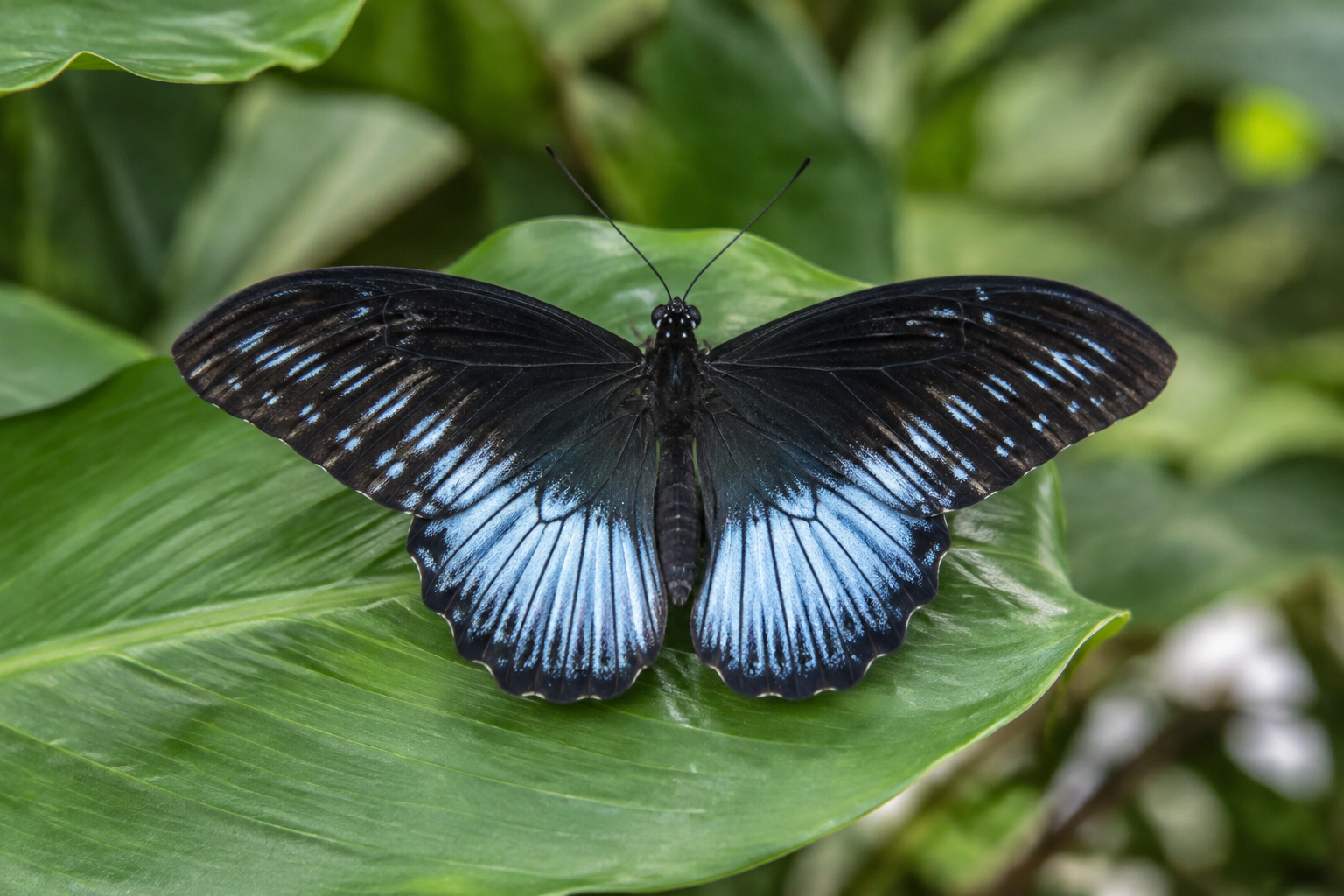
A blue mormon’s open wings reveal its impressive proportions, but a photograph without a scale cannot establish wingspan. · AI-generated illustration
A blue mormon butterfly can make a garden feel suddenly smaller. When its broad, dark wings open, the pale blue markings create a striking contrast, giving the insect a presence that is hard to miss. Known scientifically as Papilio polymnestor, it is a large swallowtail native to India and Sri Lanka. Its appeal is immediate, but the description often attached to it—“one of Asia’s largest butterflies”—raises a question that deserves more than an admiring glance: how much of that reputation comes from measured size, and how much comes from visual impact?
Those two things are related, but they are not interchangeable. A butterfly can look enormous because it passes close to your face, spreads its wings against a small flower, or stands out sharply from the leaves behind it. Broad wings also create a different impression from narrow ones, even when the distance between their tips is similar. The blue mormon brings several of these effects together. Its appearance helps explain why people remember it as a very large butterfly, but memory alone cannot tell us where it belongs in a comparison of Asian species.
The useful starting point is its identity and natural range, rather than a long checklist of field marks. The blue mormon belongs to the swallowtail family, Papilionidae, and is associated with wooded habitats and can also visit gardens within its range. India and Sri Lanka provide the geographical context for this species. It should not be presented as a butterfly native to Nepal. For readers exploring wildlife across South Asia, that distinction matters: a species may be familiar through regional photographs, travel accounts or butterfly collections without occurring naturally in every neighbouring country.
Its name also needs a little care when discussing size. “Blue mormon” refers to a particular species, not a general category of large blue butterflies. Size claims become less useful when common names are loosely applied or photographs are shared without a reliable identification. Here, the subject is specifically Papilio polymnestor. Keeping that scientific name attached to the discussion makes it easier to distinguish information about this butterfly from material about other swallowtails with similar names or colouring.
Even with the species established, “how large?” is not quite a single question. Are we asking about an ordinary adult, an unusually large individual, or the upper end of a published wingspan range? A species does not have one fixed adult measurement. Biological variation means that a representative size and a reported maximum serve different purposes. For a traveller hoping to understand what they might see, the usual scale is often more informative than an exceptional record.
The phrase “one of Asia’s largest” adds another layer. Asia contains a vast diversity of butterflies, including species whose dimensions make any sweeping ranking worth examining carefully. Calling the blue mormon large is straightforward; placing it among a continent’s largest requires a clear basis for comparison. This is not about diminishing a spectacular insect. It is about giving its spectacle an honest scale. The aim is to connect the butterfly people notice with the measurements that describe it—and to keep a memorable encounter separate from a claim of record-breaking size.
Measuring Wingspan—and Why Photographs Can Mislead
When someone describes a blue mormon butterfly as “large,” the useful measurement is usually its wingspan. This is the straight-line distance between the tips of the two forewings when the wings are fully spread. It is not the length of the body, the width of a single wing, or the curved distance traced around the wing edges. Keeping that definition clear helps you compare published descriptions without mixing different measurements.
Wing position matters because the same butterfly can appear to have several different widths. With its wings held upright together, a side view shows the outline of one side rather than the full span. With the wings partly open, the visible tip-to-tip width is reduced. Even when both wings look open, their angle relative to the camera may shorten the apparent distance. A tilted butterfly can therefore look smaller across the wings than it really is.
Compare the method, not just the number
Before comparing two reported sizes, check what each source actually measured. A figure labelled “forewing length” is not a wingspan, and doubling it does not reliably give the span: the wings attach on either side of the body and extend at particular angles. Measurements from carefully positioned museum specimens are also not directly equivalent to estimates made from photographs of resting butterflies.
Preparation and positioning can introduce differences even in specimen measurements. If the forewings are set at different angles, their tips will sit at different distances from each other. For a fair comparison, look for sources using the same measurement convention, and treat an unexplained number with caution. A stated range is generally more informative than a single impressive figure, provided the source explains what that range represents.
Why a photograph is not a ruler
A tightly cropped photograph can make a blue mormon butterfly fill the entire frame, while a wider view makes the same insect seem modest. Neither image establishes its actual size. The amount of space it occupies on a screen depends on framing, cropping and display size, not simply on wingspan.
Perspective creates another trap. A butterfly closer to the camera than a nearby flower, hand or leaf can look disproportionately large beside it. Lens choice often changes how the photographer frames the scene and how close they stand. A wide-angle close-up can exaggerate near–far differences; a longer lens used from farther away gives a different-looking relationship. Neither supplies a trustworthy scale by itself.
A reference scale must be in the same plane as the wings being measured. For a dependable photographic measurement, the wings and scale should also be viewed square-on, rather than at a slant. A ruler behind the butterfly, or a finger closer to the lens, cannot provide an accurate comparison. Familiar objects are weak substitutes anyway: leaves, flowers and human hands vary in size.
In the field, prioritise observation over measurement. Do not catch, restrain or flatten a live butterfly to obtain a wingspan, and do not disturb it to position a ruler. Photograph it where it settles naturally and describe uncertain size impressions as estimates. When an exact measurement matters, use a reliable published source with a clear method rather than turning a dramatic photograph into numerical evidence.
Testing the Claim: One of Asia’s Largest?
The blue mormon butterfly (Papilio polymnestor) is often described as having a wingspan of 120–150 mm, or 12–15 cm. That would make it an impressive swallowtail. However, a frequently repeated measurement is not automatically a verified one: several websites may copy the same figure without identifying where it was first recorded.
The 12–15 cm figure should therefore be treated here as a commonly reported range, not an independently verified measurement. Before publication as a confirmed range, it needs checking against a named reference, such as C. T. Bingham’s The Fauna of British India, Including Ceylon and Burma: Butterflies or Isaac Kehimkar’s Butterflies of India. These are identifiable works to consult, not proof that their species accounts necessarily give that exact range. The relevant entry, page and measurement wording must be checked.
A range is not a record
Even if a field guide confirms 12–15 cm, the interpretation matters. A general wingspan range usually helps readers recognise a species; it does not necessarily describe a statistically measured “typical” population. Nor does its upper endpoint establish the largest individual ever documented. Calling 15 cm a record would require evidence for an actual measured specimen, with its identification and measurement method recorded.
Sex, locality and the number of specimens examined can also affect a published range. A museum series from one region and a guide covering the whole species may legitimately report different limits. Historical references may use “expanse” rather than “wingspan”; that wording and any explanation of the measurement should be retained in the research notes. Forewing length must not be substituted for full wingspan.
Compare the right butterflies
Birdwings provide a useful test of the size claim because some Asian species exceed blue mormons in wingspan. Two relevant comparisons are the common birdwing (Troides helena) and golden birdwing (Troides aeacus). Their scientific names matter: common names can vary between countries and publications, making an apparently straightforward comparison surprisingly easy to muddle.
- Common birdwing: Its distribution extends across parts of South and Southeast Asia. A regional guide may cover only part of that distribution. Any comparison should identify whether its measurements describe males, females or both, rather than treating a large female’s measurement as the species average.
- Golden birdwing: This species also occurs across parts of South and Southeast Asia. Its comparison figure needs the same checks: full wingspan, geographic coverage, sex and whether the stated upper value is a guidebook limit or a documented specimen.
Without checked entries from comparable sources, attaching precise birdwing ranges would create an appearance of certainty rather than a sound comparison. A defensible size table would use all three species’ wingspans from the same established reference where possible, then explain any supplementary museum measurements separately. It should never compare a blue mormon’s ordinary range with another species’ exceptional maximum without saying so.
“One of Asia’s largest” is a broad description, not a formal ranking. Asia includes butterfly-rich tropical regions and exceptionally large birdwings; selecting only a few familiar species cannot establish a continent-wide position. Until the measurements and comparison set are verified, “a large Asian swallowtail” is the more reliable description of the blue mormon butterfly.
Conclusion: Describe the Size, Not Just the Spectacle
The blue mormon butterfly deserves a description that captures its impressive size without turning admiration into an unsupported ranking. The editorial verdict is to qualify the title’s claim. Calling it “one of Asia’s largest butterflies” suggests more than a striking appearance or a substantial wingspan: it implies a comparison across a vast region. That wording should remain only if the supporting sources establish that broader claim, rather than simply describe the species as large.
This distinction does not diminish the butterfly. It separates two different statements: that an animal has a documented size, and that it occupies a particular place among other animals. A reliable wingspan measurement can support the first statement directly. The second needs a clear basis for comparison. If the evidence presented establishes size but not regional standing, the headline should reflect that limit. A title can be inviting without promising a ranking that the article cannot substantiate.
A safer version would be “Blue Mormon Butterfly: How Large Is This Striking Asian Butterfly?” It preserves the reader’s main question while removing the part that requires broader proof. If the original title is retained, the article should clearly explain the limits of its wording. “One of the largest” should not function as a convenient phrase that sounds factual but remains undefined. The question mark after the title does not, by itself, resolve that problem.
The conclusion should therefore give priority to the sourced wingspan evidence already discussed. Present that measurement in its proper context: whether the source describes a usual range, an approximate figure or an upper limit. Those descriptions are not interchangeable. An upper limit should not quietly become the size readers expect every individual to reach, and a range should not be reduced to its largest endpoint merely because that number makes a stronger headline.
Equally, uncertainty should be expressed plainly rather than hidden behind confident language. Where sources differ, the useful response is to acknowledge the difference and preserve the qualifications attached to their figures. There is no need to force a single definitive number if the evidence does not justify one. Precision in writing means matching the strength of the statement to the strength of the source, not making every answer appear exact.
Photographs still have an important place in the story. They convey colour, pattern and the visual impact that makes this butterfly memorable. But their editorial role is illustration, not independent proof of wingspan. A dramatic close-up can accompany a measured account; it cannot strengthen a numerical claim simply by looking persuasive. Keeping those roles separate allows the image to impress without asking it to establish something it cannot reliably show.
The best closing judgment is therefore neither to dismiss the spectacle nor to repeat the superlative. It is to say what the evidence supports, qualify what it leaves unresolved and let the butterfly’s documented dimensions carry the description. That approach gives readers a clearer answer to “How large is it?” and a sound reason to trust the answer. For understanding the blue mormon butterfly’s size, a sourced measurement is more informative than an impressive close-up or an unsupported superlative.