Wildlife & Nature
Common Mormon: A Beautiful Butterfly of Nepal, Beyond Its Wings
EverestBlog AI · Oct 30, 2026 · 21 min read
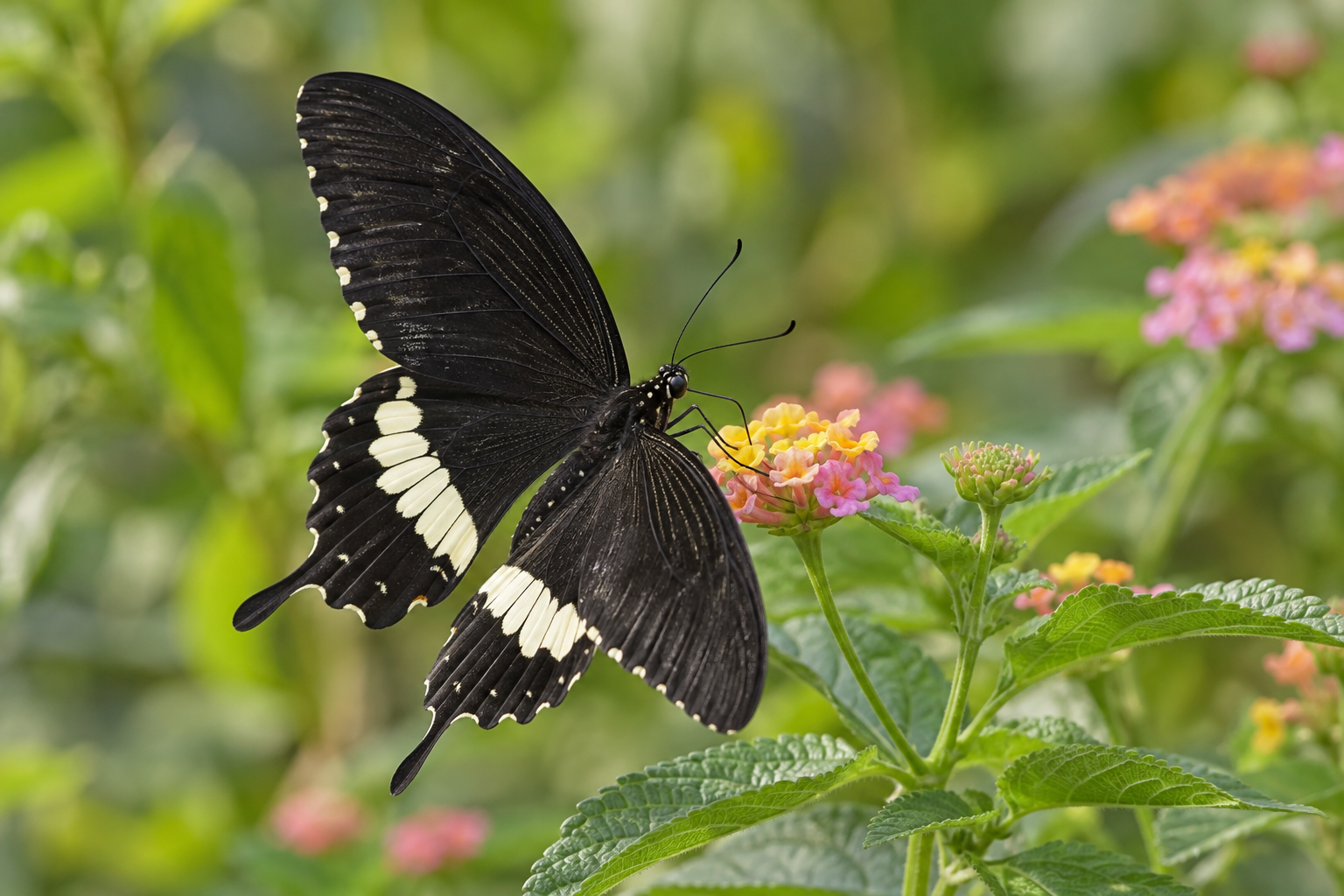
The common mormon (Papilio polytes), a swallowtail whose life connects leafy host plants with nectar-rich flowers. · AI-generated illustration
A dark butterfly crosses a sunny garden, pauses at a flower and moves on before its markings become clear. It is the kind of brief encounter that can make a butterfly seem familiar without revealing much about it. The common mormon butterfly belongs to this easily noticed but often little-understood world. Its adult wings attract attention, yet most of its story involves other things: a suitable leaf, a hungry caterpillar, a sheltered resting place and the plants that make survival possible.
The common mormon, Papilio polytes, is a swallowtail butterfly recorded in Nepal. A reliable starting reference is Colin Smith’s Butterflies of Nepal (Central Himalaya), published in 1989, which includes the species in Nepal’s butterfly fauna. That gives its presence a firmer foundation than a photograph labelled only “Asian butterfly.” It does not, however, establish that the species occurs everywhere in Nepal or is abundant wherever suitable-looking greenery remains.
A note on the evidence: a separate, confidently identified Nepal observation could not be verified for this section, so no particular photograph, locality or encounter is presented here as a confirmed sighting. This distinction matters. A national reference supports inclusion in Nepal’s fauna; a traceable field observation supports an occurrence at a particular place and time. Neither should be stretched into a claim about how frequently visitors will see the butterfly.
For a reader in Nepal, gardens, planted courtyards and cultivated ground offer useful places to begin understanding its needs. Common mormon caterpillars feed on members of the citrus family, including cultivated citrus plants. A garden with these plants may therefore offer something more important than a colourful stop for passing adults: somewhere the next generation could develop. But a host plant alone is not a guarantee of occupation. Local climate, vegetation, pesticide use and access to other resources all influence whether a place can support butterflies.
Even recognising the adult requires care. Male and female common mormons do not always look alike, and females occur in different forms. Some resemble other swallowtails that predators learn to avoid. This resemblance, known as mimicry, is one reason a quick glimpse of dark wings and pale or reddish markings may not settle an identification. Wing patterns, the body and clear views from more than one angle can be useful. The word “common” in the English name is not a substitute for checking those features.
The species also invites a wider question: what do we mean when we say a garden is good for butterflies? Flowers are only part of the answer. An adult drinking nectar and a caterpillar chewing a leaf use the same landscape in very different ways. A gardener may welcome the first and remove the second, without realising they belong to the same life cycle. Looking beyond the wings helps connect these apparently separate encounters.
That shift in attention makes butterfly watching more rewarding. Instead of searching only for a perfect adult photograph, we can notice which plants receive visits, whether leaves show feeding signs and how insects use sunny and sheltered spaces. These clues need patient interpretation: a damaged citrus leaf is not proof of a common mormon caterpillar, just as an unidentified dark butterfly is not a confirmed adult.
The common mormon’s beauty is therefore an invitation rather than the whole subject. Following its life from egg to adult reveals a small network of relationships between plants, predators, weather and human decisions. In Nepal, understanding those relationships begins with reliable identification—and grows through careful observation, without assuming more than the evidence shows.
A Brief Look at Its Identity
The common mormon butterfly, Papilio polytes, belongs to the swallowtail family, Papilionidae. Its scientific name gives us a reliable way to discuss it across languages and regions: Papilio is the genus, while polytes identifies the species. “Common” is part of its English name, not a promise that it will be abundant wherever you visit. In Nepal, sightings depend on suitable habitat, season and local conditions.
Swallowtails include many large, eye-catching butterflies, often with extensions on their hindwings that resemble a swallow’s forked tail. The common mormon has these little tails, but tails alone do not establish its identity. Not every swallowtail has them, and butterflies from other families can also carry tail-like extensions. Family membership reflects shared ancestry and biological features, rather than one decorative detail.
A Dark Butterfly with More Than One Look
A typical male has dark wings crossed by a conspicuous band of pale markings on the hindwings. Smaller pale spots also contribute to the pattern. The narrow hindwing tails give the outline an elegant finish, especially when the butterfly pauses with its wings spread. In moving or worn individuals, however, markings may be difficult to see, and tails can be damaged or missing.
Females make identification more interesting because one species can have several female appearances. Some resemble the male, while others have a different arrangement of pale patches and red markings. These alternatives are called female forms. They are not separate species, nor are they stages through which every female passes. An adult does not switch from one form to another as it ages.
Across the species’ wider Asian range, accounts commonly discuss forms named cyrus, stichius and romulus. The male-like form is generally called cyrus; the other two names are associated with rose-like mimetic patterns. These names are useful when reading butterfly literature, but a range-wide list must not be treated as a checklist of forms confirmed in Nepal.
Why Some Females Resemble Rose Butterflies
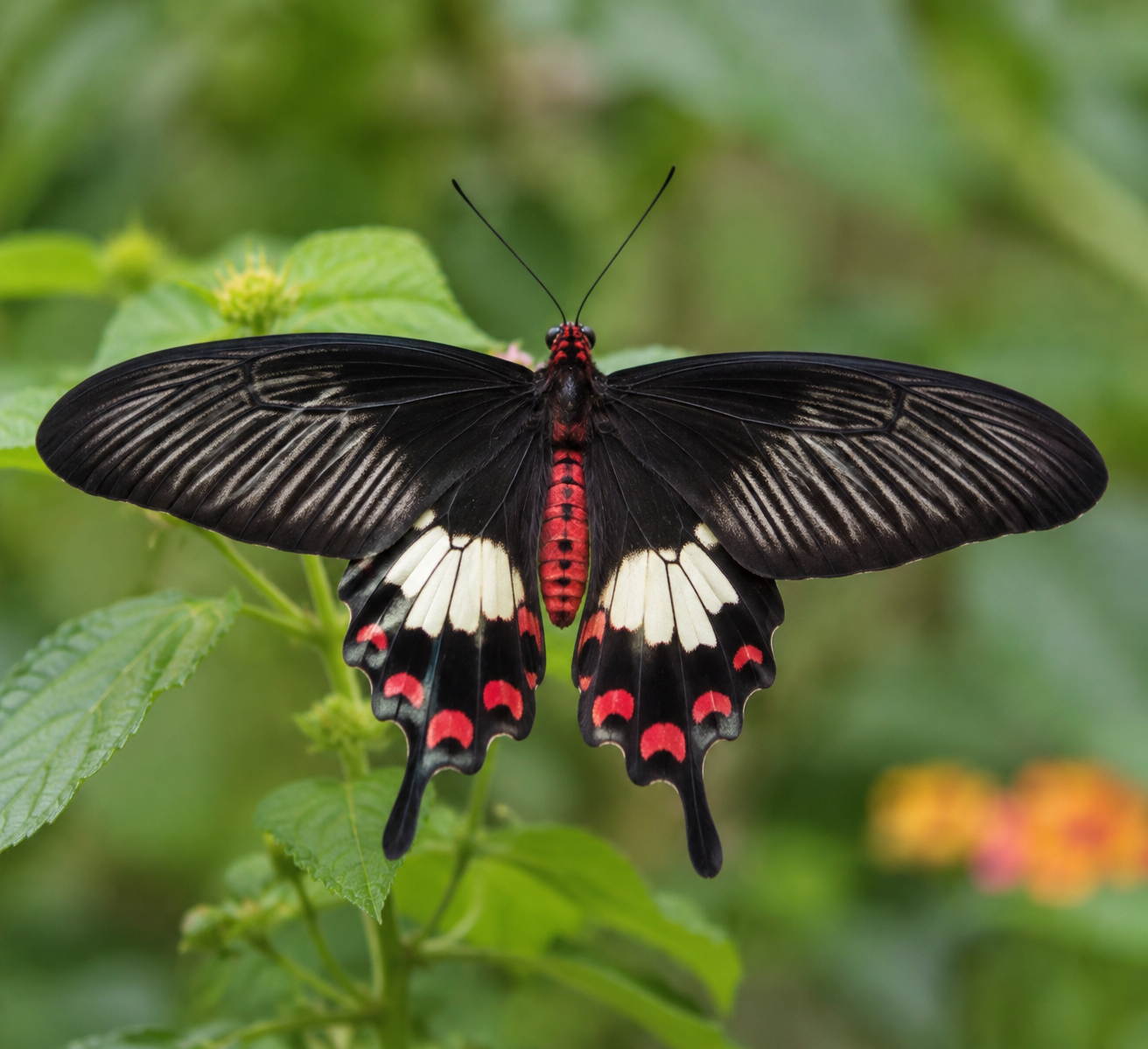
Some female common mormons resemble rose butterflies, including the common rose and, in parts of the species’ range, the crimson rose. Rose butterflies gain chemical protection associated with their larval food plants. Their conspicuous colours can serve as warning signals to predators. A predator that learns to avoid such a butterfly may also avoid another butterfly with a similar appearance.
The common mormon is a classic example of Batesian mimicry: a relatively undefended species gains protection by resembling a defended one. This does not mean that every bird is fooled, or that resemblance guarantees survival. Its value depends on predators recognising the warning pattern and responding to it. Nor does the butterfly consciously choose a disguise; these inherited appearances have developed through evolution.
Keeping the Nepal Picture Precise
For Nepal, separate two questions: what is known about Papilio polytes as a species, and which female forms have been reliably recorded within the country. The wider mimicry story answers the first question. The second requires Nepal-specific records with clear identifications and localities. A photograph from elsewhere in South Asia cannot establish that the same form occurs in Chitwan or another Nepalese district.
For local identification comparisons, consult the Chitwan butterfly guide rather than relying on this short overview. Keep its documented examples distinct from broader accounts of female variation, and avoid assigning a form name when a photograph does not show enough detail. Recording the location and photographing both wing surfaces, when possible without disturbing the butterfly, makes an observation more useful. The essential starting point is simple: strikingly different females may still belong to the same species.
Eggs: Finding the Right Leaf
For a female common mormon butterfly (Papilio polytes), laying an egg means choosing the first food her caterpillar will eat. Nectar flowers may fuel her own flight, but they do not necessarily feed her young. She must find a suitable larval host plant: a plant whose leaves the caterpillar can recognise, eat and grow on. This makes the search for a leaf an important part of the butterfly’s life, not simply a pause between flowers.
The account below describes general species biology, not a verified egg-laying observation from Nepal. Published host records from other parts of the butterfly’s range provide useful context, but they should not automatically become a list of confirmed Nepalese hosts. A plant growing in a Nepal garden—even a familiar citrus tree—is not, by itself, evidence that local common mormons use it.
A family of plants, not just one tree
The common mormon’s established host plants belong mainly to Rutaceae, the citrus family. Host compilations, including the Natural History Museum, London’s HOSTS—A Database of the World’s Lepidopteran Hostplants, record associations with Citrus species and other members of this family. Records from outside Nepal also include curry leaf, traditionally listed as Murraya koenigii, and bael, Aegle marmelos. These are examples of recorded hosts across the species’ range, not a Nepal-specific checklist.
The distinction matters because host use can vary between places. Plant availability, leaf condition and local growing conditions all influence what a female encounters. Even closely related plants should not be treated as interchangeable without evidence. For a Nepal wildlife account, the strongest support would be an identified female laying on an identified plant, ideally followed by observations showing that the resulting caterpillar feeds and develops there.
How a female checks a leaf
A searching female may approach several plants, hover near their foliage and briefly land before moving on. Visual clues help her find possible hosts, while contact with the plant allows closer assessment. Like other swallowtails, females use chemical-sensitive structures on their feet to detect plant cues. What looks like a momentary touch can therefore be part of a careful selection process.
Fresh, tender growth often attracts attention because it offers food suitable for a newly hatched caterpillar. However, “always on the youngest leaf” would be too rigid a rule. Leaf age, placement and condition can differ between observations. A female may inspect a plant and reject it; landing alone does not prove that it is a host or that an egg has been laid.
Once she accepts a site, she bends her abdomen towards the surface and deposits an egg. Common mormons lay their eggs singly rather than in clusters. The eggs are small, rounded and usually pale yellow when newly laid. More than one egg may eventually occur on the same plant, so “singly” describes the laying pattern—not a strict limit of one egg per tree.
Watching without disturbing
In Nepal, a useful observation begins with patience rather than handling. Watch from a little distance and note exactly where the abdomen touches the plant. After the butterfly leaves, look carefully without turning, plucking or shaking the leaf unnecessarily. A photograph of a tiny yellow egg alone may not establish which butterfly laid it.
- Photograph the female, the egg and the whole host plant if possible.
- Record the location, observation date and whether egg-laying was actually seen.
- Include clear leaf photographs, and flowers or fruit if available, to help identify the plant.
- Leave the egg in place; avoid spraying or pruning that growth.
Such records can help distinguish an assumed host from a documented local relationship. The valuable discovery is not merely an egg on a leaf, but evidence connecting a Nepalese butterfly with the plant that supports its next generation.
Caterpillars: Eating, Growing and Staying Hidden
For a common mormon butterfly caterpillar, the food plant is both a dining table and a hiding place. After emerging, the tiny larva begins feeding on its host leaf, often after eating part of its eggshell. Common Mormon larvae use plants in the citrus family, including cultivated citrus and curry leaf. In Nepal, these plants offer useful places to look, but a chewed leaf alone does not identify the caterpillar responsible.
At first, the larva hardly looks like the green caterpillar many people expect. Its dark, uneven-looking body carries pale patches that make it resemble a small bird dropping. This disguise helps it blend into an ordinary leaf surface without advertising itself as food. The effect is especially convincing when the caterpillar rests quietly. Rather than relying on speed, these young larvae benefit from being overlooked by birds and other hunters.
Feeding happens between periods of rest, and growth requires repeated changes of skin. A caterpillar’s outer covering cannot stretch indefinitely, so it moults, shedding the old covering and emerging in a larger one. Each stage between moults is called an instar. Common Mormon larvae normally pass through five instars, although an observer may miss the changes because the cast skin can be eaten and the caterpillar may remain still around a moult.
A motionless larva is therefore not necessarily sick or starving. Before moulting, it may stop eating and stay attached to its resting spot. Pulling it from the leaf or trying to make it move can disturb a vulnerable moment. If you are watching one on a garden plant, leave the leaf and caterpillar untouched. Return later and compare photographs rather than testing its response.
As the larva reaches its later stages, the bird-dropping disguise gives way to a much greener appearance. The larger caterpillar has a swollen-looking front region, with eye-like markings that are not its actual eyes. Its true head is smaller and sits at the front, below this broader area. Green colouring helps it merge with foliage, while the markings may make a close encounter less straightforward for a predator. These changes are part of normal development, not evidence that a different species has arrived.
The caterpillar also carries a hidden defensive tool called an osmeterium. This is a soft, forked scent organ just behind the head. When threatened, the larva can turn it outward, briefly revealing two fleshy prongs. The organ releases a strong-smelling chemical secretion that can help deter some attackers. It is not a sting, and its purpose is defence rather than feeding. There is no need to touch, squeeze or frighten a caterpillar to see it; undisturbed behaviour is more useful to observe.
For a useful Nepal observation, note the location, the host plant and the larva’s appearance. Photograph the whole caterpillar and enough of the plant to show its leaves clearly. Other swallowtails also feed on citrus, so neither the food plant nor green colouring is enough for a firm identification. A locally checked identification, ideally supported by photographs across growth stages or a documented adult emergence, makes a stronger larval record than a single uncertain image.
Do not expect every caterpillar to follow the same timetable. Temperature, leaf quality and other conditions affect feeding and development. Watch for changes in size, colour and behaviour rather than counting down a fixed number of days. Where possible, tolerate some leaf loss and avoid spraying occupied plants. A modest patch of suitable, unsprayed foliage can support this less celebrated part of the butterfly’s life: an animal quietly eating its way towards the next transformation.
The Chrysalis: A Quiet Transformation
The chrysalis of the common mormon butterfly may look like a small, lifeless part of a plant. Yet this quiet stage holds one of the most remarkable changes in its life. Inside the protective pupal covering, the caterpillar’s body is reorganised into an adult butterfly. The details below describe the species generally, rather than observations confirmed specifically in Nepal. Local conditions may affect development, but they should not be used to guess Nepal’s seasonal timing or overwintering behaviour.
A Silk Pad and a Supporting Girdle
Before becoming a chrysalis, a fully grown caterpillar stops feeding and searches for a suitable place to settle. This may be a stem, twig or another firm surface. The chosen support must hold it through pupation and provide enough space for the emerging adult to hang while its wings expand.
The caterpillar spins a small silk pad on the surface and makes a separate loop of silk called a girdle. This loop passes around the body and is anchored to the support, much like a safety belt. As the caterpillar sheds its final larval skin, the pupa secures its rear end to the silk pad using tiny hooks on a structure called the cremaster. The girdle supports the upper body. Together, these attachments hold the chrysalis in place; it does not simply dangle freely from its tail.
A chrysalis is the pupa itself, not a silk bag surrounding it. Unlike the familiar cocoons made by many moth caterpillars, the common mormon’s silk serves mainly as an anchoring system. Its exposed outer covering protects the developing insect beneath.
Camouflage Without Movement
Common mormon pupae can be green or brownish, with an angular outline that helps them blend with vegetation or woody surfaces. These forms are species-level features. They do not mean that every chrysalis perfectly matches its resting place, or that an observer can reliably predict its colour from the background alone.
Camouflage matters because a pupa cannot walk away from danger. Its colour and shape can make it less noticeable to predators, but concealment is not complete protection. Handling it, clearing nearby growth or moving its support can damage either the chrysalis or its fine silk attachments. For a garden observer, leaving it undisturbed is usually the most helpful choice.
Busy Beneath the Surface
Apparent stillness hides major internal change. During metamorphosis, some larval tissues break down, while others are remodelled or develop into adult structures. Wings, long legs, antennae and the feeding apparatus take their adult form. This is an organised biological process, not simply a caterpillar growing wings, nor a body dissolving into an entirely unstructured liquid.
Development time depends on conditions, including temperature. A general account of the species cannot establish how long a particular chrysalis will take in a Nepal garden. Nor does finding one during a cool period prove that the species overwinters as a pupa there. Such conclusions need reliable local observations.
Emergence and the First Wing Stretch
When development is complete, the pupal covering splits and the adult works its way out. Its wings are initially small, soft and folded. Clinging to the empty chrysalis or a nearby support, it pumps body fluid into the wing veins, unfolding the wings towards their full size. They then need time to firm and dry before flight.
This is a vulnerable interval. Do not touch the wings, pull away the empty casing or try to help the butterfly fly. Keep pets and curious hands away, and preserve its hanging space. Watching from a short distance allows the transformation to finish without turning a close encounter into an avoidable injury.
Adult Days: Nectar, Minerals and Movement
An adult common mormon butterfly must move between places that offer different things: flowers for fuel, sheltered vegetation for rest, and, especially for males, damp ground for dissolved minerals. These journeys make a garden, woodland edge or streamside more than a backdrop. Each can provide part of what the butterfly needs, although a brief sighting rarely reveals the purpose of its whole journey.
Flowers Provide Flight Fuel
At a suitable flower, the butterfly uncoils its long proboscis and reaches towards nectar held inside. The sugars in nectar supply energy for flight and other activity. Common Mormons often keep their wings moving while feeding, so a visit may look restless even when the insect remains at one flower. Watch the proboscis rather than the wings: probing a flower is stronger evidence of feeding than simply landing beside it.
Flower shape, nectar availability and the butterfly’s ability to reach the reward all influence which blooms it uses. For a useful observation, note the plant, whether the proboscis enters the flower, and whether the butterfly visits several blooms. If you cannot identify the plant, photograph its leaves and flowers rather than guessing. A colourful flower does not necessarily offer accessible nectar.
A nectar visit alone is not proof of effective pollination. The butterfly might touch pollen-bearing anthers or a receptive stigma, but it might also reach nectar without making the contact needed to transfer pollen. Showing that it pollinates a plant effectively requires more evidence than a feeding photograph. “Visited the flowers” is usually the more careful description.
Reading Nepal Records Carefully
A published starting point for Nepal is Colin Smith’s Butterflies of Nepal (Central Himalaya), published by Tecpress Service in Bangkok in 1989. Its treatment of Papilio polytes, the Common Mormon, documents the species in Nepal, including the Kathmandu Valley area. Such distribution information anchors the butterfly in a named landscape; it does not establish what an individual was feeding on or where it rested.
Keep that distinction when using Nepal examples. A Kathmandu Valley occurrence record supports a statement about presence, not a claim that butterflies there regularly feed on a particular garden flower. A behavioural account needs its own locality, date and observation details. Older records also cannot promise a sighting today. For current access or sighting conditions, check locally.
Movement and Quiet Pauses
Between feeding stops, a Common Mormon may cross open ground, follow vegetation or disappear into shade. Moving between resources is a reasonable interpretation of some flights, but not every passing butterfly is searching for nectar. It could be seeking a mate, avoiding disturbance or, if female, investigating a host plant. Record the visible action first; explain its possible purpose separately.
Resting is part of adult life too. A butterfly settled quietly on vegetation may remain with its wings held together. Observe from a distance and avoid shaking the perch. A shaded resting place may offer shelter, but one sighting does not prove that the insect is escaping heat or using a regular overnight roost.
Why Males Visit Damp Ground
Male Common Mormons also practise puddling: taking up moisture from damp soil, sand or other suitable surfaces. Unlike sugary nectar, this moisture can supply salts, particularly sodium, and other dissolved nutrients. A wet stream margin or muddy track can therefore be a feeding resource, not merely a place to pause.
Look for the proboscis touching the surface and sustained probing. Standing on mud alone does not demonstrate puddling, and the behaviour alone should not determine the butterfly’s sex. Keep clear of the patch, avoid altering it to attract insects, and let the butterfly leave undisturbed.
Conclusion: Making Room for the Whole Life
Making room for the common mormon butterfly means looking beyond the adult that visits a flower. A garden may offer plenty of nectar yet provide nowhere for a caterpillar to feed. Another may have suitable larval food plants but few flowers for adults. Protecting both resources is a practical way to welcome the butterfly’s whole life, whether you care for a home garden in Nepal, a school courtyard or a small patch beside a field.
Start with the plants already growing around you. Citrus and other suitable plants in the rue family can serve as larval food plants, while flowering plants offer nectar to adults. Before removing a plant or cutting back its branches, look carefully for eggs, caterpillars and attached chrysalises. You do not need to identify every small creature before deciding to pause. Leave occupied leaves undisturbed whenever possible, and avoid moving a caterpillar simply to get a clearer view.
Some leaf damage is part of supporting a leaf-eating animal. On a well-established garden plant, consider whether a few chewed leaves genuinely require action. Young or stressed plants may need closer attention, but an immediate spray is not the only response. If pruning can wait, mark the occupied branch loosely without touching the animal, and return to inspect it later. Where others share responsibility for the garden, explain why that branch has been left alone so it is not tidied away by mistake.
Adult feeding resources deserve the same care. Keep a mix of suitable flowering plants rather than relying on a single brief flush of blooms. Ask a knowledgeable local nursery about non-invasive choices that suit your soil, sunlight and seasonal conditions. A modest, well-tended patch can be more useful than plants that struggle in the wrong place. When cutting flowers or clearing spent growth, work in stages where practical, so the entire patch is not stripped of flowers at once.
Avoid unnecessary insecticide use, including routine spraying when no clear problem has been identified. Products used against other garden insects may also expose butterflies and their immature stages. “Natural” does not automatically mean harmless to caterpillars. If a plant problem needs treatment, first identify the cause and seek locally appropriate advice. Tell the adviser that butterfly eggs or larvae may be present, and follow any product label carefully. Do not spray occupied leaves as a precaution against possible future damage.
Observation offers a rewarding alternative to collecting. A notebook or phone can hold a useful record: the date, place, plant, weather and life stage you noticed. Photograph from a comfortable distance, without bending leaves toward the camera or clearing away nearby growth. Revisit the same plant when convenient, but accept that an animal may disappear between visits. An empty leaf alone cannot tell you whether a caterpillar moved, was eaten or reached another stage. Recording uncertainty is better than turning a guess into a fact.
Keep encounters hands-off. Do not collect eggs, take caterpillars indoors, handle adults or disturb a chrysalis for a photograph. Patient watching allows you to see behaviour without making the butterfly respond to your touch. With children, set a simple shared rule: look closely, give space and leave everything where it belongs. Share photographs and notes with local naturalists when you want help understanding an observation.
The next butterfly you notice can become the beginning of a longer story. Look for the plant that feeds its young, the leaf left untouched and the flowers available later in the season. Return with curiosity rather than an expectation of seeing every stage. Over time, a familiar garden can invite you to notice not just wings passing through, but a whole life unfolding.