Wildlife & Nature
Common Crow Butterfly: Identification and Habitat
EverestBlog AI · Oct 31, 2026 · 21 min read
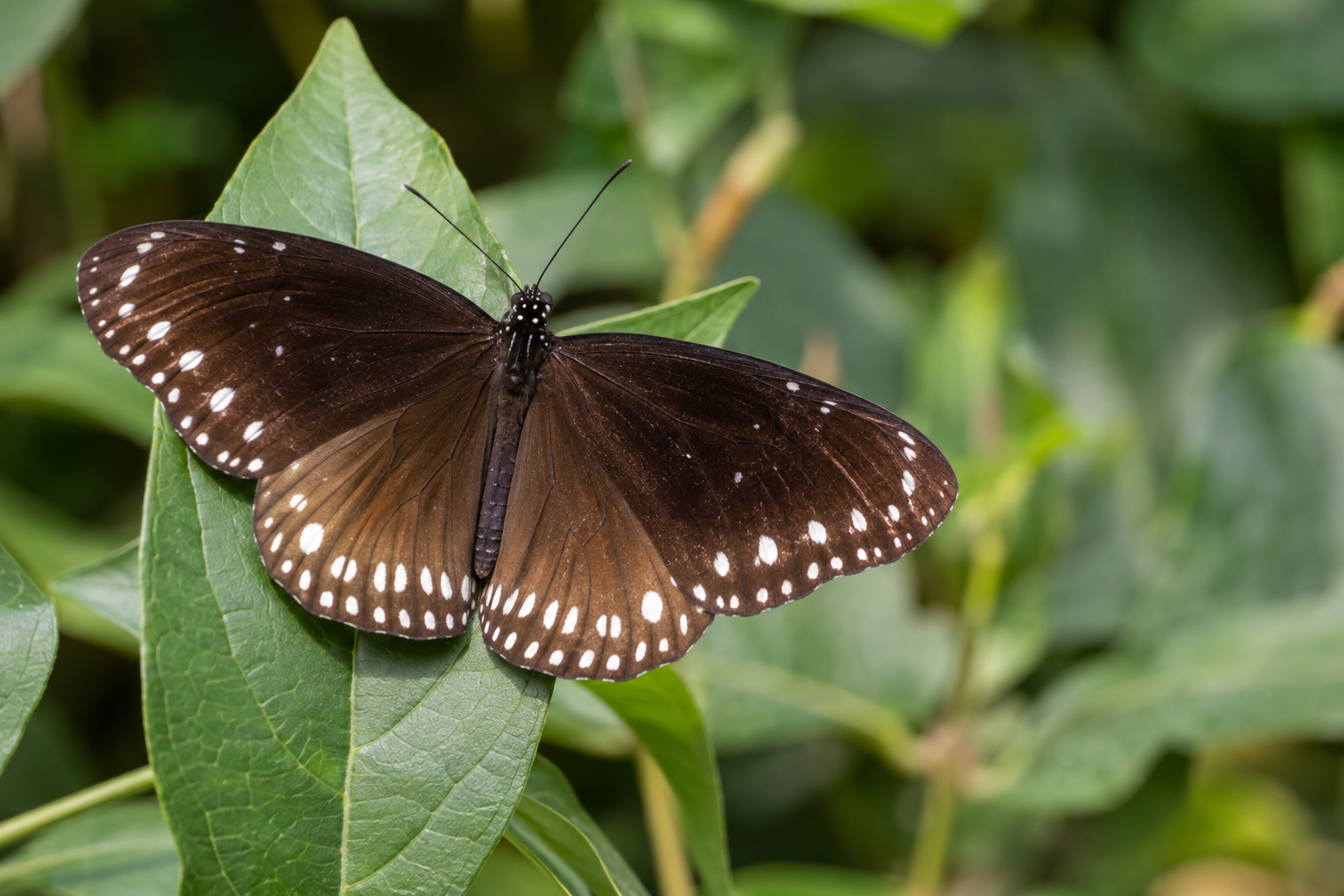
The common crow (Euploea core) has dark brown wings with pale spots near the margins; compare several features for a confident identification. · AI-generated illustration
The common crow butterfly is a dark, quietly striking butterfly whose beauty becomes clearer when you slow down. Instead of bright orange or electric blue, it offers rich brown wings edged with pale spots. In suitable weather, an adult may drift past vegetation, pause at flowers or settle in shade. These ordinary encounters make it an approachable subject for nature watchers, but a dark butterfly with white markings is not automatically a common crow. A useful introduction begins with its scientific identity and the limits of a quick impression.
Known scientifically as Euploea core, the common crow belongs to the family Nymphalidae, often called the brush-footed butterflies. Members of this family have reduced forelegs that are not used for walking in the same way as the other legs. Within Nymphalidae, the common crow belongs to the subfamily Danainae, the group that also includes monarchs and several butterflies known as tigers. These relationships help explain why butterfly guides may place species with quite different colours close together.
The name “crow” refers to its dark appearance, not to any relationship with the bird. “Common” is also worth treating carefully: it is part of the butterfly’s English name, not a promise that you will find it on every outing. Local abundance depends on suitable vegetation, weather, season and other conditions. A species that is familiar across much of its range may still be absent from a particular garden, trail or forest patch during your visit.
Euploea core has a broad distribution across parts of South and Southeast Asia, extending to Australia, and it is recorded in Nepal. That wide range makes the scientific name especially useful. English names can vary between regions, and photographs shared online may come from places with a different set of similar-looking butterflies. Using the name Euploea core keeps the discussion tied to one species rather than to every butterfly described casually as a “crow”. It also makes searching field guides and biodiversity records more precise.
For readers exploring Nepal, this article is a focused species reference. It is not a survey of Chitwan butterflies, a checklist for Chitwan National Park or a guide to everything likely to appear beside a forest trail. For that wider context, consult EverestBlog’s existing Chitwan butterflies overview. The two articles serve different purposes: the overview introduces a broader butterfly community, while this reference helps you understand one named member without treating every local sighting as evidence about the whole community.
That distinction matters because a butterfly encounter is only a small window into a landscape. An adult feeding at a flower shows that it is using that resource at that moment; it does not, by itself, show that the species breeds nearby. Likewise, seeing several individuals together does not establish how widespread they are across a protected area. Keeping these limits in mind makes a species account more useful than a collection of confident claims based on attractive photographs.
The common crow also offers an entry point into butterfly biology. Like other butterflies, it lives very different lives as a caterpillar and as a winged adult. Its needs therefore extend beyond the flowers that attract a photographer’s attention. Understanding a species means considering those connected stages, not simply recognising the finished adult.
The aim here is to build that understanding in manageable steps. The sections that follow separate identification from lookalikes, describe habitat and early life, and explain how to observe and record responsibly. You do not need specialist equipment to begin. You do need patience, a willingness to look beyond colour, and the confidence to leave an uncertain sighting unnamed.
Identification Checklist
Identify an adult common crow butterfly (Euploea core) by combining several features, rather than relying on its dark colour alone. The most useful starting points are the brown wing background, rows of pale spots near the edges, and broad, rounded wings. Check both wing surfaces when possible: a photograph of a resting butterfly may show only the underside, leaving important details hidden.
- Ground colour: dark brown, not necessarily jet black. Fresh adults usually look deep chocolate brown to almost blackish brown above. In bright sunlight, the brown tone becomes easier to see; in shade, the same butterfly can look nearly black. Worn individuals may appear paler or less evenly coloured. Look for a largely plain, dark central wing area rather than broad pale bands. Camera exposure can hide the brown background, so do not reject an otherwise good match simply because a photograph looks black.
- Pale spots: inspect their position, not just their presence. Look for small whitish or cream-coloured spots arranged near the outer wing edges. The marginal series lies closest to the edge, while the submarginal series sits farther inward. These markings form a dotted border rather than a continuous pale stripe. Their size and visibility differ between wings and individuals, and some can be faint or missing. Trace the arrangement around each visible wing instead of expecting every spot to match a reference photograph exactly.
- Forewing outline: broad, with a rounded tip. The forewing is roughly triangular, but its outer edge is gently curved rather than sharply angular. The tip is rounded, not drawn into a narrow point. Assess the outline when the wing is reasonably flat: a partly folded or tilted wing can appear much narrower than it really is. Small bites, tears and worn edges can also distort the shape, particularly in older adults.
- Hindwing outline: smoothly rounded and without tails. The hindwing has a broad, rounded outer margin, giving an open-winged adult a full, balanced outline. There are no long hindwing tails. When the wings are closed, the rounded hindwing usually forms much of the visible lower outline, while part of the forewing may be concealed. Do not mistake the overlapping edges of the two wings for an unusual wing shape.
- Upper surface: a dark field framed by pale dots. Viewed from above, the wings are predominantly dark brown, with the pale outer markings providing the clearest contrast. The pattern is restrained rather than strongly banded or heavily mottled. Inspect the forewings and hindwings separately, because the spot rows need not look equally bold on both. An open-wing photograph is particularly helpful for checking whether the overall pattern agrees across all four wings.
- Lower surface: generally lighter brown, with additional detail visible. The underside usually appears lighter than the upper surface and carries the same general pale-spotted border pattern. Additional small pale spots occur farther inward, especially on the forewing; some may be obscured by the hindwing when the butterfly rests. Compare an underside view with underside reference images, not just photographs taken from above. Light passing through the wings can make their colour misleadingly warm or pale.
Allow for variation. Sex, geographical form, wear and lighting can change the apparent strength of individual markings. Use the whole combination of colour, spot arrangement and outline; a single absent or enlarged spot is not decisive.
Reference check: Compare your observations with the Euploea core account and photographs in Butterflies of India (IFoundButterflies), and the identification treatment in Isaac Kehimkar’s Butterflies of India, published by the Bombay Natural History Society. Prefer examples from the same region where available, and leave uncertain sightings unconfirmed.
Similar Butterflies and Identification Pitfalls
A dark butterfly with white spots is not automatically a common crow butterfly (Euploea core). Other members of Euploea can look remarkably similar, especially when seen briefly beside a forest path. Brown or black colouring is a weak starting point: sunshine, shade, camera exposure and worn scales can all change its appearance. A stronger identification uses the arrangement of spots, the outline of each wing and the surface visible in the photograph.
Start with a regionally reliable shortlist
Before comparing named species, check which Euploea butterflies have reliable records from the area. For Nepal, use a current national checklist alongside published locality records or a regional field guide. A species recorded somewhere in South Asia is not necessarily a realistic candidate at your observation site. Equally, an incomplete local list cannot prove that an unfamiliar butterfly is absent.
No regional records have been verified for this comparison, so naming particular lookalikes would risk creating a misleading shortlist. Instead, use the following features to compare your butterfly with locally documented species. Distribution information can change as records improve; check locally with a butterfly specialist or natural-history organisation when a possible identification depends on an uncertain range.
Compare the pattern, not just the spots
The common crow typically shows white spots arranged towards the margins of dark wings, with additional spots farther inside the forewing. However, “white-spotted wings” describes a pattern shared by several crows. The useful question is not simply how many spots are visible, but where each spot sits in relation to the wing veins and neighbouring marks.
- Forewing tip: Compare the cluster near the apex, or outer tip. Note whether the spots form a curve, how far they sit from the edge, and whether any extend noticeably inward.
- Forewing interior: Look for spots between the outer rows and the central part of the wing. Their positions and relative sizes can be more informative than the overall brightness of the border.
- Hindwing border: Compare the marginal and submarginal rows—the outer row and the row just inside it. Check their spacing, continuity and relative spot sizes rather than treating them as one dotted band.
- Matching wing surfaces: Compare an underside photograph with an underside reference. Marks visible below may differ from those above; mixing surfaces can produce a false match.
Allow for variation between individuals and regional forms. A missing or faint spot is not necessarily decisive, particularly on a worn butterfly. Use several agreeing features rather than letting one apparently unusual mark determine the identification.
Use wing shape as supporting evidence
Compare the forewing’s length, the sharpness or roundness of its tip, and the curve of its outer edge. Then examine how broad and rounded the hindwing appears. These proportions help separate similar Euploea butterflies when checked against suitable regional references. Some males also have specialised scent-related marks, but interpreting these requires a clear view and a species-specific guide.
Wing shape is easily distorted by perspective. A butterfly photographed at an angle may appear narrower or more pointed than it really is. Partly folded wings, overlapping wings and damaged edges also weaken shape comparisons. Whenever possible, use photographs taken squarely to the visible wing surface.
Know when a photograph is not enough
A distant image, blurred border or single view with the forewing hidden may not show the features needed for a confident identification. Record such an observation as Euploea sp., or “possible common crow,” rather than forcing a species name. Retain the original photographs and location details for expert review. An honest uncertain record is more useful than a confident label based only on colour.
Habitat
The common crow butterfly (Euploea core) is associated with woodland edges, scrub, gardens and other planted landscapes across its wider range. Species accounts from Singapore’s National Parks Board and the regional reference Butterflies of Singapore describe its use of forest margins and urban green spaces. These associations help explain its habitat needs, but they do not establish where it occurs in Nepal. The focus here is on the resources a place provides, rather than identification features.
Edges, Openings and Sheltered Green Space
A useful habitat often combines vegetation cover with accessible feeding areas. Woodland margins, scrub edges and openings beside trees can provide this mixture. Flowering plants offer food, while nearby foliage supplies sheltered places to rest. A single butterfly may move between these resources, so the spot where an adult feeds is only one part of the habitat it uses.
Gardens and parks can also supply suitable resources. Their value depends less on whether they look tidy or “wild” than on what grows there and how it is managed. A planted area with nectar flowers, suitable larval food plants and sheltered vegetation offers more than a flower bed surrounded by paving. Conversely, a lush-looking garden may provide little breeding habitat if its plants cannot support caterpillars.
Adult Nectar Resources
Adult food and caterpillar food are different habitat requirements. Adult common crows visit flowers for nectar. Regional species accounts record flower visits in gardens and other disturbed or planted settings, showing that adults do not depend exclusively on undisturbed forest. However, an adult feeding on a flower does not mean that plant supports its young.
For adults, the availability of flowers over time matters. A brief burst of blossom can attract butterflies temporarily, while a mixture of plants with overlapping flowering periods can provide a more continuous food supply. Sunlit feeding patches close to shelter are useful features to consider when assessing a site. Flower abundance alone, however, cannot demonstrate that a resident breeding population is present.
Larval Host Plants and Breeding Habitat
Caterpillars require suitable host plants: plants whose tissues they can eat and develop on. Published accounts of Euploea core include hosts in the dogbane family, Apocynaceae. Examples reported from its wider range include oleander (Nerium oleander) and the climber Ichnocarpus frutescens. These are wider-range host records, not evidence of host use at any particular Nepal site.
This distinction changes how habitat should be understood. A nectar-rich roadside might be a feeding stop without offering breeding resources. A less conspicuously flowery patch could be important because suitable host plants grow there. The strongest habitat assessment therefore considers both adult feeding opportunities and larval requirements, rather than treating every butterfly sighting as evidence of complete habitat.
Host-plant records also need careful interpretation. A plant recorded as a host elsewhere should not automatically be recommended for planting locally. Local suitability, native status, toxicity and management needs all matter. Oleander, for example, is poisonous; its appearance in a host list is not a general recommendation for a household or school garden.
Applying Habitat Information to Nepal
For Nepal, broad regional descriptions must remain separate from verified national evidence. A habitat association reported in India or Singapore cannot establish a Nepal locality, elevation range or preferred vegetation zone. No Nepal-specific locality or elevation claim is made here without a supporting Nepal record.
When evaluating published Nepal information, look for a clearly identified species, an explicit locality and a documented habitat description. Elevation should come from the record itself, not an estimate based on a nearby town. Where those details are missing, the responsible conclusion is limited: the butterfly’s wider-range resource needs are known, but its use of that particular Nepal habitat remains unconfirmed.
Life Cycle and Host Plants
The common crow butterfly (Euploea core) passes through four stages: egg, caterpillar, chrysalis and adult. Only the caterpillar eats its host plant; the adult feeds mainly on nectar and other liquid resources. This distinction matters when watching the species in Nepal. A butterfly visiting a flower shows where it feeds, but it does not establish that its caterpillars can develop on that plant.
From Egg to Adult
A female usually lays eggs singly on a suitable host plant, often on the underside of a leaf. The pale egg is dome-shaped, with fine ridges visible under magnification. Finding one requires patience: examine leaves gently without bending tender shoots or rubbing their surfaces. An isolated egg is difficult to identify confidently, so watching the female lay it provides stronger evidence than judging its appearance alone.
After hatching, the caterpillar begins feeding and grows through several stages, shedding its skin between them. Larger common crow caterpillars are colourful, with contrasting bands and four pairs of long, fleshy, tentacle-like projections. These are not legs or stinging hairs. Colour and markings change as the larva grows, so a small caterpillar may look noticeably different from a mature one. Photographing the same individual over successive visits can help document these changes without handling it.
When fully grown, the caterpillar stops feeding and seeks a place to pupate. It attaches itself to a silk pad and hangs head-down before forming its chrysalis. The common crow’s smooth chrysalis can have a striking metallic, silvery or golden appearance. It may hang away from the feeding plant, so a chrysalis on a fence, twig or garden structure does not identify a larval host.
Inside the chrysalis, the insect transforms into an adult. After emergence, the butterfly hangs while its wings expand and harden. Leave it undisturbed, with clear space beneath and around it. Development depends on temperature, food quality and other conditions; a fixed timetable should not be assumed for Nepal’s different elevations and seasons.
Host Plants: Wider Records and Nepal Evidence
Across its wider range, the common crow uses several kinds of larval food plants, particularly members of the dogbane family, Apocynaceae, and the fig and mulberry family, Moraceae. Published host records include the following examples. These are wider-range records, not a list of hosts confirmed in Nepal:
- Oleander (Nerium oleander): an apocynaceous shrub recorded as a larval food plant. Its sap and other tissues are toxic; do not cut or handle it unnecessarily.
- Ichnocarpus frutescens: a climbing member of Apocynaceae recorded as a host. Accurate plant identification is important before attaching this name to a field observation.
- Banyan (Ficus benghalensis): a member of Moraceae with documented host use. This does not mean every fig species is a suitable food plant.
- Streblus asper: another member of Moraceae recorded as a larval host within the butterfly’s wider distribution.
For Nepal, a plant’s presence and a host record from another country are not enough to establish local use. No Nepal-specific host confirmation is asserted for the examples above. To describe a plant as a confirmed host in Nepal, seek a reliable Nepal-based record linking an identified plant with feeding common crow larvae, ideally followed through to an identified adult. Check locally with butterfly researchers or botanical specialists rather than treating a regional plant list as proof.
For a useful field record, photograph the whole plant, diagnostic leaves and any flowers or fruit, alongside the feeding caterpillar. Note the location and observation date. Egg-laying suggests host selection, but successful larval development provides stronger evidence of suitability. Keep nectar visits in a separate category: an adult drinking from a flower is valuable information, but it answers a different question.
Responsible Observation and Recording
Watching a common crow butterfly is most rewarding when your presence does not change its behaviour. Approach slowly, keep your shadow off the insect, and pause if it stops feeding or becomes alert. Use a zoom lens or your phone’s close-focus setting from a comfortable distance. If the butterfly repeatedly flies away as you approach, step back rather than following it from flower to flower.
Photograph both wing surfaces only when they are naturally visible. A resting butterfly with closed wings offers a view of the underside; one basking or moving its wings may reveal the upper surface. Wait for these opportunities instead of touching the wings, blowing on the insect, shaking its perch, or trying to make it fly. A clear photograph of one surface is better than a complete set obtained through disturbance.
- For the underside: Try a side-on photograph with the camera roughly parallel to the closed wings. Include the whole butterfly, keeping the wing margins and pale markings in focus.
- For the upper surface: Photograph from above or at a gentle angle when the wings open naturally. Avoid leaning over vegetation if doing so could damage plants or dislodge other insects.
- For context: Take a wider image showing the perch, flowers, or surrounding habitat. This can help explain the observation without requiring a closer approach.
Check your images before moving nearer. A slightly distant, sharp photograph often records more useful detail than an extreme close-up with blurred wing edges. Keep the original files, and use modest cropping or brightness adjustments if needed. Heavy colour changes or sharpening can obscure features. If you share an edited image for identification, retain the unedited version so someone can review it.
A useful record needs more than a photograph. Note the date and location, preferably while you are still at the site. Your phone may save these details, but location tagging can be disabled or inaccurate. Add a place name, nearby landmark, or map pin that you can check later. Record the time if available, and describe the habitat briefly: for example, a sunny garden beside woodland or a shaded streamside trail.
- Describe what you observed: Note whether the butterfly was feeding, resting, flying, mating, or laying eggs. Separate direct observations from guesses.
- Be careful with counts: Several sightings along a short path may involve the same individual. If uncertain, record “at least one” rather than treating every encounter as a different butterfly.
- Keep identification open: If the photographs do not show enough detail, label the record as uncertain and seek help from a knowledgeable local naturalist or a recording community.
Give eggs, caterpillars, and pupae extra space. Do not pick them up, turn them over, remove leaves, or carry them home for a better photograph. Avoid opening shelters or clearing vegetation around them. These actions may injure the insect or expose it to predators and drying conditions. Photograph an immature stage where it is, and record the plant without assuming that every plant it rests on is a food plant.
At protected areas, botanical gardens, community forests, and other managed sites, check locally for access rules, photography restrictions, permitted paths, and any guide requirements. Ask permission before entering private land. Keep precise locations private if sharing them could encourage trampling or unwanted collection.
Finally, describe each sighting as an observation, not a guarantee for future visitors. Weather, flowering plants, vegetation management, and other local conditions can affect what people see. Avoid promising sightings in a particular month without reliable local evidence. Patient visits and careful notes remain valuable even when no butterfly appears.
Conclusion
Identifying a common crow butterfly is best treated as a careful judgement, not a quick match to a single memorable detail. The strongest conclusion comes when several visible features agree with a reliable reference and no clearly observed feature contradicts it. Habitat can help you understand an encounter, but it cannot settle the identification. A butterfly being where you expect it to be is a reason to look more closely, not proof of its name.
Before you close your notebook or label a photograph, ask yourself one simple question: What evidence actually supports this identification? Separate what you saw clearly from what you inferred. A feature visible in a sharp image carries more weight than an impression formed during a brief flight. Equally, something hidden from view should remain unknown. Not seeing a feature is different from seeing that it is absent, and that distinction can prevent an uncertain encounter from becoming an incorrect record.
Try to weigh evidence rather than count it. Several vague similarities do not necessarily outweigh one clear mismatch. If most of your confidence comes from the setting, your expectations, or a general resemblance, pause before deciding. Return to the clearest observations and compare them with the relevant identification guidance. If a discrepancy remains, keep it in your notes rather than explaining it away simply because the first name you considered feels familiar.
A useful final review can be short and practical:
- Check agreement: Do the visible identifying features support the same conclusion when considered together?
- Check the limits: Which details were obscured, blurred, or never observed well enough to judge?
- Check your assumptions: Would you reach the same conclusion if you did not know the habitat?
- Choose an honest label: Does your wording reflect the strength of the evidence, rather than the certainty you hoped to achieve?
When the evidence is incomplete, retaining uncertainty is the most useful outcome. You can describe an observation as a possible common crow butterfly, provided that wording fits what you actually recorded. If even that suggestion feels too narrow, leave the identification broader. There is no need to force every sighting into a species name. An unresolved record with a clear photograph and honest notes may be more valuable than a confident label that cannot be checked.
Make that uncertainty specific whenever possible. Instead of writing only “not sure,” note what prevented a firmer decision: an incomplete view, an unclear image, or a feature you could not assess. This gives you a useful starting point if you revisit the record or ask someone else to review it. Keep the original evidence alongside any suggested identification, so that another observer can evaluate the sighting without relying entirely on your interpretation.
Be willing to revise a name later. A correction does not reduce the value of the encounter; it improves the record and sharpens your judgement for future observations. Likewise, a record that remains unresolved has not failed. You have still documented what you could see and recognised what you could not. That habit helps keep photographs, field notes, and shared sightings dependable, especially when other people may use your identification as a reference.
The aim is not certainty at any cost, but a conclusion proportionate to the evidence. Look for a combination of features, use habitat as supporting context rather than proof, and allow unanswered questions to remain unanswered. Whether your final note says “common crow butterfly,” “possible identification,” or simply records an unidentified butterfly, careful observation remains worthwhile. A good identification ends with a name only when the evidence supports one; otherwise, it ends with an honest account of the limits of the view.