
Travel & Food
Traditional Nepali Food Every Traveller Should Try: What to Order and How to Eat It
EverestBlog AI · Oct 31, 2026 · 16 min read
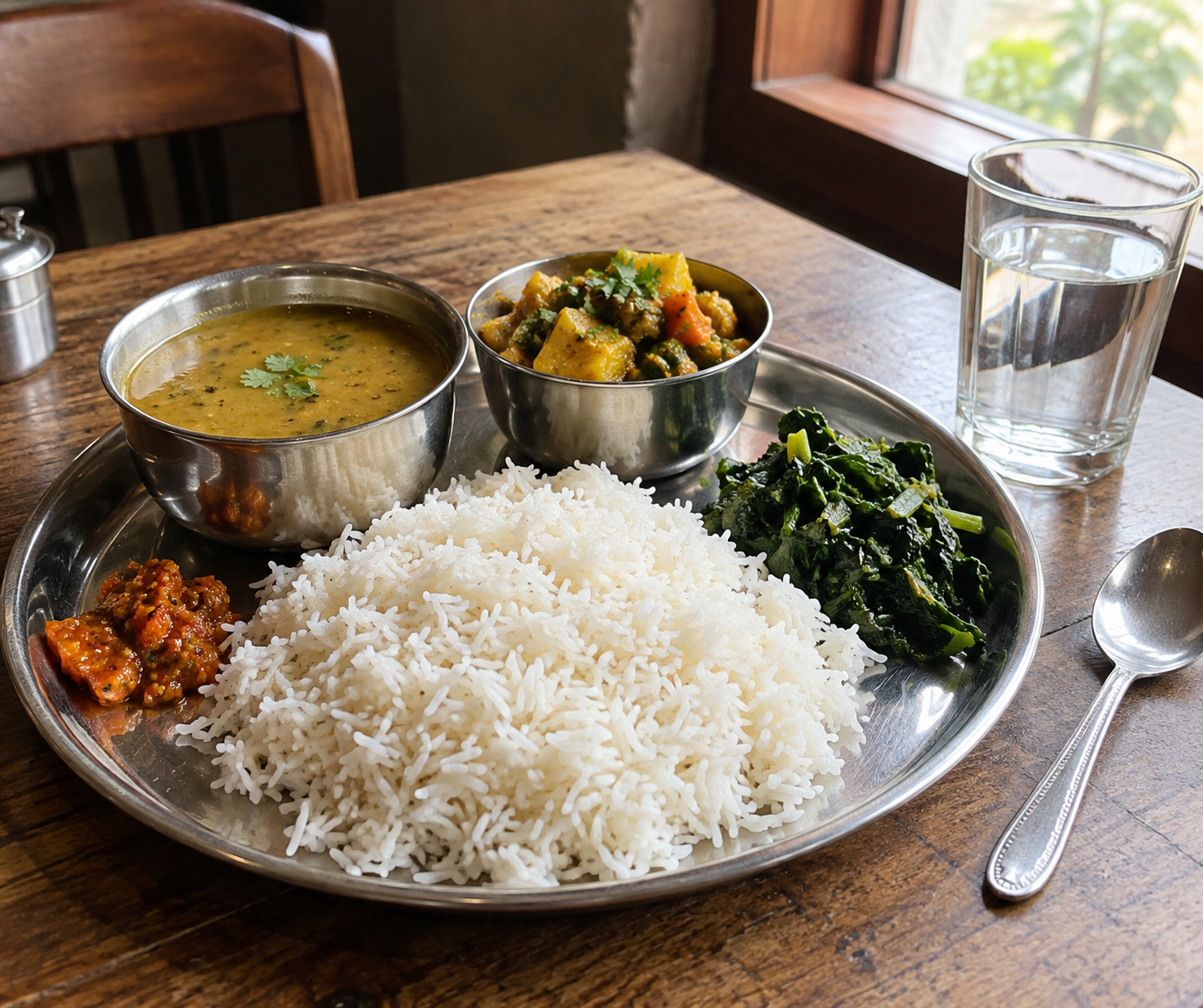
Dal bhat brings rice, lentils and accompaniments together in a filling meal; the selection varies by kitchen. · AI-generated illustration
Your first encounter with traditional Nepali food may begin with a question: how hungry are you? Before worrying about unfamiliar names, decide whether you want a full meal, a light plate or something to eat alongside another order. That choice makes a menu easier to understand and helps you avoid ordering an accompaniment when you expected dinner. You do not need to recognise every ingredient to order well. Start with the size and purpose of the food, then ask what comes with it.
For a full meal, look for a combination rather than a single item. A meal may bring together a staple, pulses, vegetables, pickles and other sides, with meat available in some versions. Ask whether everything listed is included or whether certain additions cost extra. Some places offer refills of selected components; others serve a fixed portion. Do not assume either arrangement. A simple question such as “What comes with this meal?” is more useful than guessing from a photograph, especially when the menu description is brief.
For a light plate, check the portion and how it is served. Something described as a snack may suit a small lunch, but it may not be enough after a long walk. Ask how many pieces you receive, whether the plate is intended for one person and whether it comes with a sauce or side. If you are eating with others, sharing a plate can be a low-pressure way to try an unfamiliar flavour. Order modestly at first and add more if you are still hungry.
For an accompaniment, ask what it usually goes with. A strongly flavoured, sour or spicy item may be intended to brighten a mouthful of the main meal rather than be eaten in a large serving by itself. Other foods work as a small extra, a tea-time bite or part of a wider spread. Menu categories do not always make those roles clear. Asking “Is this a meal or something to have with it?” can prevent disappointment without requiring you to know the local food vocabulary.
These are useful starting points, not rigid categories. Nepali cooking reflects different landscapes, communities, seasons and household habits. What is familiar in a hill home may differ from everyday food in the southern plains or a Himalayan settlement. Newar food traditions of the Kathmandu Valley add another distinct range of preparations and eating occasions. Even two kitchens in the same neighbourhood may prepare the same named food differently. Think of this guide as a set of practical expectations, not one fixed national menu.
When ordering, explain dietary needs clearly rather than relying on a dish name. Ask about meat, stock, eggs, milk products and any ingredient you must avoid. A vegetable option does not necessarily answer every question about how it is prepared. Mention allergies specifically, and ask about shared utensils or cooking surfaces if cross-contact matters. For heat, request a mild preparation where possible and ask whether chilli sauce or pickle can be served separately. Some mixtures are prepared ahead, so adjustment may be limited.
How you eat can be simple, too. A spoon is perfectly practical, and you can ask for cutlery if it is not provided. If you choose to eat with your hand, wash it first and use your right hand; watch your host for guidance in a home. Use serving utensils for shared food rather than your own used spoon. Before confirming an order, check the current price and any extras; for changing menus and refill policies, check locally. The best first order is one you understand: enough food for your appetite, ingredients that suit you and a clear idea of what belongs together. Curiosity helps, but there is no need to order a feast to begin.
For a Full Meal: Dal Bhat and Dhido
When you want a filling introduction to traditional Nepali food, order dal bhat. At its simplest, the name means lentils and rice, but a restaurant order commonly arrives as a complete meal: steamed rice, lentil soup, cooked vegetables and achar, with meat dishes available in some places. Think of the whole plate as your lunch or dinner, rather than treating each bowl as something you must order separately.
Dal Bhat: Get to Know the Whole Plate
The rice provides a mild base, while the dal brings moisture and flavour. Vegetable sides change with the kitchen and season; you might find potatoes, cauliflower or leafy greens. Achar adds a sharper contrast and may be sour, hot or both. Its ingredients and texture vary, so try a small amount before mixing it through your food. A meat curry, if offered, may cost extra rather than come with the standard plate.
Before ordering, ask, “Which sides are included?” This helps you understand whether you are choosing a vegetable meal, a meat version or a basic rice-and-dal serving. Menus may use terms such as “set” or “thali” for a complete plate, but the contents are not identical everywhere. If you are hungry after a walk or a long journey, ask about refills too: some kitchens offer extra rice, dal or vegetables, while others charge separately. Check locally rather than assuming every item is unlimited.
To eat, pour a little dal over one area of rice and mix in a small helping of vegetables or curry. Take a bite, then adjust the next mouthful with a touch of achar. Working through small portions keeps the flavours distinct and stops all your rice becoming wet at once. There is no need to empty every bowl onto the plate immediately; you can return to each accompaniment as you go.
A spoon is perfectly practical. If you prefer to eat with your hand, wash it first and use your right hand. Bring a small amount of rice and its accompaniments together with your fingertips, then lift a manageable bite to your mouth. You do not need to copy anyone perfectly. Start with a spoon if that feels easier, and let hot food cool before touching it.
Dhido: A Different Base for a Hearty Meal
Dhido replaces loose grains of rice with a thick, cooked flour staple. Millet and buckwheat are common choices, though other flours are also used. Flour is stirred into hot water and cooked into a dense, cohesive mass. Its flavour depends on the grain: it can be earthy and more pronounced than plain rice. Ask “What flour is used?” if you want to know what you are trying or need to avoid a particular ingredient.
Dhido becomes a full meal through its accompaniments, such as lentils, cooked greens or curry. On its own, it may feel unfamiliar, so take a small portion and combine it with a little of a side dish. You can use a spoon or your right hand, allowing it to cool first. Smaller mouthfuls make it easier to enjoy the thick texture alongside the wetter lentils or gravy; there is no reason to rush.
For either meal, explain dietary needs before the kitchen starts serving. Ask whether ghee or meat stock is added, and clarify which part of the meal you mean: the staple, dal, vegetables or curry. A vegetable-looking dish does not tell you everything about how it was cooked. For allergies or strict dietary requirements, ask about shared preparation too.
A useful final check is: “What comes with this, and are refills included or charged separately?” For dhido, confirm the flour as well. These questions help you choose a satisfying meal without unexpected ingredients or costs; serving arrangements and recipes vary, so check locally.
For a Snack or Light Meal: Momo and Chatamari
If you want traditional Nepali food without ordering a full set meal, momo and chatamari are useful choices. Both can suit a short lunch stop or an afternoon appetite, but neither comes in one standard portion. Before ordering, ask what is inside or on top, how much you will receive, and whether the accompanying sauce is mild or fiery.
Momo: Filled Dumplings with Achar
Momo are filled dumplings, commonly served steamed with achar, a sauce or relish that brings acidity, spice and sometimes a nutty flavour. The wrapper should hold the filling while remaining tender enough to bite through. Momo belong to a wider Himalayan food culture, with connections across Nepal, Tibet and neighbouring regions. In Nepal, they have become an everyday favourite, with variations shaped by local cooks and tastes.
Typical fillings include vegetables, chicken and buffalo meat, often called “buff” on menus. Other options depend on the kitchen. A vegetable filling may contain cabbage, onion or other chopped ingredients, while meat fillings are usually seasoned and minced. Do not assume every restaurant offers the same choices. If you avoid meat, dairy or particular ingredients, ask directly rather than relying only on a short menu label.
Steamed momo are a good starting point because you can taste the filling without a crisp outer layer. Fried versions offer a different texture; some kitchens also serve pan-fried styles. For something warmer and more spoon-friendly, look for broth-based versions. Jhol momo commonly arrive in a generous, soupy sauce, although its ingredients, thickness and temperature vary. If you want dumplings in hot broth, ask the server which option matches that expectation.
- Ask about the filling: Confirm the meat or vegetables used, especially if the menu simply says “momo.”
- Check the piece count: A plate may be a snack or a light meal, depending on the number and size of the dumplings.
- Check the sauce heat: Ask whether the achar is spicy and whether extra chilli sauce can stay on the side.
Use the cutlery provided, dip or spoon on a little achar, and take a careful first bite. The centre can be much hotter than the wrapper, especially when the dumplings have just left the steamer. Let steam escape before taking another bite. Start with a small amount of sauce: achar can be tangy and gentle, sharply hot, or somewhere between the two. If sharing, use a serving spoon for communal sauce rather than dipping a bitten dumpling into it.
Chatamari: A Rice-Flour Crepe with Choices on Top
Chatamari is a Newari rice-flour crepe associated with the food traditions of the Newar communities of the Kathmandu Valley. It may be served plain or topped with ingredients such as egg, minced meat and seasonings. You may hear it described as “Nepali pizza,” but that shorthand misses its character: the base is a rice-flour batter, not a bread dough.
Rice-flour preparations have wider regional connections across South Asia, but chatamari has a distinct place in Newari cooking. That context is more useful than claiming exclusive origins for crepes or topped flat foods. For a traveller, the practical question is what the kitchen’s version includes. Ask whether the toppings are fixed or chosen separately, which meat is used, and whether an egg-free or meat-free option is available.
Chatamari is usually a snack or light meal. Ask about its size before deciding whether to share one or order your own. Eat it in manageable pieces, using your fingers if comfortable or the cutlery provided. A topped version may be easier to cut first so the filling stays with the base. Try a plain edge before adding any accompanying sauce; this lets you taste the crepe itself. If you have a food allergy, confirm both the batter and toppings rather than assuming a rice-flour base makes the whole dish suitable.
For a Tasting Plate or Add-On: Samay Baji, Gundruk and Sel Roti
For a wider taste of traditional Nepali food, try a plate with several small components or add something fermented or lightly sweet to your order. Samay baji, gundruk and sel roti serve different purposes: one is an assortment, one is usually an accompaniment, and one is a fried bread. Knowing the difference helps you order enough without accidentally treating a side dish as lunch.
Samay Baji: Explore a Newari Assortment
Samay baji is a Newari assortment centred on beaten rice, often called chiura. It brings together contrasting textures and flavours rather than one blended dish. Depending on the kitchen, the plate may include beans, vegetables, achar, egg and meat. There is no single restaurant serving you should assume you will receive, so ask for the exact components before ordering.
A small serving can be a substantial snack; a generous plate may work as a meal. Ask whether the portion is enough for one person’s lunch or intended for sharing. This is particularly useful when the menu gives only the dish name, without describing the size or accompaniments.
To eat it, combine small bites of beaten rice with different items. Try some beans and vegetables first, then add a little achar for a sharper or spicier mouthful. The beaten rice is dry and crisp, so mixing each bite with a moist component can make it easier to eat. You do not need to mix the entire plate at once.
For a vegetarian order, ask which items can replace the meat and whether egg is included. Extra beans or vegetables may be possible, but check locally rather than assuming substitutions are available. If you are vegan, specify no meat, fish, eggs or dairy, and ask about the ingredients in each component, including achar.
Gundruk: A Tangy Accompaniment
Gundruk is fermented leafy greens, commonly dried after fermentation for later use. Its tangy, savoury character adds a different flavour to a meal. You may encounter it in preparations such as soup or achar; the name alone does not tell you whether it will arrive brothy, relatively dry or strongly seasoned.
Gundruk is normally an accompaniment rather than a complete meal. Order it alongside your main food, or ask whether it is already included in the meal you have chosen. If you are curious but unfamiliar with fermented flavours, a small portion is a useful starting point.
Ask, “How is the gundruk prepared here?” Follow with a specific question about meat stock if you avoid animal ingredients. Although the greens themselves are plant-based, the finished preparation is not automatically vegetarian or vegan. For an achar, also ask about chilli if you prefer milder food.
Sel Roti: A Lightly Sweet Rice Bread
Sel roti is a lightly sweet, ring-shaped bread made from rice batter and fried. It is commonly eaten as a snack or as part of breakfast, rather than as a full meal by itself. Some people enjoy it with tea; it can also accompany curry, bringing a sweet contrast to savoury flavours.
Eat it by hand, breaking off manageable pieces. If paired with curry, tear off a piece and take it with a little curry. Ask whether the sel roti is freshly made, especially if you want it warm. Recipes vary, so check whether the batter contains milk or ghee; rice batter does not necessarily mean dairy-free.
A Quick Dietary Check Before Ordering
- Allergies: Name your allergen clearly and ask about every component, including achar and garnishes.
- Dairy and eggs: Ask separately about milk, ghee, yoghurt and eggs. “Vegetarian” does not mean “vegan”; clarify both terms.
- Stock: Confirm whether soups, curries and vegetable preparations use meat stock.
- Shared equipment: Ask about shared frying oil, pans and utensils. For a serious allergy, ingredient substitutions alone do not resolve cross-contact risks; if staff cannot confirm safe preparation, choose another option.
Conclusion: Make Your First Order Simple
Your first order of traditional Nepali food does not need to cover everything on the menu. The easiest approach is to make three decisions in order: choose according to your appetite, confirm what is included, then settle ingredients and spice level before ordering. This keeps the choice practical, whether you have arrived hungry after a journey or simply want a small introduction to unfamiliar flavours.
Start by thinking about how much you actually want to eat, rather than how many foods you hope to try. A full meal makes sense when you are properly hungry and have time to sit down. Something smaller may suit a short stop, a late afternoon break or an evening when you have already eaten well. You can explore more over several meals; there is no need to turn your first order into a tasting challenge.
Next, ask what the menu price covers. A name alone may not tell you whether you are ordering a complete meal, a single item or something intended to accompany another order. A useful question is, “What comes with this?” Follow it with, “Is that enough for one person?” The answer gives you a better starting point than a photograph, which may show extras or a serving arranged for display.
Clarify quantities before adding several things. Ask how many pieces come in an order, whether there are different portion sizes, and whether the serving is meant for sharing. If you are travelling with others, explain how many people will eat from it. Do not assume that every restaurant offers smaller portions or that every meal includes refills. Where extra servings are offered, ask which parts can be replenished and whether there is an additional charge.
Once the size and contents are clear, explain your ingredient needs in plain terms. Rather than relying only on a label such as “vegetarian,” say what you avoid and ask about anything uncertain. Depending on your needs, that might mean checking for meat stock, eggs, milk, ghee or particular allergens. Recipes and kitchen practices vary, so an answer from one place should not be treated as a promise about the next.
If you have a food allergy, make that clear before the order reaches the kitchen. Ask whether staff can confirm the ingredients and avoid contact with the allergen during preparation. A translated note can help explain your needs, but it cannot guarantee that a kitchen can meet them. If the answer is uncertain, choose somewhere that can give you a clear response rather than relying on reassurance without details.
Discuss heat separately from ingredients. “Can this be made mild?” is more useful than assuming that every dish can be adjusted. Some components may already be prepared, while others can be changed when cooked. Ask whether hot accompaniments can come separately if that would suit you. Be specific about chilli heat rather than asking for “no spices,” which may suggest removing seasonings you would otherwise enjoy.
Then start with a manageable portion. Before planning to add more, ask whether another order will be easy to arrange and roughly how long it might take. This matters if you have a bus to catch or the kitchen is close to finishing service. When time allows, ordering gradually gives you room to respond to your appetite instead of committing to more food than you want.
Finally, check locally for current prices and availability, including any charges not shown in the menu price. Online menus and older recommendations may not reflect what is being served today. Your first order can stay simple: match your hunger, understand the serving, confirm what you can comfortably eat, and leave room to add more. A satisfying introduction is better than an ambitious order you cannot finish.