
Travel & Conservation
After the Safari: Where Does Sauraha’s Tourism Waste Go?
EverestBlog AI · Oct 30, 2026 · 7 min read
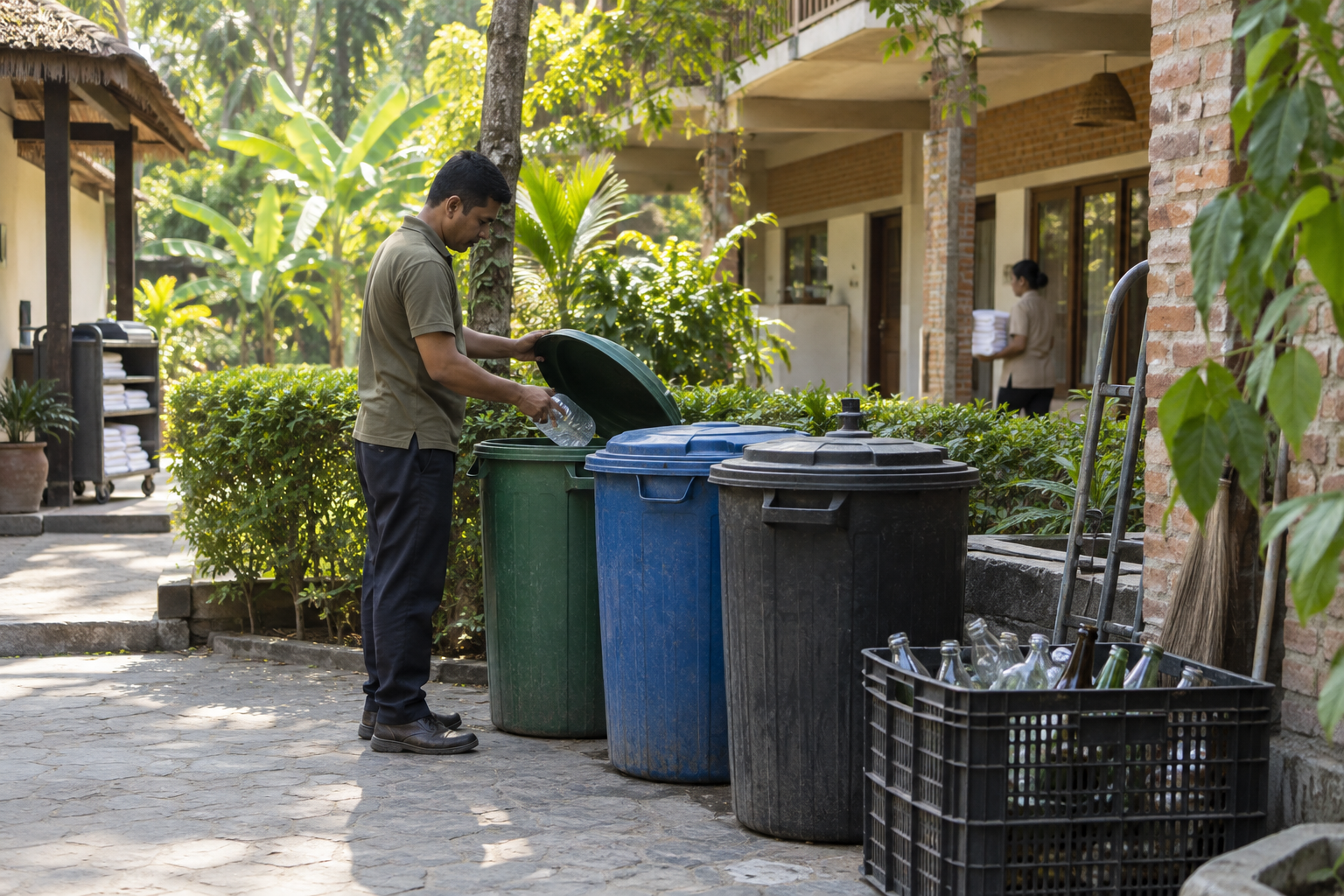
The waste journey begins behind the guest areas, where separation, storage and collection determine what happens next. · AI-generated illustration
After visitors return from Chitwan’s forests, another journey begins behind Sauraha’s hotels and restaurants. Kitchen scraps leave preparation areas, bottles gather beside storerooms, and bathroom bins fill. Safari businesses add packaging, office waste and rubbish brought back from outings. Visitors rarely see the next stage, although it matters as much as a tidy guest room.
Where does it all go? There is no responsible single answer without checking individual businesses and current local arrangements. Sauraha tourism waste management is a chain of decisions involving accommodation owners, workers, collectors, material buyers and local government. Following that chain reveals what visitors can verify—and where an attractive environmental claim needs more evidence.
Start with the limits of what is known
Sauraha is a tourism gateway to Chitwan National Park within Ratnanagar Municipality. The municipality is therefore a starting point for questions about ordinary solid waste services. That does not establish which collector serves a particular lodge, how regularly vehicles arrive, or which disposal facility currently receives its rubbish.
This article offers a way to trace those arrangements, not a verified inspection of every local waste route. Collection schedules, service coverage, fees and operating destinations can change: check locally. A reliable account should name a receiving site and explain what happens there, rather than stop at “the waste is collected.”
The first sorting decision happens inside the business
Accommodation produces several different streams: food scraps, paper, glass, plastic packaging, sanitary waste and occasional broken equipment. Safari offices and vehicle operators may generate drink containers, snack wrappers and maintenance waste. Used oil and batteries need separate handling; they should not disappear into general rubbish.
The important question is whether these materials remain separate after staff empty the guest bins. Colourful containers in a lobby prove little if everything enters one sack behind the kitchen. Ask where each stream is stored and who handles it. A brief explanation from a manager can reveal whether sorting is routine or merely decorative.
Food scraps need a destination, too
Food waste deserves attention because it is wet, heavy and quick to smell. When mixed with paper and packaging, it makes recoverable material dirty and less attractive to buyers. Exposed scraps can also attract animals, creating problems that extend beyond a property’s boundary.
Composting can be useful where a business has suitable space, trained staff and a system that controls odour, pests and runoff. But a heap at the edge of a garden is not automatically managed composting. If a hotel says scraps become animal feed or compost elsewhere, ask who receives them and how collection and storage work.
Collection is a handover, not an endpoint
Waste may move through municipal services, contracted collectors or other arrangements, depending on the business and current local provision. Do not assume all properties use the same system. Ask the accommodation to identify its collector and explain whether service is scheduled or requested when storage fills.
Useful evidence includes a recent service receipt, a collection agreement or a clear description of the route. None alone proves safe disposal, but each makes the account more traceable. Workers also need secure containers and safe handling arrangements. Overflowing sacks, leaking bins and scattered rubbish suggest problems before the vehicle even leaves.
Recyclables follow markets, not promises
Some clean, separated materials can enter resale chains through scrap buyers and aggregators. Whether a particular item is accepted depends on its material, condition, quantity and the buyer’s market. A recycling symbol does not guarantee that there is a practical local outlet.
Ask which materials a business actually sells or passes on, and to whom. Clear bottles, mixed plastic wrappers and broken glass should not be treated as interchangeable. Storage matters, too: keeping saleable materials dry and separated preserves their usefulness. Claims that “all plastic is recycled” deserve particular scrutiny unless the business can explain the different streams and receiving buyers.
Follow the remaining rubbish to its final stop
After useful materials are removed, residual waste still needs a destination. This is often the least visible part of the story. Ask whether the vehicle goes directly to a disposal site, uses an intermediate transfer point, or hands rubbish to another operator.
A transfer point is not final disposal. Nor does calling a site a “landfill” establish that it has engineered controls. Relevant questions concern access management, litter control, drainage and contaminated liquid from decomposing waste. Do not publish a site name or describe its condition as current without confirmation. For the operating destination and authorised arrangements, check locally with the municipality.
Who carries responsibility?
Nepal’s solid waste framework gives local government a central role in managing ordinary municipal waste, while waste generators also have duties. Exact service arrangements and local requirements should be confirmed with Ratnanagar Municipality or the relevant ward office. The practical task is to distinguish public responsibility from each business’s own obligations.
A hotel cannot demonstrate responsible management simply by saying it pays someone to remove rubbish. It can reduce waste, separate materials, store them safely and use an accountable service. Collectors control handling and transport. Local authorities can clarify approved arrangements, service gaps and complaint routes. Visitors can ask questions, but they are not substitutes for oversight.
Wastewater takes a different route
Not everything leaves in a sack. Toilets, showers, laundry areas and kitchens produce wastewater, which needs its own investigation. A business’s solid waste collection contract says nothing about the adequacy of its drainage or sanitation system.
Ask whether wastewater enters a sewer connection, an on-site treatment system or septic containment, and how that arrangement is maintained. Do not assume a sewer exists at a particular property. Where tanks require emptying, the next questions are who performs the work and where the removed sludge goes. Grease from kitchens also needs management. Check locally rather than accepting “it goes underground” as an explanation.
Why the wildlife setting raises the stakes
Sauraha’s proximity to rivers, wildlife habitat and a protected area makes escaped waste especially concerning. Wind can move light packaging, and rainfall can carry loose rubbish into drains and waterways. Accessible food waste may attract animals towards buildings and people.
These are pathways of risk, not proof that any named business is polluting the park. Keep that distinction clear. Prevention means covered storage, timely collection and attention to drainage, including during heavy rain. A clean riverbank after a volunteer event is welcome, but it does not replace dependable systems upstream. Removing visible litter and preventing new leakage are different jobs.
What visitors can reasonably verify
You do not need to inspect a disposal facility to ask useful questions. Start before booking, then compare the answer with what the property openly shows. Request permission before entering service areas or taking photographs, and do not expect workers to interrupt demanding shifts.
- Separation: Which materials stay separate after collection from rooms?
- Collection: Who removes the residual rubbish?
- Destination: What receiving site or operator takes it next?
- Organics: Where do kitchen scraps go?
- Sanitation: How are wastewater and any emptied sludge managed?
Specific, modest answers are more useful than a sweeping promise of “zero waste.”
Support practical changes without shifting the burden
Visitors can reduce demand for disposable items, use refill water where its safety is established, and return outing rubbish to the operator’s designated collection point. Ask staff how to separate items rather than guessing. Do not leave batteries or broken electronics in room bins; seek an appropriate collection route.
However, personal habits cannot create a missing disposal facility or reliable collection service. The stronger tourism response is collective: businesses sharing clear service expectations, authorities explaining available infrastructure, and operators making destinations traceable. Avoid rewarding unsupported green claims simply because they sound ambitious. Honest acknowledgement of a gap can be the beginning of improvement.
A cleaner courtyard is only the beginning
The test of Sauraha tourism waste management is what happens beyond the guest’s view. Does separated material reach a buyer? Do food scraps reach a managed destination? Does residual rubbish enter an accountable disposal route? Is wastewater handled safely?
Until those links are verified, “taken away” remains an incomplete answer. Visitors can encourage better practice by asking calmly, recognising specific evidence and choosing businesses willing to explain their systems. The goal is not a perfect-looking bin. It is a waste journey that does not simply move the problem elsewhere.
Up next

Travel & Conservation
How Quiet Is Chitwan’s Tourism Edge? Investigating Noise Around Sauraha

Travel & Conservation
Where Does a Chitwan Park Entry Fee Go? Following Tourism Money into Conservation

Wildlife & Conservation