Travel & Conservation
How Quiet Is Chitwan’s Tourism Edge? Investigating Noise Around Sauraha
EverestBlog AI · Oct 30, 2026 · 10 min read
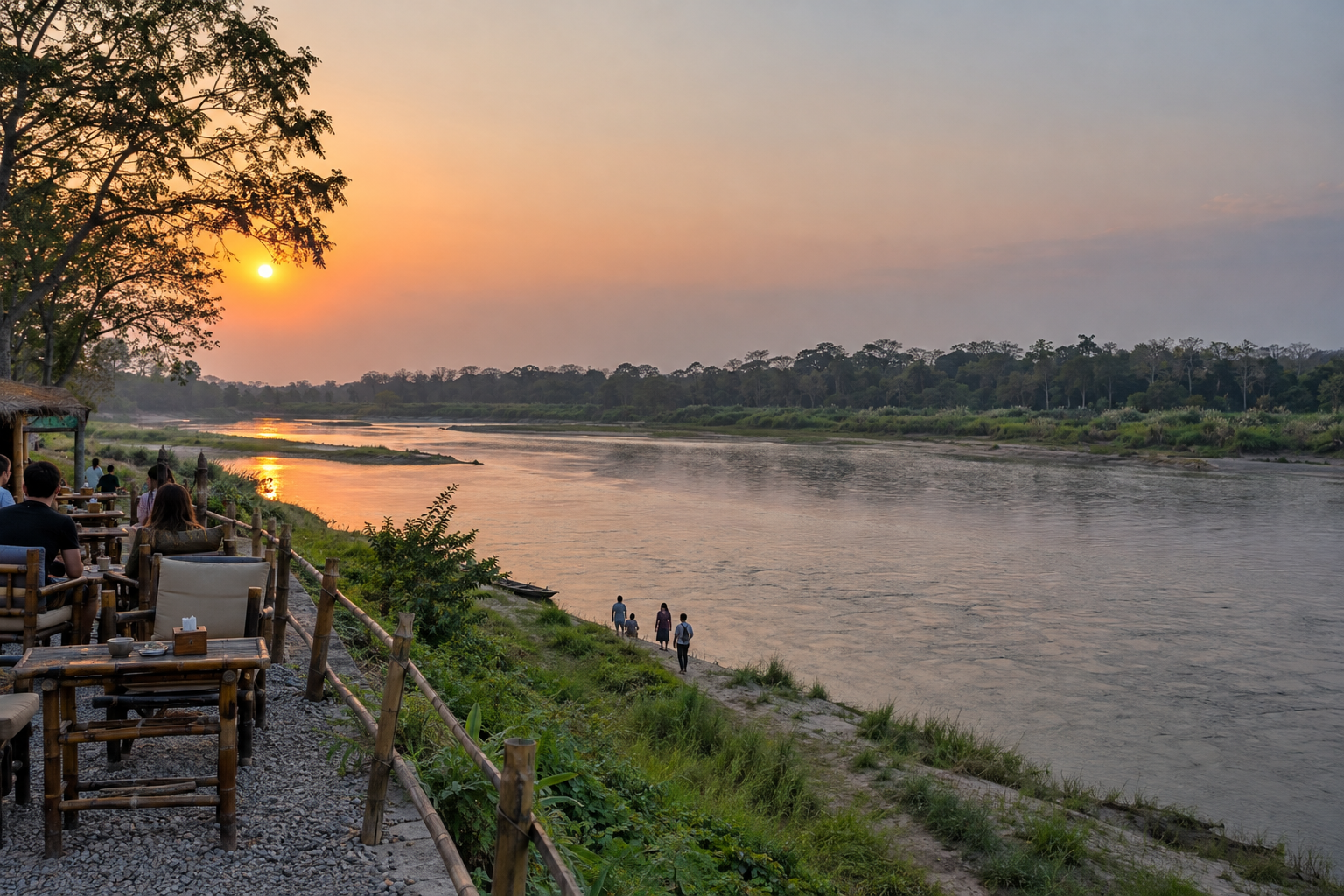
The Rapti riverfront offers a setting for examining where visitor activity and wildlife habitat meet through sound. · AI-generated illustration
At Sauraha, a question about quiet is also a question about boundaries. Roads, restaurants, accommodation and riverside gathering places sit near the landscapes visitors come to experience. People arrive hoping to hear birds, encounter wildlife and spend time away from traffic. Yet getting there, staying there and enjoying an evening all produce sound.
That makes Chitwan tourism noise pollution a useful subject for investigation, but not a conclusion to announce before gathering evidence. A busy street does not tell us how much sound reaches habitat. A quiet riverbank does not establish that nearby animals are unaffected.
Reporting note: This article is an evidence-conscious guide to investigating the issue, not a completed field survey. No on-site sound measurements or original interviews were conducted for it. The time comparisons below describe what to examine, rather than claim observations that have not been made. Residents, operators and researchers should help test the questions, not supply imagined answers.
Where the tourism edge actually lies
Sauraha is a gateway to Chitwan National Park, with visitor activity concentrated around accommodation, commercial streets and access points for nature excursions. Along the Rapti River, the relationship between settlement, visitor space and wildlife habitat becomes especially visible. But the tourism edge is not one neat line.
Sound can cross a river or travel beyond a property boundary. Buildings, vegetation, terrain, weather and the position of a source affect what reaches a listener. Water should not be treated as a dependable acoustic barrier, nor should a strip of greenery automatically be called soundproofing.
A useful investigation therefore follows routes rather than labels. It compares a commercial street, an accommodation lane, a public riverside space and a legally accessible habitat-facing location. Access conditions and park rules can change; check locally before planning observations, and never enter restricted habitat to obtain a more dramatic recording.
Separate sound from harmful noise
Not every audible human activity is pollution. Conversation, transport and work are part of a living town. The relevant questions concern loudness, duration, timing, repetition and who or what receives the sound. A brief passing vehicle and sustained amplified music may require very different responses.
For residents, unwanted sound can affect rest, conversation or the enjoyment of home. For visitors, it may change the experience they expected. Neither concern requires proof of injury to wildlife before it deserves attention.
Wildlife questions need a separate evidential step. Research elsewhere shows that human-made noise can interfere with communication or alter behaviour in some species and settings. That makes local study worthwhile; it does not demonstrate a particular effect around Sauraha. A careful report distinguishes an audible source, a measured exposure, an observed response and a supported explanation for that response.
Dawn: listen before departures gather pace
Dawn offers a useful comparison period because many nature activities begin early and birds can be vocally active. The first question is not whether morning is peaceful, but how its sound changes as the visitor day begins. Engines, loading, conversation and horns are possible sources to record, not features to assume.
At each observation point, note the start time, weather, nearby activity and dominant sounds. Repeat the listening period as departures increase. Does a vehicle pass briefly, or remain running? Is speech audible only nearby, or clearly across an open space?
Birdsong needs equally careful interpretation. Hearing fewer calls on one visit does not prove that tourism has reduced bird numbers or silenced them. Season, rain, wind, species present and the observer’s ability all matter. Record what was heard, without turning a short listening session into a population assessment.
Afternoon: test the apparent lull
An afternoon visit may offer a contrast with departure periods, but it should not be labelled quiet in advance. Deliveries, construction, road traffic, maintenance or generators could dominate a particular location. Some sources may serve the wider settlement rather than tourism alone.
Return to the same points for the same observation duration. A pleasant shaded lane and an exposed roadside are not interchangeable samples. Record whether a source is continuous, intermittent or a single event, and whether it can actually be identified.
This is also a chance to separate source from assumption. A loud engine near a hotel is not necessarily hotel equipment. Ask permission before investigating on private property, and seek confirmation from the responsible operator. Where attribution remains uncertain, say so. Identifying the wrong business or blaming tourism for every town sound would undermine an otherwise useful report.
Evening: compare activity with its reach
Evening comparisons should include both active visitor spaces and nearby places where people live or sleep. Music, conversation, vehicle movements and equipment are potential sources. Their presence, intensity and operating hours require direct checking rather than a generic description of nightlife.
The important comparison is between the source and the receiving location. Music audible beside a speaker may be faint at a house, while bass or repeated announcements may remain noticeable farther away. Note changes as venues open, become busier and close, without assuming that every business follows the same pattern.
Weather can change sound transmission, so one still evening cannot represent every night. Repeat visits across different conditions and busy and quieter periods. Ask locally about event schedules, but do not publish an unverified calendar as fact. Occasional celebrations should also be distinguished from routine nightly activity.
Ask residents about patterns, not slogans
Resident interviews should begin with open questions: What sounds do you notice? At what times? Have they changed? Where in the home are they most noticeable? These questions invite descriptions rather than push people towards calling Sauraha noisy.
Seek different positions: people beside commercial streets, households farther away, tenants, homeowners and people whose income depends on visitors. Tourism benefits and sound disturbance can exist in the same household. Neither invalidates the other.
Ask for concrete examples and permission to follow up at the relevant time. A dated diary can help distinguish recurring disruption from a memorable isolated event. Obtain consent before naming someone, particularly when a complaint concerns an employer, landlord or neighbour. A resident’s account is evidence of their experience; it should not be rewritten as a scientific finding about wildlife or as the opinion of the entire community.
Give tourism operators a fair hearing
Hotels, restaurants, guides, drivers and activity providers face different sound-management choices. Interview them separately rather than treating the industry as one voice. Ask which equipment or activities create sound, when they operate and what complaints, if any, they have received.
Useful follow-ups concern practical constraints. Could a waiting vehicle switch off its engine safely? Could speakers face inward? Does equipment need maintenance or a different location? Would an agreed quiet period be workable across neighbouring businesses?
Operators should have the chance to respond to specific, verified concerns before publication. Ask whether they keep complaint records and whether changes have helped. An assurance that guests enjoy music does not settle neighbours’ concerns, but a complaint also does not establish a legal violation. Applicable rules, permissions and enforcement responsibilities must be checked with the relevant authorities rather than inferred from what another destination does.
Ask researchers what the evidence can support
A researcher interview should start with the local evidence gap. Has anyone measured tourism-related sound around Sauraha? Were measurements taken near sources, homes or habitat? Is there a published study, an unpublished dataset or only informal observation? These are different kinds of information.
Then ask how a plausible wildlife response could be tested. Species differ in hearing, communication and activity patterns. A measurement designed around human hearing does not by itself describe what every animal hears. An absence of visible reaction is not proof of no effect.
Equally, an animal moving away does not establish noise as the cause. People, vehicles, light, smell or other animals may also be present. Researchers can help design comparisons that account for these factors. Any claim of a locally demonstrated impact should identify the study, its methods and its limits, not rely on general statements about sensitive wildlife.
Measure consistently, and explain the limits
A phone recording can document timing and character, but it is not automatically a reliable sound-level measurement. Devices and apps differ, and wind or handling can distort results. Avoid publishing precise decibel claims from an unchecked phone as if they came from calibrated equipment.
For a formal survey, use appropriate instruments and a documented method, ideally with acoustic expertise. Record location, distance from identifiable sources, microphone placement, weather and observation duration. Explain whether a reported value represents an average or a brief peak.
Repeated measurements matter more than a dramatic isolated number. Compare equivalent periods at the same sites, and include quieter reference locations where feasible. If assessing compliance, establish which standard applies and how it requires measurements to be taken. A limit copied from another country or from an unrelated land-use category cannot establish whether a Sauraha business has broken a rule.
Watch wildlife without adding disturbance
Wildlife observation must remain within permitted activities and distances, with qualified local guidance where required. Do not approach animals to see whether they react to a sound, play recordings as an informal experiment, or encourage drivers to rev engines for a comparison.
If a behavioural change occurs during an ordinary visit, document the sequence carefully. Note the sound, the animal’s apparent activity beforehand, its response and other nearby changes. A guide’s interpretation can provide valuable context, but should remain attributed as interpretation unless supported by further evidence.
Reliable work may require repeated observations, suitable comparison sites and specialist methods beyond a travel assignment. That is not a weakness to conceal. A responsible article can identify a question worth studying without claiming to have answered it. Protecting wildlife also means avoiding the extra disturbance that an overambitious investigation might create.
Make quieter choices before every question is settled
Uncertainty about wildlife effects does not prevent sensible courtesy. Visitors can keep personal speakers off in nature settings, avoid shouting to attract animals, and ask drivers to avoid unnecessary horns and idling when safe. Follow guide instructions and current park requirements.
Accommodation questions should be specific: Does the room face a road, event area or equipment? Is amplified entertainment planned? What are the property’s quiet arrangements? Conditions vary, so check locally rather than relying on a general promise of a peaceful location.
Operators can consider speaker direction, volume, scheduling and maintenance, while checking that proposed changes actually reduce sound at affected properties. Moving equipment away from guests but towards neighbours simply transfers the problem. Shared arrangements may work better than isolated efforts, especially where several sources overlap. These steps can improve comfort without being advertised as proven wildlife conservation outcomes.
Publish a finding, not a verdict in advance
A strong final investigation would place the time comparisons beside resident experiences, operator responses and researchers’ assessments. It would state which sites were visited, how often, in what conditions and with what equipment. Missing seasons or unavailable interviewees should be acknowledged.
The findings might reveal a recurring disturbance, a short-lived problem at particular locations, or a more mixed picture than expected. Each possibility deserves room. Avoid reducing the result to a contest between tourism and conservation when the evidence may concern specific sources and manageable practices.
For now, the honest answer to how quiet Sauraha’s tourism edge is remains location- and time-dependent, requiring field verification. The useful next step is structured listening: compare the same places, hear the people affected and test wildlife claims carefully. Quiet is worth protecting, but the case becomes stronger when its description is as disciplined as its ambition.