Wildlife & Nature
Who Lives Inside Chitwan’s Fallen Logs? Looking Beyond Living Trees
EverestBlog AI · Oct 31, 2026 · 8 min read
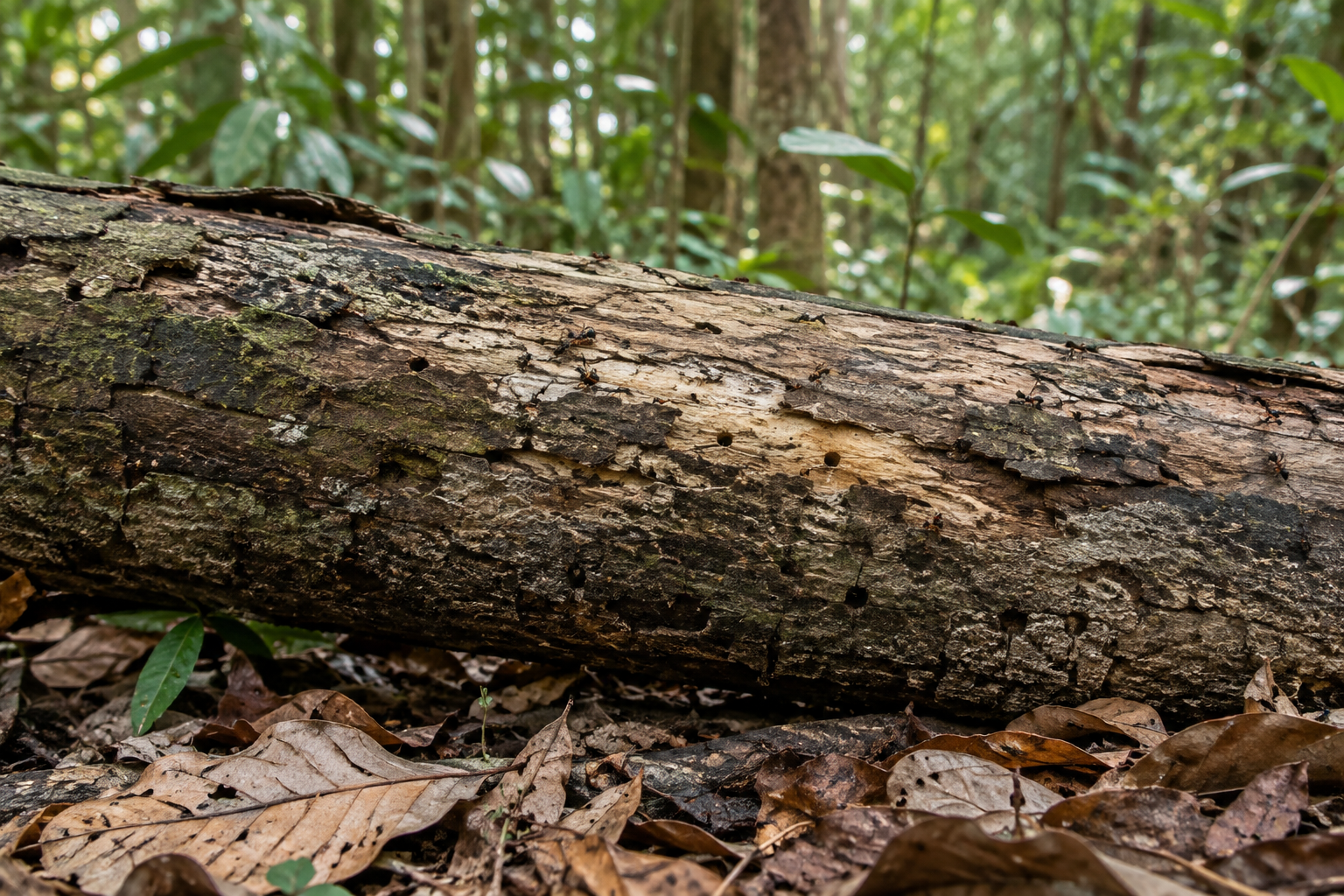
Cracked bark and sheltered crevices make fallen timber worth a closer look in Chitwan. · AI-generated illustration
Beside a fallen log on a permitted, naturalist-led forest walk in Chitwan, there is a good reason to pause without touching anything. The useful question is not simply which tree fell here, but who might now be using its timber. A crack may offer shelter; softened wood may become food. This is where a closer look at Chitwan deadwood wildlife begins: with one piece of fallen timber, approached as a habitat rather than an obstacle on the trail.
That starting point is an invitation to observe, not a claim about a particular encounter. Without field notes from a documented walk, it would be misleading to place a beetle beneath the bark or put an explanation in a guide’s mouth. What we can establish is why deadwood deserves attention, what signs a visitor might notice from a safe position, and which questions require a naturalist’s knowledge or a more detailed examination by a specialist.
A tree’s death does not end its place in the forest. Fungi help break down wood, while termites and some beetle larvae feed on dead plant material or use it during development. Other small animals may use gaps beneath loose bark, hollows, or spaces where timber meets soil. Predators can visit to hunt those residents. These are possible relationships to investigate, not a checklist of creatures guaranteed to appear on any Chitwan walk.
Food and shelter are closely connected here. Decaying timber can hold moisture and provide shaded spaces that differ from the exposed forest floor. As wood breaks down, its texture changes, opening opportunities for different organisms. A recently fallen trunk with firm bark is not the same habitat as a soft, crumbling log partly mixed with soil. Tree species, shade, contact with the ground, and the stage of decay all help shape what can use it.
Instead of moving from one living tree to another, or measuring the walk by sightings of large safari animals, this investigation follows individual logs. Each becomes a small study site. How much bark remains? Is the surface dry or damp? Are there visible holes, fungal growths, or accumulations of wood fragments? Such details give context to a close look. They do not, on their own, prove which animal made a mark or whether it is still present.
Observation also has limits. Much of a log’s activity happens out of sight, inside timber or along its underside. An apparently quiet surface does not mean an empty habitat. Nor is a brief glimpse always enough for identification. Recording colour, shape, movement, and location can be more honest and useful than attaching a confident species name to an uncertain sighting.
Access rules, walking routes, and current conditions can change; check locally with park authorities or an authorised operator before arranging a walk. Follow the naturalist’s directions about where to stop and what is safe to approach. The aim is a careful look at the forest’s smaller relationships, beginning with what a fallen log reveals without being disturbed.
Three Logs, Three Close Looks at Small Wildlife
A useful way to explore Chitwan deadwood wildlife is to compare three fallen logs with a naturalist, looking at bark, moisture and cavities before naming animals. The examples below are observation guides, not confirmed field sightings. Let the logs you actually encounter shape the investigation: record what is visible, and keep explanations separate from evidence.
First Log: Firm Wood, Dry Surface, Loose Bark
Start with a log whose exposed surface looks dry and whose remaining bark has lifted at the edges. Look into gaps already open to view; do not peel anything away. These narrow spaces can shelter animals even when the wood beneath remains firm.
If ants cross the trunk, note their movement and whether they carry anything. Ants on wood are not proof that they eat it. They may be searching for prey, travelling between feeding sites or using a cavity. A spider waiting beside a bark crack belongs to a different feeding group: a predator hunting other small animals.
Small round holes and winding channels deserve separate notes. Direct observation: holes in the surface or galleries exposed where bark has already fallen. Tentative interpretation: these may mark earlier insect activity. Their shape alone rarely identifies the maker, and an empty hole does not prove its original occupant remains inside.
Second Log: Damp Wood with a Softened Surface
Next, compare a shaded log with darker, damp-looking wood and a softened surface. Ask the naturalist whether the moisture is visible or only inferred from shade and colour. Avoid pressing fingers into the wood to test it: that can crush hidden animals and damage their shelter.
If termites are visible in an existing break, watch without widening it. Termites that consume wood help explain the wood-feeding role, but a pale insect is not automatically a termite. Identification should rest on a clear view and the naturalist’s knowledge; otherwise, “small pale insects” is an honest record.
Millipedes or small, jumping springtails may also appear on a damp surface. Their presence does not make them wood-borers. Depending on the animal, food may include softened plant material, fungi or other organic matter. A centipede, by contrast, is a predator. Record its visible features rather than guessing a species from colour alone.
Third Log: A Hollow with Deep Crevices
Finally, examine a log with an obvious hollow or deep split. Compare its entrance with the surrounding bark: is it shaded, damp, smooth or crumbly? A cavity offers a different kind of shelter from a thin bark gap, but its dark interior may remain unreadable.
A gecko or frog visible at the entrance would be a direct sighting, not evidence of wood-eating. Such animals may use the space as refuge and hunt invertebrates nearby. Do not reach inside, insert a stick or block an animal’s exit for a photograph.
At all three logs, keep two short lists: seen and suggested by signs. Surface clues reveal only part of the community. Hidden residents, old feeding traces and temporary visitors cannot always be distinguished during one careful look.
Conclusion: Look Closely, Leave the Log Intact
A fallen log is more than something lying beside a forest path. Its bark, cracks and softening wood offer small spaces where animals can shelter, feed or escape drying conditions. Fungi help break down the wood, while insects and other small creatures take part in the forest’s slow recycling work. Looking for Chitwan deadwood wildlife brings these easily missed relationships into view. The aim is not to uncover everything inside a log, but to notice what is visible without changing the habitat that makes it useful.
Leave each log exactly as you find it. Do not roll it, even if it looks light enough to move. Turning wood can expose sheltered animals, crush those underneath or change the damp conditions they depend on. Putting it back does not necessarily undo the disturbance. Do not peel bark, pull away loose wood, probe holes with sticks or fingers, or collect animals. A narrow opening may be a refuge, and an apparently empty patch of bark may conceal life you cannot see.
Make your observations from a place your guide considers safe. Pause on the permitted route rather than stepping into vegetation for a better angle. From there, you might study the outline of a hole, watch activity on an exposed surface or compare dry outer wood with a darker, sheltered crevice. These details can raise useful questions without requiring you to touch anything. Is an animal travelling across the log or repeatedly entering one opening? Does activity seem concentrated in shade? Describe what you actually observe rather than guessing what must be hidden inside.
A photograph can preserve a detail for later study, but it should not become a reason to rearrange the scene. Use your camera’s zoom if available, and accept that some subjects will remain too small or too far away. Do not shift bark, clear nearby plants or move an animal into better light. If you make notes, record visible features and behaviour. An uncertain description is more useful than a confident but unsupported species name; your guide may help, but not every small creature can be identified in the field.
Follow your guide’s instructions throughout the walk. Attention to tiny wildlife must not distract you from the wider forest, including larger animals, uneven ground and the need to stay with your group. Stop only where your guide allows, keep the route clear and move on when asked. Access arrangements can change, so check locally for current access rules and permitted walking routes before setting out. Never assume that a tempting log just beyond the path is somewhere visitors may approach.
The reward of this kind of looking is a closer understanding of habitat, not a guaranteed animal encounter. A quiet log may reveal only weathered grain, fungal growth or an old feeding trace, and those details still deserve attention. Give the visible surface a patient look, let your guide set the pace and leave its hidden spaces undisturbed. Small discoveries begin with observation, not intrusion.