Wildlife & Nature
What Happens to Rhino Dung in Chitwan? Following an Overlooked Food Web
EverestBlog AI · Oct 31, 2026 · 21 min read
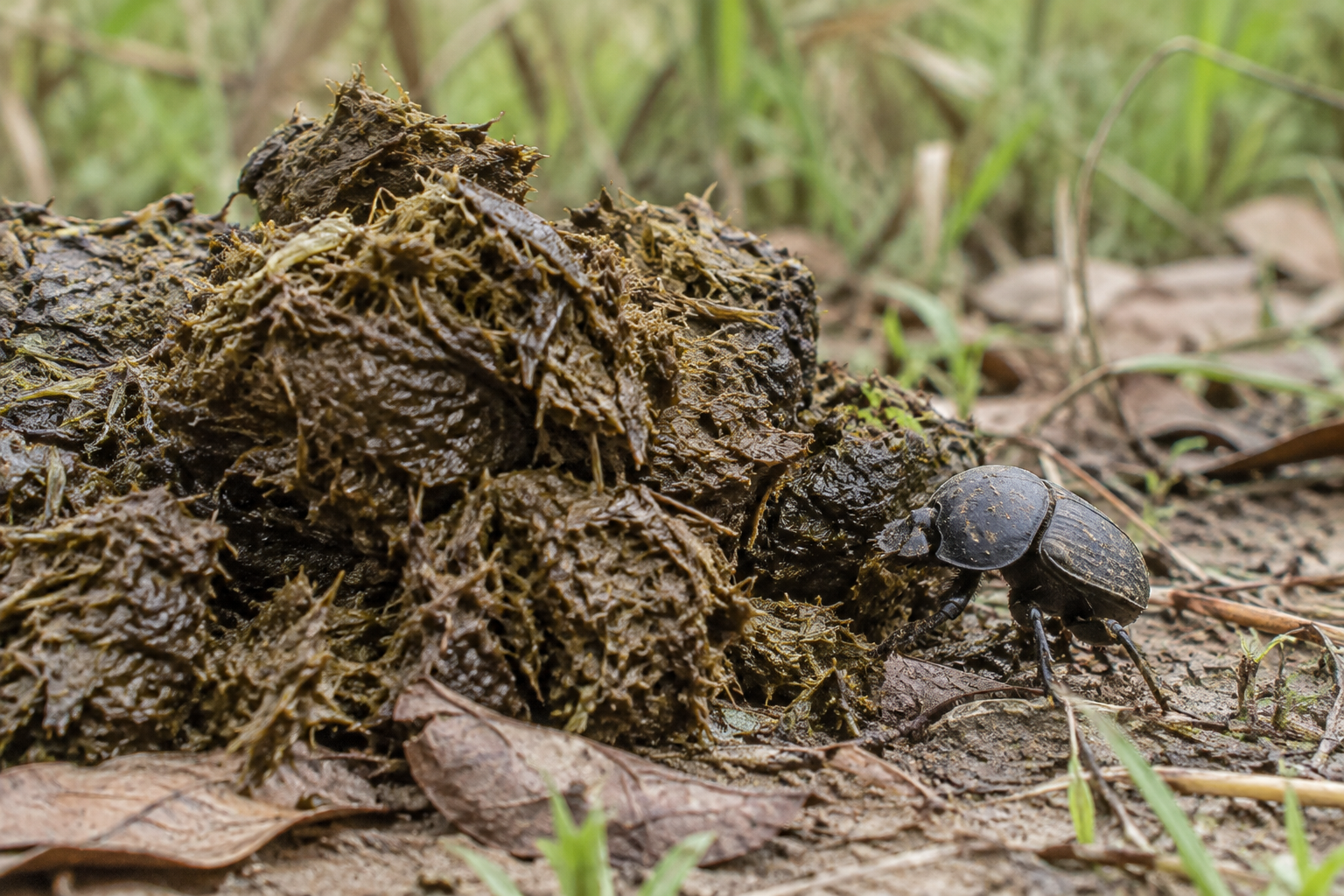
Rhino dung offers a short-lived resource for small organisms; its users change as the pile ages. · AI-generated illustration
Beside a rhino dung pile in Chitwan, the most useful view is the one closest to the ground. A heap that looks like waste from a safari vehicle becomes something more complicated when you notice its rough plant fibres, shaded folds and contact with the soil. Depending on its age and the weather, its surface may be moist or already forming a crust. The rhino has moved on. The question now is: who uses this material after it lands?
That question opens a food web that is easy to overlook in a landscape famous for large wildlife. Dung can provide food, shelter and a place to lay eggs. Organisms that feed on it may become meals for other animals. Microbes transform the material, while insects and other small creatures can move portions of it away from the original pile. These activities overlap rather than follow a tidy queue. A single deposit can hold several kinds of interaction at once.
This is the focus of rhino dung ecology in Chitwan: the life supported by a resource that arrives briefly, changes quickly and eventually loses its identity as a pile. The greater one-horned rhinoceros supplies that resource, but its biology is not the main subject here. Nor is this a guide to assessing rhino health from droppings, managing animal care or explaining forest regeneration. Our attention stays with the organisms that use dung and the feeding relationships that gather around them.
Not every visitor uses a pile in the same way. Some organisms consume dung directly; others use it during only part of their life cycle. Still others arrive to hunt the creatures attracted to it. An animal seen beside dung is therefore not automatically a dung feeder, and a beetle on its surface is not automatically burying it. Presence, feeding and breeding are different kinds of evidence. Keeping those distinctions clear makes this small habitat more interesting, not less: it replaces a simple list of visitors with questions about what each one actually does.
Place matters too. Chitwan includes riverine forest, grassland and other habitats where exposure, moisture and soil conditions vary. A pile in open sunlight may offer different conditions from one under cover. Rain can change its texture and moisture; drying can make its surface less accessible to some users. These are broader dung-ecology explanations, not proof that a particular response has been measured at every Chitwan site. They help identify what to look for without pretending that all deposits support the same community.
Throughout this article, documented findings from Chitwan will be distinguished from explanations drawn from wider dung research. A locally recorded insect can establish that the insect occurs there, but it does not, by itself, establish its relationship with rhino dung. Likewise, a feeding behaviour demonstrated elsewhere should not be presented as a confirmed observation from Chitwan. Where local evidence is limited, the useful approach is to say so and describe the broader process at the level the evidence supports.
There is also a practical boundary to this ground-level curiosity. A dung pile is not an invitation to leave an authorised route or approach a rhino. Visitors should follow their guide’s instructions, avoid handling dung and check locally about access rules. Much can be appreciated without disturbing the pile or its users. The aim is not to take apart every heap, but to recognise that something is happening there. After the large animal disappears from view, a smaller network of feeding, sheltering, hunting and decomposition can remain active beneath our notice. Following that network changes dung from an unremarkable roadside sight into a living ecological question.
A Fresh Deposit: What Makes Dung Usable?
A fresh rhino dropping is not simply a heap of waste. It is a moist mixture of partly digested plants, water and nutrients, with a structure that changes as soon as it reaches the ground. For anyone exploring rhino dung ecology Chitwan, this starting material helps explain why one deposit stays soft while another becomes a hard, dry mound.
Greater one-horned rhinos eat grasses and other vegetation. Their digestive systems extract nourishment, but the material they pass still contains plant fibres and nutrients. Broken stems, leaf fragments and coarse strands can remain visible. These pieces form an uneven framework: some parts are tightly packed, while others contain small gaps. What the animal has eaten affects the texture, so every dropping does not begin with exactly the same consistency.
Moisture makes a major difference. Water softens plant fragments and carries dissolved substances through the dung. A fresh deposit may look firm on the outside yet contain a much wetter centre. Its size, shape and degree of compaction influence how quickly that water escapes. A thick mound generally exposes less of its interior to the air than the same amount of material spread into a thin layer.
The remaining nutrients include nitrogen and phosphorus, alongside carbon held in plant material. However, these are not all immediately available in the same way. Some substances are dissolved in moisture; others remain bound within tough fibres. As the deposit weathers, its physical condition affects whether those materials stay concentrated in the pile, move into the soil below or wash onto surrounding ground.
In Chitwan’s mix of grassland, woodland and river-edge habitats, shade changes the conditions around a deposit. Beneath vegetation, reduced direct sunlight can slow water loss and keep the surface cooler. In an open patch, strong sun can warm and dry the exposed dung more quickly. Shade is not a guarantee of lasting moisture, though: airflow, soil dryness and the thickness of the pile also matter.
Temperature works together with moisture rather than acting alone. Warm conditions can speed evaporation, especially when the air is dry and moving. Cooler or more humid conditions may slow that loss. The centre and surface can therefore develop different conditions. An apparently dry dropping is not necessarily dry throughout, and a shaded deposit can still lose substantial water during a prolonged dry spell.
Rainfall can both preserve and disperse the resource. Gentle rain may rewet a drying surface, soften a crust and carry water into cracks. A heavy downpour can break loose fragments, flatten the pile or wash dissolved nutrients away. On sloping or flood-prone ground, flowing water may move material beyond the original deposit. Whether rain soaks in or runs off also depends on the underlying soil and its existing wetness.
As drying continues, a firmer outer layer may develop. This crust changes access to the softer material beneath: openings become concentrated around cracks, broken edges and places where the mound touches the ground. Shrinkage can split the surface and expose fresh interior faces. Drying therefore does more than remove water; it reshapes the deposit and changes the routes through which air and later rainfall can enter.
There is no single decomposition timetable that fits every rhino dropping in Chitwan. A sheltered mound, a sun-exposed pile and material scattered by rain begin similar journeys under different conditions. Even a familiar rhino dung site may contain older, dry material beside a fresh deposit. Looking closely at moisture, fibres, crust, shade and ground contact gives a more useful picture than judging age from appearance alone. Before following the food web, it helps to recognise this changing physical habitat.
Insects Turn Waste into Food and Nursery Space
A fresh rhino dropping can become both a feeding site and a nursery for insects. Dung-feeding beetles may use its moist material for food, while dung-breeding flies may lay eggs where their young can develop. These are potential users, not a guaranteed guest list. In Chitwan, the insects present will depend on the dung’s condition, surrounding habitat, weather and which species are active nearby.
For anyone exploring rhino dung ecology Chitwan, the important distinction is between an insect visiting a pile and one successfully raising young there. A beetle walking across the surface is not proof of breeding. Neither is a fly briefly landing. Feeding, egg laying and larval development each require closer observation.
Beetles: one resource, different ways of using it
Many adult dung beetles feed on the moist, fine material within dung rather than chewing through its toughest plant fibres. Their mouthparts help them separate usable particles from coarser remains. Rhino dung, with its partly digested vegetation, offers a mixture of textures. A damp interior may remain usable after the exposed surface begins to dry, although suitability differs among beetles.
Researchers commonly describe three broad dung-use strategies. These explain what beetles might do, but they are not a checklist of behaviours found in every rhino pile.
- Dwellers use the dung itself, or the zone immediately beneath it, as their living and breeding space. Eggs may be laid within the material, and larvae develop close to their food. Much of this activity can stay hidden inside a pile that looks quiet from above.
- Tunnellers dig below or near a deposit and move dung underground. Depending on the species, females place eggs with stored dung in brood chambers or prepared brood masses. The larvae then feed on that provision. Burial also moves organic material from the surface into the soil.
- Rollers shape portions of dung into balls and move them away from the original deposit. A ball may be used for feeding or prepared and buried for breeding. Where a brood ball is made, the developing larva feeds within its stored supply. Not every ball being rolled contains an egg.
Beetle young look very different from the adults: they are grubs, not miniature armoured beetles. After feeding and growing, a larva pupates before becoming an adult. The location of these stages depends on the species and its breeding strategy. Assigning a particular Chitwan beetle to one of these groups requires identification and evidence of its behaviour, rather than a guess based on size or colour.
Flies: the nursery may matter more than the visit
Some flies use dung chiefly as a place for their larvae to grow. Adults may take up liquid food from moist surfaces, but adult and larval diets do not always match. A fly attracted to a dropping might be feeding, searching for an egg-laying site or simply resting. Only some visitors are dung breeders.
In egg-laying dung-breeding flies, females place eggs in suitable moist material or protected crevices. After hatching, maggots feed within the dung, using decomposing organic matter and associated microorganisms according to their species. They grow through larval stages before pupating; some leave the feeding material and seek a more suitable place nearby. Successful development depends on conditions lasting long enough, not merely on the availability of fresh dung.
Drying, heavy rain, disturbance and competition can all alter this nursery. A crust may shelter moisture beneath it, while excessive drying can make exposed material unusable. Beetles removing dung may also change what remains available to fly larvae. Without local observations, however, there is no sound basis for naming a fixed arrival order. Each pile is a changing opportunity, not a predictable insect timetable.
The Hunters Around the Pile
For a hunter, the attraction of rhino dung is often not the dung itself but the animals gathering around it. Flies, beetles and their young can turn a deposit into a patch of concentrated prey. This adds another layer to rhino dung ecology Chitwan: plant material eaten by a rhino can support dung-feeding insects, which may then feed predators or support the development of parasitoids. Yet each link needs evidence. An animal beside a pile is not automatically part of its food web.
Predators Follow the Insects
In dung communities studied elsewhere, predatory beetles are among the hunters found within or beneath deposits. Some rove beetles and hister beetles hunt fly eggs and larvae, although feeding habits differ between species. The soft, sheltered spaces where maggots develop can therefore become hunting grounds. A beetle feeding on those maggots is using dung indirectly: its meal is an animal that has used the deposit as food or nursery space.
Hunting can also happen at the edges. Ants may capture exposed insects, while spiders can intercept visitors on nearby ground or vegetation. These are general possibilities, not confirmed records of particular species hunting at rhino dung in Chitwan. A spider beside a deposit might be catching insects attracted to it, or simply occupying a good hunting position that would be useful even without the dung.
The prey’s life stage matters too. Eggs and young larvae offer different opportunities from mobile adults. As fly larvae mature, some leave their feeding material to pupate in nearby soil. Hunters may therefore exploit a wider area than the visible pile. To follow the feeding links properly, an observer needs to look beyond its surface without disturbing the surrounding ground.
Parasitoids Use a Host, Not Just a Meal
Parasitoids add a less visible link. Unlike a predator, which typically kills and consumes several prey during its life, a parasitoid develops in or on a host and eventually kills it. Among dung-associated insects, certain small wasps attack the immature stages of flies. In some well-studied systems, a female wasp places an egg in a fly puparium—the hardened case enclosing the developing fly—and her offspring develops using the host.
That example explains a mechanism, not a verified Chitwan pairing. Naming a local wasp and its fly host would require reliable identification and evidence connecting them, such as a wasp reared from a collected host. Seeing a tiny wasp land on rhino dung cannot establish what it attacks, whether it lays eggs there, or whether it depends on that habitat.
Dependence Is Different from Opportunity
The most useful distinction is between animals that require dung-associated resources and those that merely take advantage of them. Even a regular visitor may use livestock dung, other wildlife dung or entirely different habitats. Dependence on dung does not necessarily mean dependence on rhino dung.
- A close association: a hunter or parasitoid repeatedly uses insects that breed in dung. Its connection is indirect but potentially important to its life cycle.
- An opportunistic visit: a generalist predator takes available prey near a pile but also hunts across many other habitats.
- An unproven connection: an animal rests, shelters or passes nearby, with no observed feeding or host use.
These distinctions keep the story accurate. Dung supplies food directly to some organisms and brings prey or hosts within reach of others. Predators and parasitoids can affect how many dung-associated insects survive, but their presence alone does not show how strongly they influence decomposition. In Chitwan, the careful question is therefore not simply “What visits rhino dung?” but “What feeds on what, and how do we know?”
Microbes and the Slow Disappearance of the Remains
After the most obvious insect activity fades, a rhino dung pile may still hold coarse grass fibres, softened plant fragments and a drying outer crust. These remains are not simply waiting to disappear. Bacteria and fungi are already using them, and have been active while insects fed, dug and bred in the same deposit. In rhino dung ecology Chitwan, visible animal activity and microscopic decomposition overlap rather than follow a fixed timetable.
Fresh dung carries microbes from the rhino’s digestive system, while soil, air, rain and visiting animals provide other possible sources. Conditions outside the animal differ sharply from those inside its gut, so not all microbes remain equally active. Oxygen, moisture and temperature help determine which organisms can grow. Even within one pile, the exposed surface and damp interior can offer different working conditions.
Bacteria and fungi help turn complex organic matter into smaller, usable compounds. Many release enzymes that act outside their cells, breaking down substances in the dung. The microbes then absorb suitable products to support growth and maintenance. Some compounds are readily available, while tough plant structures require more processing. Cellulose and other components of plant cell walls can therefore remain after easier food sources have been used.
Fungi are especially useful to picture because many grow as fine threads called hyphae. These can spread through suitable patches of dung and reach plant fragments. Some fungi can attack resistant plant material, although their abilities vary widely. Bacteria also contribute to the breakdown of plant residues and simpler compounds. It would be misleading to assign each group one exclusive job: their activities overlap, and the community changes with local conditions.
Fragmentation makes this work easier without being the same thing as decomposition. Chewing insects, burrowing animals, trampling and repeated wetting and drying can divide a deposit into smaller pieces. This exposes more surface for microbial activity and may bring fragments into closer contact with soil. A fibre broken in two is still a fibre, however. Its chemical breakdown depends on further biological processing, not just its reduced size.
As microbes consume organic matter, part of its carbon becomes microbial cells and part is released through respiration, commonly as carbon dioxide where oxygen is available. Nutrients held in organic compounds can also be released into forms that other organisms can use. But this is not a simple, immediate release of everything in the pile. Growing microbes temporarily hold nutrients in their own bodies; later, grazing, death and further decomposition move that material onward.
The surrounding soil receives material by several routes. Rain can carry dissolved compounds out of dung and wash fine particles into nearby ground. Animals may bury or mix fragments with soil, while material already touching the ground is processed at that boundary. Microbial cells, their products and partly decomposed residues can all become part of soil organic matter. Some are consumed again quickly; others persist longer, especially when protected within soil aggregates or associated with mineral surfaces.
In Chitwan, seasonal changes in moisture help shape this process, but wetter does not always mean faster. Moderate moisture supports microbial activity, whereas drying can slow it and waterlogging can restrict oxygen. Shade, contact with the ground and the makeup of the dung also matter. A crusted pile may look unchanged while processing continues in moist pockets beneath it. Conversely, a deposit scattered by heavy rain may vanish from view without being fully decomposed. Disappearance is therefore not one event: it is an uneven combination of breakdown, consumption and movement into nearby soil, with several processes operating together. Following those pathways reveals more than simply recording when a pile can no longer be seen.
How Researchers Follow the Dung Food Web
Studying rhino dung ecology Chitwan means tracking more than how quickly a pile shrinks. Researchers need to ask what arrives, what feeds, what leaves and where the material goes. The methods below are illustrative approaches, not a description of a verified Chitwan study. Any fieldwork must follow protected-area requirements: check locally for research permissions, sampling rules and guidance on working safely around rhinos.
Start with deposits of known age
A useful study begins with dung whose deposition time is known, ideally recorded through safe, permitted observation without approaching or disturbing the animal. Researchers can mark the location, photograph the deposit and record shade, ground conditions, recent rain and signs of disturbance. If the exact time is uncertain, that uncertainty belongs in the records rather than being replaced with a guessed age.
Repeated visits then reveal a sequence: insects arriving, tunnels appearing, surfaces cracking or fungal growth becoming visible. Observations should follow a consistent schedule and method. Several deposits across different conditions are needed because one shaded pile cannot represent an entire floodplain. Rhino dung sites may receive fresh additions, so researchers must distinguish the original deposit from later material.
Identify visitors and test their roles
Timed visual counts can document surface activity, while carefully limited samples may reveal insects hidden within dung or beneath it. Different methods capture different communities: watching the surface alone misses buried larvae, while traps may favour mobile adults. Researchers should record sampling effort and avoid removing so much material that their observations alter the habitat they are trying to measure.
Identification may require microscopes, reference collections or specialist help. DNA-based identification can sometimes support this work, but depends on suitable reference data. Finding an insect on dung does not establish that it eats dung. Observations of feeding, brood chambers or prey capture help distinguish dung feeders, breeders, predators and incidental visitors.
Look beyond visible organisms
Fungal and microbial work can compare small samples from the crust, moist centre and underlying soil. Microscopy, culture methods and DNA analysis reveal different parts of this community; no single method finds everything. Clean tools, appropriate storage and contamination controls matter because soil or handling can introduce organisms into samples.
DNA can show which organisms are present, but presence alone does not demonstrate active decomposition. Measurements of respiration or enzyme activity can offer evidence of biological processes, although these also need careful interpretation. For example, carbon dioxide measured around a deposit may include contributions from the soil below it. Suitable controls help separate those sources.
Separate drying, removal and decomposition
Moisture-corrected mass measurements are essential. A deposit can become much lighter simply because water evaporates. Researchers can weigh representative subsamples fresh, dry them to constant mass under a defined laboratory protocol, and use their dry-matter fraction to estimate the dry mass of the material being measured. Destructive sampling may require separate, comparable deposits for each sampling time.
Even a decline in dry mass does not prove decomposition. Beetles may bury dung, rain may wash particles away, and animals may scatter it. Dissolved substances can also move into soil. Researchers therefore combine mass records with checks for burial, fragments and movement beyond the original pile.
Controlled access experiments can help identify causes. Comparable dung portions might remain open or sit beneath mesh that excludes selected visitors. Mesh can also change shade, airflow and moisture, so partial-cover controls and microclimate measurements are important. Random allocation and replication strengthen comparisons. Together, these methods distinguish material disappearing from view from material being transported, consumed or broken down biologically—a much more informative account of the food web.
Conclusion: A Small Habitat Worth Noticing
A rhino dung pile in Chitwan may look like something to step around and forget. Yet it is also a temporary habitat: a small patch of food, moisture and shelter that changes as it ages. Its importance lies not only in what it contains, but in the relationships it makes possible. Animals feeding, breeding or hunting around it, together with organisms breaking down its remains, connect an ordinary deposit to the wider landscape.
This is the broader lesson of rhino dung ecology Chitwan: waste does not sit outside nature’s useful work. What leaves one animal’s body becomes available to other life. Some relationships are easy to notice, such as an insect landing on the surface. Others happen underneath, within the dung or at a scale we cannot see unaided. The visible pile is only part of the habitat, and a brief look reveals only a moment in its changing life.
That perspective adds something valuable to wildlife watching in Chitwan. A rhino is remarkable in its own right, but its ecological presence extends beyond the animal we photograph. Feeding, moving and depositing dung create opportunities for other organisms. Noticing these links does not make a dung pile more important than the surrounding grassland, forest or wetland. It helps us see that the landscape works through connections, including small ones that rarely become the focus of a safari.
There are still local questions worth asking. Which organisms use rhino dung in different parts of Chitwan? How does that community change between wet and dry conditions, or between shaded and exposed ground? Which visitors are feeding, which are breeding, and which are simply passing through? Those questions cannot be answered reliably by treating every insect near a pile as a dung specialist, or by assuming findings from another place apply here unchanged.
A complete inventory should not be claimed without the local evidence to support it. Even identifying a visitor does not automatically explain its role. Likewise, finding few visible insects during one visit does not show that a pile has little ecological value. Weather, timing and the condition of the deposit can affect what an observer sees. Careful uncertainty is part of understanding this habitat, not a reason to dismiss it.
For visitors, the most useful response is curiosity with restraint. Watching should not change the small habitat being watched, or create a risky encounter with the animal that produced it. A few simple practices keep that interest low-impact:
- Keep your distance from wildlife. Never approach a rhino to examine nearby dung, and do not use a deposit as a reason to follow an animal. Let your guide decide whether stopping is appropriate.
- Leave dung undisturbed. Do not poke, turn, spread or collect it. Opening a pile may expose organisms and alter the shelter and moisture they depend on.
- Follow guide and park instructions. Stay within permitted routes and activities. Access rules and conditions can change; check locally rather than assuming independent exploration is allowed.
- Observe without arranging the scene. If a safe, permitted stop is possible, use binoculars or a camera’s zoom. Do not move dung or its visitors for a clearer photograph.
You do not need to name every organism to notice something meaningful. From an approved viewing position, you might see an arrival, a departure or a brief interaction, while accepting that much remains hidden. That is enough to shift the story from “waste on the ground” to a living set of relationships. In Chitwan, a small habitat worth noticing is also one worth leaving intact.