Travel & Conservation
When Safari Vehicles Crowd a Sighting: Who Sets the Limits in Chitwan?
EverestBlog AI · Oct 31, 2026 · 11 min read
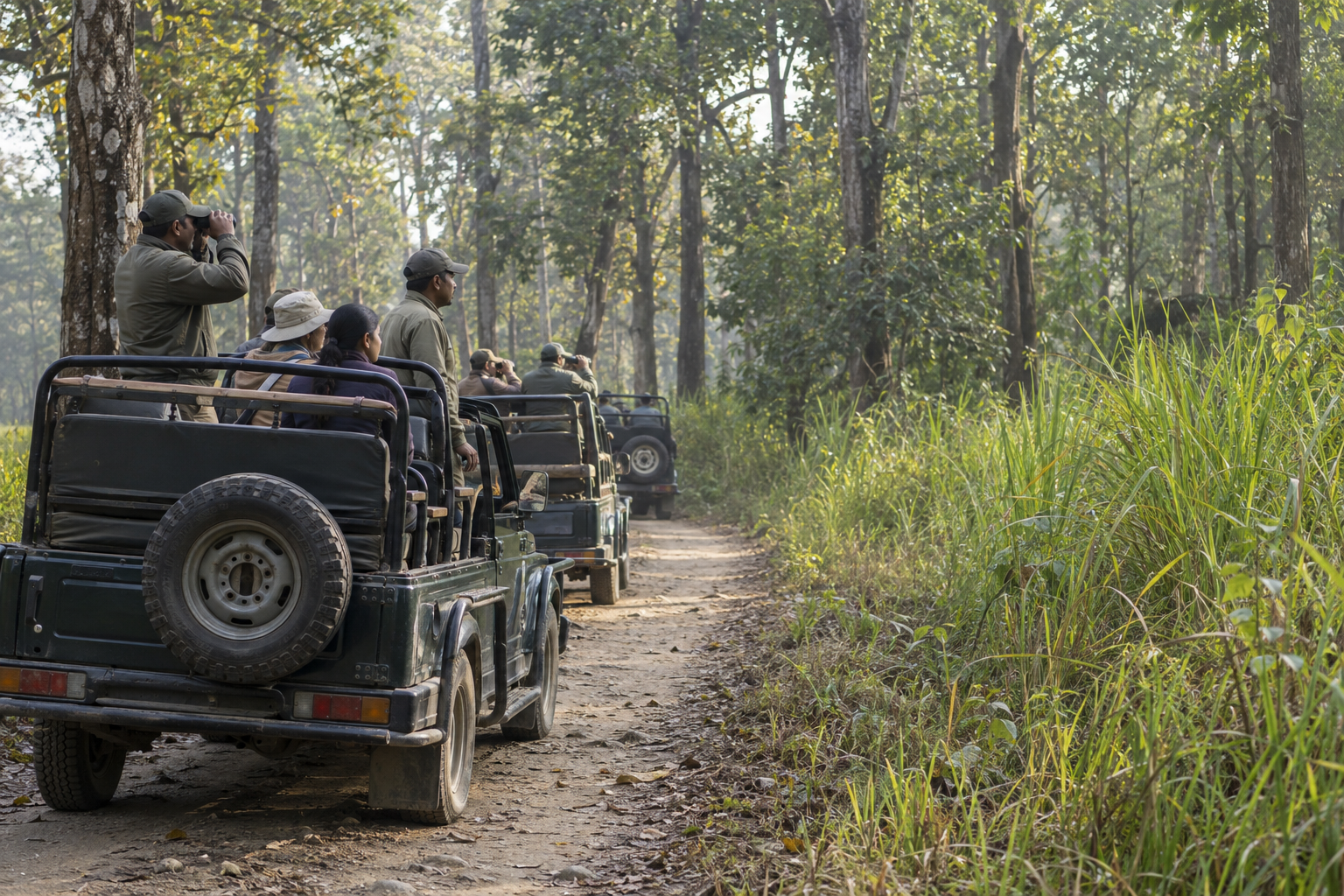
A shared wildlife sighting raises questions about vehicle spacing, waiting turns and who has authority to move vehicles on. · AI-generated illustration
A wildlife sighting can become a shared-space problem when several safari vehicles seek a view of the same animal. Each group wants a clear look, but the animal needs space to feed, rest or move away. A vehicle that stops for one group may narrow the route available to another. If more vehicles arrive, a brief pause can turn into a gathering. The central issue is not simply whether visitors get close enough to see: it is whether their presence leaves wildlife with a genuine choice about where to go.
In Chitwan, that dilemma raises a practical question: who sets the limits at a sighting, and who makes sure those limits are respected? Visitors may hear instructions from a guide or driver, while park authorities hold a wider responsibility for managing access and protecting wildlife. Yet a general duty to behave responsibly does not, by itself, explain who should tell an arriving vehicle to wait, ask a stopped vehicle to move on, or end a gathering that is becoming too crowded.
Understanding Chitwan safari wildlife viewing rules therefore means looking beyond a list of visitor dos and don’ts. It means asking how written requirements translate into decisions on a forest road. Does a published rule address crowding directly, or does it set broader expectations about disturbance and conduct? Is there a clear instruction for situations involving several vehicles? If someone decides that the animal needs more room, what authority supports that decision? These questions matter because a rule is only useful at a busy sighting if people know how to apply it.
Vehicle numbers are only one part of the problem. Position, distance, noise and the length of a stop also shape the pressure around an animal. Even a small gathering can be poorly placed if it blocks a possible crossing or closes off an escape route. Conversely, counting vehicles alone cannot establish whether a particular arrangement is acceptable. The important point is to examine what limits protect, rather than assume that a good view and responsible viewing are automatically the same thing.
There is also a human coordination problem. One driver may be ready to leave while another is still approaching. A guide may recognise a reason to pull back, while passengers may not understand why their viewing time should end. Without a shared understanding of who directs the situation, restraint can depend on individual judgement rather than a consistent process. That makes clear communication important: visitors should know whose instructions to follow, and those giving instructions should be able to explain the basis for them.
This investigation separates what published rules require from what people report happening in practice. It does not assume that every crowded sighting involves a breach, or that an unwritten habit has the force of a park rule. The aim is to identify where authority is clear, where decisions rely on discretion, and where accountability needs closer scrutiny. For visitors, the useful starting point is simple: ask how shared sightings are managed, not only where a vehicle can go. Current operating instructions can change, so check locally with park officials and your safari operator before entering the park.
What the Published Rules Actually Require
The key question behind Chitwan safari wildlife viewing rules is not simply whether visitors should behave responsibly. It is whether an official instruction tells drivers how to manage a crowded sighting—and identifies who can enforce it. General wildlife protection duties matter, but they do not establish a specific vehicle cap, viewing distance or waiting time unless an applicable rule says so.
Start with the official source
The first places to check are the Chitwan National Park office and the Department of National Parks and Wildlife Conservation (DNPWC). Relevant documents include visitor regulations, dated park notices, permit conditions and official instructions issued to safari operators. Notices displayed at entry points may also matter, particularly when access changes. Ask for the actual notice rather than relying only on a guide’s summary.
Nepal’s National Parks and Wildlife Conservation Act, 2029 (1973) provides the national legal framework for protected areas. Its year is not evidence that a particular safari traffic rule has remained unchanged since then. Any claim about current sighting limits needs the applicable regulations or a later, valid park instruction.
Verification limit: current signed Chitwan notices and operating instructions were not available for inspection for this section. Their issue dates, continuing validity and numerical requirements therefore cannot be confirmed here. That is a gap in verification—not evidence that no limits exist.
Five requirements that need a direct check
- Minimum spacing: look separately for distance between vehicles and distance from wildlife. A general instruction not to disturb animals does not, by itself, establish a measurable minimum distance.
- Vehicle caps: distinguish a daily entry quota from a limit at one sighting. A restricted number of safari permits does not necessarily answer how many vehicles may gather around one animal.
- Waiting and viewing limits: check whether instructions control queueing time, time beside an animal, or both. Confirm whether any limit applies universally or only to particular routes or situations.
- Overtaking: seek an explicit instruction covering passing on safari tracks and moving ahead of vehicles already watching wildlife. Do not turn a driver’s preferred practice into a park-wide prohibition.
- Animal routes: check for wording requiring vehicles to leave crossings, escape paths or travel routes open. Responsible viewing should avoid surrounding or trapping wildlife, but that advice must not be presented as a verified local clause.
Record scope and enforcement responsibility
For every document, record its title, issuing authority, issue or revision date, and geographic scope. Does it cover the national park, a specified entry route, or a buffer-zone community forest? Rules governing one area should not automatically be applied to another. An undated photograph or screenshot needs confirmation from the issuing office before being described as current.
Formal park enforcement rests with officials empowered under Nepal’s protected-area law, including the park’s chief conservation officer and authorised personnel—not an operator simply because it runs safaris. Which personnel can issue directions or penalties in a particular situation requires confirmation from the applicable legal provision or official instruction.
Label operator policies and voluntary guidance separately from mandatory rules. Before travelling, check locally with the relevant park or entry office for current route access, closures, permit conditions and any updated viewing instructions.
Reported Practice: Who Makes the Call at a Sighting?
At a crowded wildlife sighting, the important question is not simply who speaks loudest. It is whose instruction carries authority—and whether other vehicles follow it. For Chitwan safari wildlife viewing rules, published requirements and roadside decisions need separate evidence. No dated field notes, interviews or responses to specific allegations were supplied for this section, so it would be misleading to name an operator, describe a confrontation or claim that crowding is routine.
Queues, spacing and waiting time
Each verified requirement should be compared with an account that records what actually happened. Where a rule concerns distance, vehicle movement or disturbance, “there were too many jeeps” is not enough. A useful visitor observation identifies the date, location, number of vehicles visible, their arrangement and whether an animal’s route remained open. If distance was estimated rather than measured, that limitation belongs in the account.
Queues also need context. Vehicles waiting behind one another on a track are not necessarily surrounding wildlife. Conversely, a short line can still obstruct an animal’s movement. Reports should distinguish vehicles arriving, stopping briefly, parking alongside others and trying to overtake. Stationary time should come from a timed observation where possible; a visitor’s later impression that a stop “lasted ages” is recollection, not a measured duration.
An animal approaching a stationary vehicle presents another distinction. A smaller gap does not, by itself, establish that the driver moved closer. A reliable account records the sequence: where the vehicle stopped, how the animal moved, whether an exit remained available and what the driver did next. Any comparison must use the actual wording of the applicable requirement, not an assumed universal distance.
Who can tell another vehicle to move?
A guide asking another driver to reverse is not proof that the guide has authority over that vehicle. Reporting must distinguish formal authority, responsibility within one vehicle and informal cooperation. Whether a guide can issue binding directions to another vehicle requires confirmation from the park, with the relevant rule or operating condition identified. Current arrangements may change; check locally.
Accounts from guides and drivers should be attributed separately. A guide may explain a request to leave space; the other driver may describe limited reversing room or an instruction from someone else. Park staff should clarify who can intervene, how visitors or crews can contact them and how competing instructions are resolved. Without those responses, an apparent disagreement remains an incomplete account—not evidence of a settled enforcement practice.
Commercial pressure needs evidence, too
Operators can explain scheduling, guest expectations and their instructions to crews, but financial pressure should not be inferred merely because several paying groups want the same sighting. A claim that a driver stayed longer to satisfy guests needs attribution and, where possible, supporting evidence. Ask whether staff can end a sighting despite passenger objections and whether complaints about missed photographs influence their decisions.
Before publishing an allegation, give the named guide, driver or operator—and relevant park staff—the specific conduct, date and location, then seek a response. Identify direct observation, recollection and disputed claims clearly. One documented incident can reveal a problem worth investigating; it cannot establish how Chitwan safaris usually operate.
Conclusion: Clear Authority, Accountable Viewing
Accountability at a crowded wildlife sighting depends on more than whether rules exist. It depends on whether someone recognises a problem, makes a decision and follows through. The central distinction is between the park’s authority to set and enforce conditions for safari activity and the decisions made by the people running each trip. Those responsibilities are connected, but they are not interchangeable. A visitor should not have to guess who can turn a general obligation into action beside an animal.
The investigation’s conclusion must remain narrower than a claim that every crowded stop has a clearly designated controller. Published requirements and accounts of practice cannot, by themselves, establish that one person always directs all vehicles at a sighting. Nor does an orderly encounter prove that a consistent coordination system exists. The unresolved issue is how authority works across vehicles: who takes the lead, how others receive that decision and what happens when they disagree.
That distinction matters when interpreting Chitwan safari wildlife viewing rules. A rule can establish an obligation without explaining every operational decision needed to fulfil it. Equally, a guide’s or driver’s sensible choice does not automatically amount to a park-wide requirement. Where the evidence does not establish a shared procedure, the honest conclusion is that the procedure remains unclear—not that no responsibility exists, or that every operator behaves in the same way.
Responsibility also should not disappear into the phrase “everyone’s duty.” The operator is the visitor’s practical point of contact before departure and after a concern arises. The guide and driver are the people visitors can ask about immediate decisions during the trip. Questions about formal enforcement belong with the relevant park authority. These are distinct points of contact, not proof that any one of them has been assigned control of every crowded encounter. Current reporting contacts and arrangements may change; check locally.
Any call for a named lead at congested stops, a shared departure procedure or a clearer reporting route should therefore be labelled as a proposed improvement, unless an applicable published requirement already establishes it. Such proposals could make decisions easier to understand and review. They should not be presented as powers that guides already hold or procedures that every safari must already follow. Clearer arrangements would also need to explain how decisions are communicated between separate vehicles, rather than placing the burden on visitors to negotiate.
For travellers, a worthwhile safari is not measured only by how long a vehicle remains beside an animal. Leaving a crowded sighting can be a responsible outcome, even when it means losing a photograph or ending a promising encounter. An operator willing to explain that choice offers something more useful than a promise of unrestricted viewing: an indication that restraint is part of the trip. Visitors can support that approach by asking for clarity before departure, rather than pressing staff to stay once crowding develops.
- Who manages a crowded stop? Who makes our vehicle’s decision, and how will staff coordinate with other vehicles?
- When will the vehicle leave? What circumstances will prompt us to move away, even if others remain?
- How can a concern be reported? Who should receive it, what details are useful, and how can we request a response?