
Wildlife & Conservation
What Is Growing Over Chitwan’s Wetlands? Investigating Invasive-Plant Removal
EverestBlog AI · Oct 31, 2026 · 16 min read
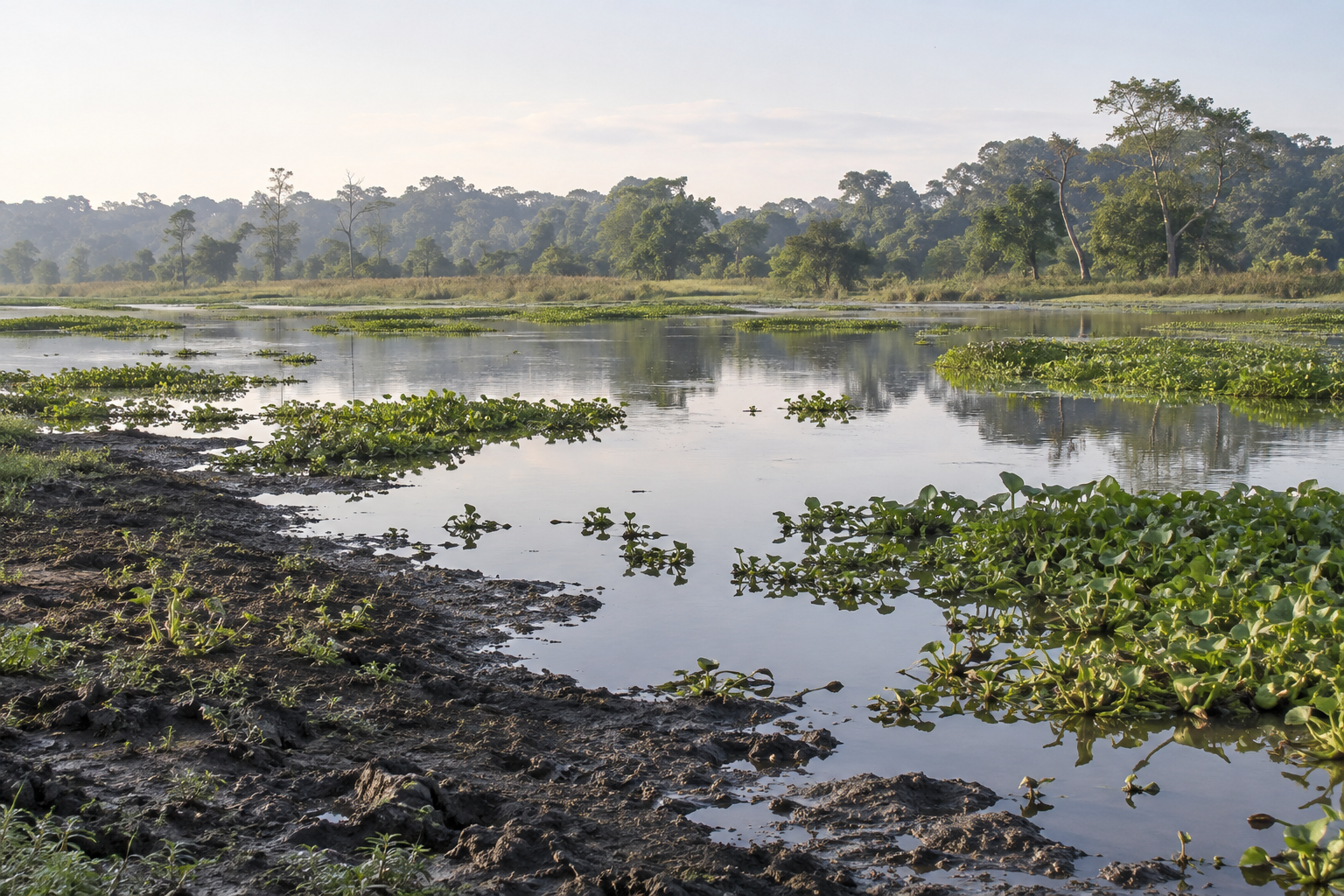
Vegetation cover alone does not establish an invasion: plant identification and local evidence must guide decisions about wetland clearance. · AI-generated illustration
A wetland can look wonderfully green and still be losing some of the habitat that wildlife needs. Floating leaves may cover water where birds once fed, while dense vegetation can narrow the boundary between a lake and its marshy edges. Yet greenery alone proves little. Native wetland plants also form thick stands, and seasonal growth is part of a living lake. An investigation into Chitwan wetland invasive plants must therefore begin with records and identification, not with the assumption that every crowded patch needs clearing.
Beeshazar and Associated Lakes, a Ramsar-listed wetland complex in Chitwan’s buffer-zone landscape, provides a documented starting point. Ramsar site information and wetland management documents identify invasive aquatic vegetation, including water hyacinth, as a concern and describe vegetation control within the management response. That recorded connection between a named wetland, invasive growth and management is why Beeshazar belongs in this investigation. It is not being selected simply because a photograph shows a green lake. The location and timing of current removal work, however, need confirmation: check locally.
That distinction matters. A management document can establish that a problem has been recognised, but it cannot tell us what a particular inlet looks like today. Nor does a plan to control plants prove that work happened, reached the intended area or improved habitat. Before describing any recent operation, reporting should connect the paperwork to a specific lake or shoreline, a responsible organisation and a record of work. Where those links are missing, the gap should remain visible rather than being filled with an appealing story.
The central question is not simply, “How much vegetation was removed?” It is who decides what to remove, on what evidence, and for whose benefit? Park authorities, wetland managers, community groups and people carrying out the work may have different responsibilities. Those roles should be established rather than assumed. A worker pulling plants from the water may not have chosen the species, the site or the schedule. Likewise, people who use or watch the wetland may notice changes that do not appear in a brief completion report.
The second question is what would count as success. An open patch of water immediately after clearance is evidence of removal, not necessarily recovery. A stronger result would be a lasting reduction in the target invasive plant alongside conditions that support native vegetation and wetland wildlife. Even that requires care: some animals need open water, while others depend on sheltered, vegetated margins. The useful comparison is not “green versus clear”, but whether the work protects a varied wetland without replacing one habitat problem with another.
Wildlife gives this inquiry its purpose, but it also demands restraint. Waterbirds, fish, turtles and aquatic invertebrates use different parts of a wetland, and their responses may not be immediate or easy to see. A bird feeding beside a cleared area makes an interesting observation; it does not, by itself, establish that removal improved the bird’s habitat. Seasonal water levels, weather and disturbance can also change what an observer finds. Claims of benefit need evidence that goes beyond a single visit or a dramatic before-and-after image.
This investigation stays with wetland vegetation, removal decisions and wildlife habitat. It does not attempt to resolve river-water allocation or sal-forest regeneration, which involve different evidence and management questions. At Beeshazar, the task is narrower and more practical: establish what unwanted plants are recorded, understand the authority and reasoning behind intervention, and ask whether its results can be demonstrated. For visitors, that means looking beyond a tidy shoreline. For readers, it means distinguishing a documented management effort from a proven ecological improvement. The aim is neither to praise clearance automatically nor to oppose it on sight, but to find out when removing plants genuinely helps a Chitwan wetland remain a living habitat.
Identify the Plants Before Calling Them Invasive
A mat of floating leaves or a dense fringe of reeds can look worrying, but appearance alone does not establish an invasion. Investigating Chitwan wetland invasive plants starts with two separate questions: what is growing here, and what evidence supports calling it invasive? A plant may be native, introduced without documented invasive behaviour, or too poorly identified to classify. Seasonal growth can also change a wetland’s appearance without signalling a new ecological threat.
Begin with a clearly defined wetland
Record the focal wetland’s name, location and boundaries before collecting plant claims. Note alternative local names and whether a document refers to the open water, surrounding marsh, nearby grassland or a wider management area. These distinctions matter: a species recorded beside a road or in another lake elsewhere in Chitwan is not automatically present at this wetland.
Build a simple evidence file using management plans, vegetation surveys, removal logs and relevant research. For each source, record who produced it, when observations were made, where sampling occurred and how plants were identified. A publication date is not necessarily the date of a field observation. Older records can establish past presence, but they cannot confirm that a plant remains there today.
- Management records: Look for species lists, mapped patches, survey notes and photographs attached to work reports. A general reference to “weeds” does not identify a species.
- Research: Read study methods and site descriptions, not just titles or summaries. Check whether the focal wetland was actually surveyed and whether records have precise locations.
- Field evidence: Keep dated photographs and location notes linked to individual observations, rather than a loose collection of pictures labelled “Chitwan.”
Make photographs useful for identification
A wide photograph shows the extent and setting of a patch, but usually not the features needed for identification. Add closer images of leaves, stems, flowers and fruits where available. Photograph leaf arrangement and the point where a leaf joins the stem. Include a size reference without damaging the plant. Record whether it is floating freely, rooted in shallow water or growing on exposed ground.
Take photographs from safe, permitted access points. Wetland margins can be unstable, and wildlife deserves distance. Do not enter restricted areas or collect specimens without permission. If photographs are insufficient, ask the responsible management authority and a qualified botanist whether an authorised specimen is needed. Plant-identification apps and informal suggestions can provide leads, but should not be treated as final confirmation.
Separate identity from invasive status
Ask a botanist with relevant regional or aquatic-plant expertise to review the evidence. Keep their identification, its date and any limitations with the observation. When possible, link it to a properly documented specimen or an established botanical reference. Scientific names should be checked for synonyms so that older and newer records are not mistaken for different plants.
Then assess status separately. Non-native does not automatically mean invasive. Establish whether reliable sources describe the species as introduced to the relevant region and invasive there. Evidence of spread and ecological effects strengthens an invasion claim; abundant cover in one photograph does not. Equally, a native plant can form dense stands or obstruct access without becoming a non-native invader.
Season also matters. Falling water can expose mud where plants germinate, while changing water levels can concentrate floating vegetation. Compare observations from similar seasons where records allow. A larger visible patch may reflect water conditions, viewing angle or survey coverage rather than expansion.
Finally, label uncertainty plainly: “confirmed native,” “confirmed non-native; invasive status unresolved,” or “identity unconfirmed,” as appropriate. Name a species in this investigation only when its presence at the focal wetland is documented. Records from elsewhere in Chitwan offer context and clues for a survey, not proof. Where sources disagree, explain the disagreement rather than selecting the most dramatic label.
How Managers Decide Whether and When to Remove Plants
Deciding whether to remove Chitwan wetland invasive plants means weighing ecological harm against the disturbance that removal may cause. Dense growth alone is not enough to justify clearing. Ask the responsible manager what problem the work is intended to solve: slowing a spreading plant, reopening shallow feeding areas, restoring water movement or maintaining access. Each aim needs evidence, and each may call for a different response.
Ask What Triggers Action
Interview the person responsible for the wetland alongside staff who inspect it regularly. Ask them to describe the latest removal decision and show the observations behind it. Was the plant expanding into new areas, returning after earlier work or blocking a channel? Photographs taken from fixed points, mapped patches and dated field notes can support an explanation. A general statement that a wetland looks “overgrown” cannot establish either the cause or the need for intervention.
- Spread: Is the affected area increasing, and over what observation period? Has growth reached previously unaffected pools or connecting waterways?
- Blocked habitat: Which feeding, resting or breeding areas have become less accessible, and to which animals?
- Wildlife use: What animals use the vegetation itself? Could clearing remove shelter or disturb active nests?
- Practical limits: Can workers reach the patch safely, remove material without spreading it and return for follow-up?
Keep observed effects separate from assumptions. If staff report fewer birds, ask whether comparable counts exist and whether water levels or disturbance also changed. If a channel is blocked, establish whether plants, sediment or both are responsible. The question is not simply whether an unwanted plant is present, but whether the proposed work addresses a demonstrated problem.
Include People Who Use the Wetland
Speak separately with local wetland users, such as people with authorised fishing, fodder collection or other access, where applicable. Their repeated visits may reveal changes that occasional inspections miss: a passage closing, floating vegetation shifting after rain or a cleared patch quickly filling again. Ask where and when they noticed each change, rather than treating every recollection as a measured trend.
Local views may differ. One person may want open water for access, while another values vegetation used by fish or other wildlife. Record these differences without assuming that either preference settles the ecological question. Ask whether users were consulted before work was planned, whether their concerns changed the proposal and how they can report damage or regrowth afterward.
Confirm Authority and Compare Alternatives
Establish who manages the particular wetland, who approves intervention and who carries it out. A team doing the cutting is not necessarily authorised to decide its extent. Request the relevant approval, management plan or work order, where available. For current responsibilities, work schedules and access arrangements, check locally; arrangements may differ between sites and management jurisdictions.
Ask which alternatives were considered: targeted removal of expanding edges, staged clearing, repeated small interventions, addressing a continuing source of plant introduction or leaving vegetation in place while monitoring it. Doing nothing immediately can be a reasoned choice if identification remains uncertain, wildlife is actively using the patch or likely disturbance outweighs the expected benefit. Equally, postponement needs a review point if spread is continuing.
Distinguish Policy from Practice and Timing
Separate written criteria from informal practice. Does a plan specify priority habitats, wildlife safeguards or conditions for stopping work? Or do teams act mainly when labour, funding and access become available? Both shape decisions, but describe them accurately. An interview explanation is not evidence of a written rule.
Finally, ask how timing accounts for water levels, monsoon access, breeding wildlife and the target plant’s growth cycle. Check what inspection occurs before work and who can postpone it. A useful account explains not just why removal was approved, but why that method and season were chosen.
Follow the Removal Work and Test Its Results
To investigate removal of Chitwan wetland invasive plants, follow the work from the first cut to the next growing season. A cleared patch or a photograph of workers proves little about the operation’s extent or lasting effects. The key questions are what was removed, how it was handled, what happened afterwards, and whether monitoring supports the claimed result.
Establish What Actually Happened
Start with work records held by the organisation responsible for the site. Depending on the wetland, these may include park staff, buffer-zone groups, community forest committees or project partners. Request dated work logs, mapped treatment areas, contractor reports and photographs with identifiable locations. Separate planned activities from completed work: a proposal or budget allocation does not establish that removal occurred.
Field reporting should test those records. Visit the treatment area with someone who supervised the operation, then speak separately with workers and nearby wetland users. Ask them to identify the boundaries and explain any gaps between the plan and the work. If accounts differ, report the uncertainty rather than combining them into a confident narrative.
- Removal method: Record whether plants were pulled, cut, lifted mechanically or treated by another method. Note whether roots or submerged parts remained.
- Biomass handling: Establish where removed material went, how it was transported, and whether floods or drainage could carry it back into water.
- Follow-up: Check whether teams returned to collect fragments, remove new growth or inspect disposal sites. Seek records of completed visits, not just promises.
Trace Risks Along the Removal Route
Removing unwanted vegetation can also disturb a wetland. Workers or machinery may damage banks, stir sediment or disrupt animals using dense cover. Mixed stands create another risk: native plants may be pulled out with the target species. For plants capable of growing from fragments, cutting and transport can spread viable pieces into untreated areas.
These are risks to investigate, not impacts to assume. Look for documented observations, such as damaged bank sections, native plants identified in removed heaps, or fragments escaping downstream. Ask whether crews had identification guidance and safeguards suited to the species and site. Follow the disposal route too: a clean-looking shoreline may conceal a pile left within reach of rising water.
Describe evidence precisely. A worker’s concern about nesting birds is different from a recorded nest disturbance. Likewise, fragments seen floating after cutting indicate a possible spread pathway; they do not, by themselves, prove that new colonies became established.
Compare Recovery, Not Just Clearance
Useful monitoring begins before removal and revisits the same locations afterwards. Seek estimates of target-plant cover, native vegetation and open water, alongside water level and survey dates. Fixed photo points help reveal change, but photographs alone may miss submerged growth or roots that later produce shoots. Repeated checks should track regrowth beyond the immediate clearance period.
Where available, compare treated patches with similar untreated patches observed over the same period. Note differences in depth, flow, shade or grazing that could affect the comparison. Without an untreated reference, a decline in plant cover may partly reflect seasonal flooding, drying or another change rather than removal alone.
More open water is a vegetation result, not automatic proof of wildlife benefit. Wildlife claims need observations matched to the species concerned. Repeated counts, feeding observations or breeding records are more informative than a single sighting. Some animals may gain access to open water while others lose shelter, so report responses separately.
Finally, compare like with like. Bird numbers can shift with migration and water levels; sightings also rise when observers spend longer searching or can see farther through cleared vegetation. Check survey duration, route, time of day and methods. If these differ substantially, explain the limit. The strongest conclusion may be that clearance reduced plant cover temporarily, while its lasting wildlife effects remain untested.
Conclusion: What the Evidence Can Support
The verdict for the focal wetland is limited: a wildlife benefit from invasive-plant removal remains unproven on the evidence available here. No site-specific removal records, repeat vegetation measurements or comparable wildlife observations have been provided to support a stronger conclusion. That does not mean removal failed. It means the difference between an encouraging intervention and a demonstrated ecological improvement has not yet been established. This finding applies only to the focal wetland, not to every wetland in Chitwan.
The strongest defensible finding concerns the limits of the evidence: documenting clearance is not the same as documenting habitat recovery. A dated photograph or work log can establish that workers removed vegetation from a particular patch. It cannot, by itself, show that native plants recovered, fish gained useful habitat or wetland birds found more food. Even visibly open water is an intermediate result, not a complete measure of success. Its value depends on which plants were removed, what remained and how wildlife subsequently used the area.
That distinction matters when assessing Chitwan wetland invasive plants. A clearer water surface may improve access for some feeding birds while reducing shelter for animals that use dense vegetation. Removing a confirmed invasive species may be justified, but stripping a wetland of native cover would be a different intervention with different consequences. A sound verdict therefore needs to separate the target plant’s decline from changes in the wider habitat. Neither a tidier appearance nor a larger cleared area should automatically count as an ecological gain.
The most important evidence gap is a comparable record of conditions before and after removal, repeated through relevant seasons. Without that record, changes caused by clearance are difficult to distinguish from changes caused by water levels, rainfall, disturbance or normal seasonal movements of wildlife. A single visit with more birds is encouraging but inconclusive. A later visit with fewer birds is equally difficult to interpret. Monitoring must record observation effort and habitat conditions alongside animal sightings, rather than treating every change in a count as a treatment effect.
The practical response is neither to declare victory nor to demand that all work stop. Managers should review whether the original objective was specific enough to test. If the aim was to restore feeding access along a shallow margin, monitoring should examine that margin and the animals expected to use it. If the aim was to suppress a spreading plant, surveys should measure its return. Rapid regrowth, damage to native vegetation or disturbance during sensitive wildlife periods would each justify reconsidering the method, timing or scale.
Future reporting should make three linked records available for the focal wetland:
- A treatment record: the confirmed target species, mapped removal area, work dates, method, handling of removed material and any observed disturbance or accidental damage. Record follow-up work separately so that repeated clearance is not mistaken for lasting control.
- A habitat record: fixed photo points and repeat measurements of invasive and native plant cover, open water, water depth and other locally relevant conditions. Include untreated comparison patches where feasible, without allowing harmful spread simply to preserve a comparison.
- A wildlife record: repeat observations using consistent routes, timing and effort, with notes on feeding, sheltering or breeding where observation is appropriate. Report uncertainty, missed visits and identification limits, not just favourable sightings.
These records should feed into a short, accessible review stating what changed, what remains unknown and what will happen next. Name the organisation responsible for monitoring, publish the survey schedule and explain the conditions that would trigger further removal or a pause. Where a comparison is impossible, say so and keep causal claims modest. Accountability means making the next decision traceable to evidence. For this wetland, demonstrated recovery—not the amount of vegetation hauled away—should determine whether the approach is continued, adjusted or replaced.
Up next
Wildlife & Conservation
Who Treats an Injured Wild Rhino? Reporting on Veterinary Care in Chitwan
Wildlife & Conservation
Who Shares Chitwan’s River Water? Investigating Dry-Season Decisions Along the Rapti
Wildlife & Conservation