
Wildlife & Conservation
10 Rare and Endangered Animals You Can Discover in Nepal: Rarity, Status and Sighting Reality
EverestBlog AI · Oct 31, 2026 · 16 min read
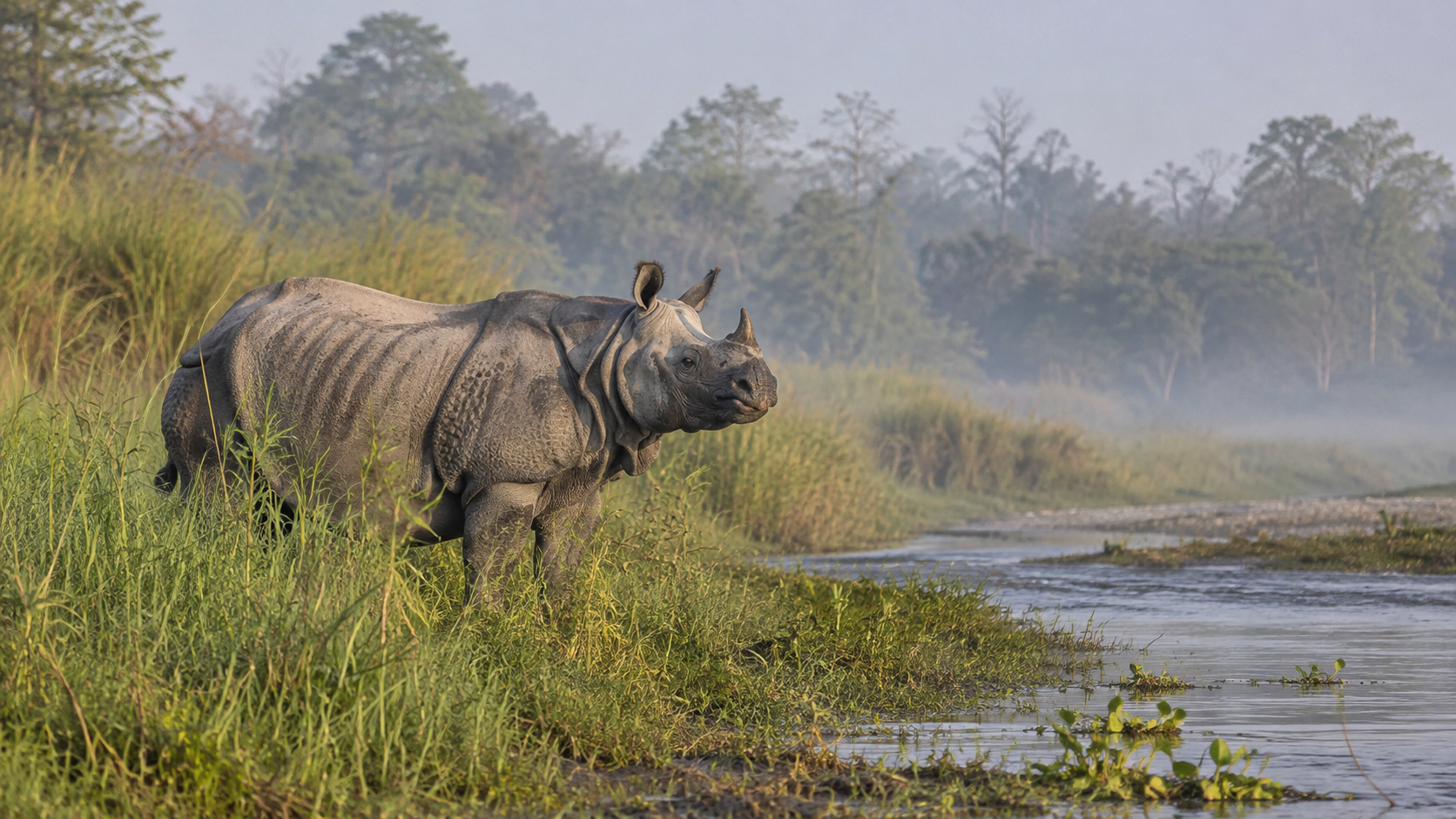
The greater one-horned rhinoceros illustrates why conservation status and the chance of a local sighting are different measures. · AI-generated illustration
A greater one-horned rhinoceros can be surprisingly visible for an animal that still needs strong protection. In Nepal’s Chitwan National Park, visitors sometimes watch one feeding beside a wetland or moving through grassland. A snow leopard presents a very different prospect. It lives across vast mountain terrain, blends into rock and shadow, and remains unseen by most travellers. Both animals need conservation, but their visibility tells us little about how secure their futures are.
That contrast is the starting point for exploring endangered animals in Nepal. The phrase often brings together wildlife with very different conservation situations: species facing severe global threats, animals with small or restricted populations within Nepal, and creatures that are simply difficult to observe. These groups overlap, but they are not interchangeable. An animal can be relatively easy to find in one well-protected place while remaining vulnerable across its wider range. Another may be elusive without belonging to the highest threat category.
Nepal makes these differences especially interesting because its wildlife habitats change dramatically between the southern plains and the high Himalaya. Lowland forests, rivers and grasslands support large mammals whose movements sometimes cross established visitor routes. Farther uphill, temperate forests and alpine landscapes shelter animals adapted to narrower sets of conditions. For a traveller, this means that “wildlife watching in Nepal” is not one experience. A guided lowland outing and a mountain trek offer different opportunities, limitations and responsibilities.
This article compares ten animals rather than presenting ten complete species profiles. The aim is to help you understand what makes each animal rare or threatened, where it belongs, and how realistic an encounter might be. Five large lowland mammals provide one set of comparisons; five habitat specialists provide another. Looking at them together reveals why a familiar safari animal may still need urgent protection, and why a rarely photographed species should not automatically be described as more endangered.
Conservation language deserves care here. Endangered is a formal category on the IUCN Red List, not a general label for every animal in trouble. Other categories, including Vulnerable and Critically Endangered, describe different levels of extinction risk. Global assessments also answer a different question from national assessments: a species’ situation across its entire range may differ from its situation in Nepal. Throughout this comparison, rarity, conservation status and sighting prospects will be treated as separate pieces of information, not three ways of saying the same thing.
For visitors, the most useful expectation is also the simplest: “discover” does not mean “see.” You can discover a species by learning how it uses its habitat, understanding the pressures it faces, or hearing a knowledgeable local guide explain signs of its presence. Tracks, feeding marks or distant calls can make a landscape more meaningful, although identification requires care. A rewarding wildlife journey need not produce a close encounter, and an honest guide cannot guarantee that a free-ranging animal will appear.
Even in established wildlife destinations, conditions matter. Vegetation, weather, access rules and an animal’s daily movements can all affect what visitors observe. Before planning around a particular species, check locally with park authorities and responsible guides about current access and suitable activities. Treat claims of guaranteed sightings cautiously, especially when they involve approaching dens, baiting animals or leaving permitted routes. The animal’s safety and freedom to move should come before a photograph.
There is also value in looking beyond the hoped-for animal. Its forest, river or mountain slope supports many less celebrated species and often matters deeply to nearby communities. Paying attention to that wider setting turns a checklist into an understanding of place. Read the comparisons that follow as a guide to informed curiosity: which animals share landscapes, which depend on particular habitats, and why protecting those habitats matters whether you see their most remarkable residents or not.
How to Read Rarity, Conservation Status and Sighting Chances
Searching for endangered animals in Nepal brings together three different questions: Is a species at risk of extinction worldwide? How restricted or uncommon is it within Nepal? And how likely is a visitor to see it? These questions overlap, but their answers are not interchangeable. A globally threatened animal may be regularly observed in one protected area, while a species in a lower risk category may remain almost invisible to travellers.
What an IUCN category tells you
The IUCN Red List assesses extinction risk using evidence such as population change, geographic range and population size. Its global categories describe a species across its assessed worldwide range, not simply inside Nepal. Endangered, with a capital E, is one specific category. It means the species faces a very high risk of extinction in the wild.
Threatened is the broader grouping covering Vulnerable, Endangered and Critically Endangered. These indicate high, very high and extremely high extinction risk in the wild, respectively. Calling every threatened species “Endangered” blurs an important distinction. Near Threatened and Least Concern sit outside this threatened grouping; neither means an animal is safe from local decline or needs no protection.
Data Deficient means the available evidence is insufficient for a direct or indirect assessment of extinction risk. It does not mean the species is secure. Not Evaluated means it has not yet been assessed against the criteria. Extinct in the Wild and Extinct describe losses beyond the threatened categories. Legal protection under Nepalese law is another separate matter: a protected species does not automatically carry the global Endangered label.
Separate Nepal rarity from visibility
Rarity within Nepal concerns the animal’s national distribution and population context. A species may occur only along a few river stretches, in isolated grassland patches or within a narrow elevation band. Another may occupy a wider area but exist at low densities. Neither pattern can be established from a memorable sighting, a lodge advertisement or a global category alone.
Detectability concerns whether an animal is noticed when present. Dense vegetation, nocturnal activity, camouflage, seasonal movement and difficult terrain all reduce visibility. An animal that uses open riverbanks can be easier to observe than one concealed in forest, even if the riverbank species has a more severe global threat category. “Rarely seen” therefore describes an encounter pattern, not necessarily biological rarity.
Broad locality also needs careful wording. A confirmed record from a national park does not mean the species occurs throughout that park, beside tourist routes or near every lodge. Historical records require particular caution: past presence alone cannot establish current wild occurrence. Captive animals and unconfirmed reports should not be presented as evidence of a wild population.
Verify first, then use one consistent entry
Before the ten species entries are finalised, each needs a source check. Confirm the accepted scientific name, latest available global IUCN category and assessment year directly in the Red List assessment. The assessment year is not necessarily the publication year or the year a webpage was updated. Then confirm wild occurrence in Nepal through the Department of National Parks and Wildlife Conservation (DNPWC) or credible species research, checking where and when the evidence was collected. Proposed labels are not live-verified here and must remain provisional until those checks are complete.
Use this compact template for every entry:
- Global status: IUCN category, scientific name and assessment year.
- Nepal rarity or distribution: evidence-based national context, without unsupported abundance rankings.
- Habitat and broad locality: suitable habitat and confirmed general areas, avoiding sensitive locations.
- Sighting reality: a qualitative description, with the reason encounters are easy or difficult.
- Principal Nepal threat: the main locally documented pressure, rather than an assumed global threat.
Avoid numerical sighting odds. Access, season and guiding conditions change; check locally. Describe uncertainty plainly, and never turn confirmed presence into a promised encounter.
Five Large Lowland Mammals: Different Prospects in Shared Landscapes
Some of the best-known endangered animals in Nepal share the lowland Terai, but they do not offer equal chances of an encounter. Grasslands, forests, wetlands and rivers support different species, and a park’s wildlife list is not a promise for your visit. The categories below are global IUCN Red List assessments, not measures of local abundance. The rhinoceros is Vulnerable, rather than Endangered, but remains an important conservation priority.
Greater One-Horned Rhinoceros
Status: Vulnerable. Where in Nepal: Chitwan National Park is the main stronghold; Bardia and Shuklaphanta also support populations. Rhinos use riverine grasslands, wetlands and nearby forests, so suitable habitat matters more than simply entering a protected area.
Rarity and sighting reality: A globally threatened animal can be comparatively visible within a well-protected stronghold. In Chitwan, rhinos may be seen feeding in open grassland or resting near water on suitable safari routes. Nevertheless, vegetation, flooding, access restrictions and animal movements affect encounters. Ask which accessible routes have had recent sightings, rather than accepting a general “rhinos guaranteed” claim.
Responsible approach: Keep your distance and follow your guide’s instructions. A feeding rhino is still a powerful wild animal; never crowd one for a closer photograph.
Tiger
Status: Endangered. Where in Nepal: Chitwan and Bardia national parks are established tiger landscapes. Both protect forest, grassland and river habitats that support tigers and their prey.
Rarity and sighting reality: Tigers occupy large areas, blend into cover and can pass close to a route without being seen. Their presence does not translate into dependable tourist sightings. Tracks, alarm calls or camera-trap records confirm activity, but they are not equivalent to a visitor seeing a tiger. Ask guides about recent direct sightings along currently open routes, including how much searching those encounters involved.
Responsible approach: Allow time for the wider landscape rather than making a tiger your only measure of success. Never request baiting, crowding or pursuit.
Asian Elephant
Status: Endangered. Where in Nepal: Wild elephants occur across parts of the Terai, including the Bardia landscape and eastern Nepal. They also use corridors and land outside protected areas, sometimes moving across the border with India.
Rarity and sighting reality: Wild elephant encounters are much less predictable than seeing captive elephants around tourism facilities. An elephant at a lodge, breeding centre or organised activity is not evidence of a wild sighting. Herd movements can change local prospects quickly, and recent activity may lead to safety restrictions rather than viewing opportunities.
Responsible approach: Ask explicitly whether an activity involves wild or captive elephants. Follow local warnings, never approach on foot independently, and avoid blocking a herd’s route.
Wild Water Buffalo
Status: Endangered. Where in Nepal: Koshi Tappu Wildlife Reserve is Nepal’s principal stronghold for wild water buffalo, locally called arna. Its floodplain grasslands and wetlands provide essential habitat.
Rarity and sighting reality: Buffalo may be visible in open areas, but access, seasonal flooding and herd location affect viewing. Domestic buffalo also occur in the wider landscape, and hybridisation is a conservation concern. Do not identify every buffalo near the reserve as a wild animal; use an experienced local guide.
Responsible approach: Observe from a safe distance without surrounding herds. Ask where reserve staff have recently confirmed wild buffalo activity.
Ganges River Dolphin
Status: Endangered. Where in Nepal: The Karnali river system is a documented locality; dolphins also occur in the Koshi system. Their distribution within Nepal’s rivers is restricted and affected by water conditions and connectivity.
Rarity and sighting reality: Dolphins surface briefly and can easily go unnoticed. A riverside visit or boat trip offers no reliable guarantee. Ask conservation staff or knowledgeable local guides about recent confirmed sightings, river levels and suitable observation points; check locally before arranging travel specifically for dolphins.
Responsible approach: Prefer quiet observation. Never ask a boat operator to chase, encircle or repeatedly approach a surfacing dolphin.
Five Habitat Specialists: Elusiveness Is Not a Status Category
For these five endangered animals in Nepal and their threatened relatives, habitat shapes the encounter as much as population size. All five have documented records in Nepal, but they occupy very different landscapes. The categories below are global IUCN Red List classifications, not estimates of abundance within Nepal. Snow leopards, for example, are globally Vulnerable, even though finding one may be harder than seeing a Critically Endangered gharial in suitable river habitat.
Snow Leopard
Status and Nepal records: Vulnerable. Snow leopards are documented across Nepal’s northern mountain belt, including protected Himalayan landscapes such as Annapurna, Manaslu and Sagarmatha. Their distribution is broad compared with the tiny area a visitor can realistically scan.
What limits sightings: Remote alpine terrain, low densities and excellent camouflage make encounters exceptional. Steep slopes, altitude and weather also limit where people can safely search. Tracks or other signs are more likely than a clear view, and identification needs care.
Responsible encounter: Use experienced local guides and allow time without expecting success. Never approach a kill, pursue an animal across a slope or pressure guides to reveal sensitive locations. Here, difficult access compounds natural elusiveness; it does not indicate a higher threat category.
Red Panda
Status and Nepal records: Endangered. Red pandas occur in Nepal’s temperate mountain forests, with documented populations in eastern Nepal and protected landscapes including Langtang. Their habitat typically combines forest cover and bamboo, rather than the open alpine slopes associated with snow leopards.
What limits sightings: Suitable forest is patchy, and animals can remain hidden among branches and dense vegetation. Specialist guided searches may offer a more realistic opportunity than casual trekking, but neither suitable habitat nor a recent report guarantees an encounter.
Responsible encounter: Choose operators who keep groups quiet and maintain distance. Do not surround a tree, shake vegetation or encourage baiting. Forest visibility and fragmented habitat constrain sightings differently from the snow leopard’s vast, exposed mountain range.
Chinese Pangolin
Status and Nepal records: Critically Endangered. The Chinese pangolin is documented in Nepal’s hills, particularly in eastern and central regions, as well as some lower-elevation areas. It is a separate species from the Indian pangolin; a generic “pangolin” report does not establish which species was present.
What limits sightings: Nocturnal activity and time spent underground make direct encounters very unusual. Burrows may indicate possible use, but an entrance alone cannot reliably identify the species or confirm that a pangolin currently occupies it.
Responsible encounter: Avoid burrow inspections, digging, lights directed into entrances and public location-sharing. Its extreme conservation concern reflects threats such as illegal trade and habitat loss, not simply the difficulty tourists face in seeing it.
Indian Pangolin
Status and Nepal records: Endangered. Nepal has documented Indian pangolin records in its southern lowlands, including the Terai. Records are more limited than those of the Chinese pangolin. The broad lowland–hill contrast is useful, but elevation alone should never determine identification.
What limits sightings: Like the Chinese pangolin, it is mainly nocturnal and burrowing. It is not a realistic target for an ordinary wildlife safari. Limited observations also mean that confident claims about local abundance deserve caution.
Responsible encounter: Keep the species distinct in trip reports and leave uncertain observations unidentified. Do not publish precise locations. For both pangolins, an ethical trip may produce no sighting at all.
Gharial
Status and Nepal records: Critically Endangered. Free-ranging gharials are documented in Nepal’s river systems, notably the Narayani–Rapti network and the Babai. Their distribution is restricted, and conservation breeding and releases support recovery efforts.
What limits sightings: Access to occupied river stretches, water levels and basking conditions matter. Unlike pangolins, gharials may be visible in daylight from an appropriate distance. Ask guides about current conditions; check locally.
Responsible encounter: A breeding-centre visit is a captive viewing, not a wild sighting. A released gharial living freely in a river is free-ranging, however. Keep boats away from basking banks and never disturb nesting areas.
Conclusion: Let Conservation Guide the Encounter
Looking for endangered animals in Nepal comes with a responsibility: the animal’s needs must matter more than the visitor’s photograph or checklist. A successful wildlife trip is not measured only by what appears. It is also measured by how little disturbance you cause, whose local knowledge you support, and whether your choices help keep habitats safe. Build your visit around those goals, and even a quiet forest walk can become a worthwhile encounter with Nepal’s natural world.
Use authorised local guides and arrange wildlife activities through operators who can explain their permissions and viewing rules. Ask how they respond when an animal moves away, whether they stay on approved routes, and how they manage a crowded sighting. A responsible guide should be willing to end an encounter rather than push closer. Be cautious about anyone promising a particular rare animal or offering secret access to restricted habitat. For current access, permits and wildlife-viewing conditions, check locally with the relevant protected-area office or authorised visitor service.
Make your expectations clear before setting out. Tell your guide that you prefer a distant, undisturbed view to a close approach that changes an animal’s behaviour. Carry binoculars if possible, and learn how to use them before the walk or drive begins. Keep voices low, silence unnecessary phone alerts, and follow instructions about where to stand or remain seated. On vehicle-based trips, do not pressure a driver to block an animal’s path or crowd another vehicle simply to improve your angle.
Observe from a safe distance, remembering that there is no single distance suitable for every species, landscape or situation. Follow protected-area rules and your guide’s directions, and allow extra space around animals with young. Never position yourself between a parent and its offspring or between an animal and its escape route. If wildlife becomes alert to your presence, stops feeding or repeatedly moves away, avoid advancing. Let your guide manage a calm withdrawal rather than treating the reaction as part of the entertainment.
Set firm limits on the methods used to obtain a sighting. Do not bait, chase or handle wildlife, and do not request access to dens or nests. Refuse staged encounters that depend on feeding, cornering or restraining animals. Avoid asking guides to imitate calls or play recordings to draw animals closer; these methods can disrupt behaviour, especially around breeding sites. An animal resting out of sight is not a problem for someone to solve. Accepting that boundary protects wildlife and removes pressure on guides to take risks.
Use the same care when sharing your visit. Avoid posting precise locations of sensitive dens, nests or vulnerable animals, including location data attached to photographs. A dramatic image can attract crowds long after you leave. Share the wider landscape, the guiding experience and the conservation lessons instead. Keep food and rubbish secure, use designated facilities, and stay on permitted trails. These ordinary habits help prevent damage and reduce the chances of wildlife becoming accustomed to food left by people.
If you suspect wildlife crime, report your concerns through appropriate local authorities, such as protected-area staff, the relevant forest office or Nepal Police. Do not confront suspected offenders, buy wildlife products as evidence, or put yourself at risk to investigate. From a safe place, record useful details you directly observed, such as the location, time and activity. Distinguish observations from assumptions, and provide photographs only if they were taken safely and lawfully. Check locally for the appropriate reporting contact.
Finally, value the habitat even when your target animal never appears. Forest cover, functioning wetlands and connected grasslands sustain lives that visitors may never see. Pay required fees, choose responsible local services, and support credible habitat protection efforts where possible. Leave knowing that restraint was part of your contribution. The best wildlife encounter is one that leaves the animal free to continue its day.
Up next
Wildlife & Conservation
What Is Growing Over Chitwan’s Wetlands? Investigating Invasive-Plant Removal
Wildlife & Conservation
Who Shares Chitwan’s River Water? Investigating Dry-Season Decisions Along the Rapti
Wildlife & Conservation