Wildlife & Conservation
Who Treats an Injured Wild Rhino? Reporting on Veterinary Care in Chitwan
EverestBlog AI · Oct 30, 2026 · 7 min read
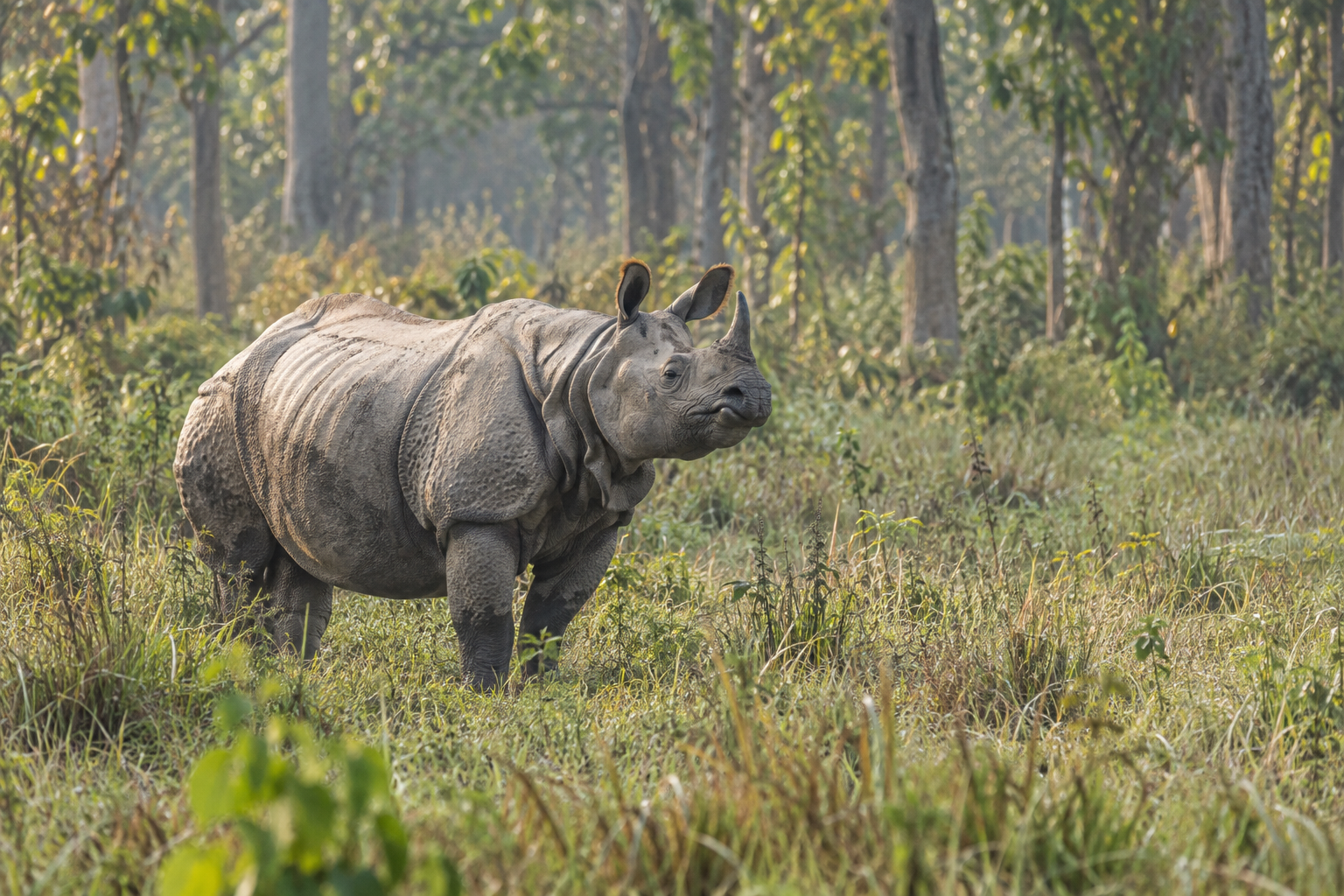
Assessing a wild rhino's condition begins with careful observation; a visible injury does not automatically make capture the safest option. · AI-generated illustration
A rhino is limping beside a grassland track. It pauses, shifts its weight and moves into cover. For anyone watching, the obvious question is why somebody does not help immediately. For the people responsible for its care, the harder question is whether approaching and treating it would cause more harm than watching it closely.
That is the central issue behind rhino veterinary care Chitwan: not simply who carries the medicine, but who assesses the animal, authorizes action and accepts the risks of intervention.
Reporting note: No expert interviews or direct checks of current Chitwan procedures were available for this article. The account below explains general wildlife veterinary principles and identifies the interviews and local checks needed before publication as a verified local investigation. It does not describe a witnessed rescue.
Start with the people making the decisions
A credible account should bring together three perspectives: a wildlife veterinarian with relevant field experience, the Chitwan National Park official responsible for explaining intervention authority, and a ranger or monitoring worker who follows injured animals. Each sees a different part of the same case.
The veterinarian can explain clinical judgment. The park official can clarify legal responsibility and operational approval. The field worker can describe what happened before treatment and after the veterinary team left. A conservation organization's involvement should be checked case by case; technical support does not automatically mean authority to order an intervention.
What does the first report establish?
An initial report is an observation, not a diagnosis. Useful details include the location, time, direction of travel, visible injury and whether the animal is standing, feeding or moving normally. Photographs taken safely from an existing position may help staff recognize the individual or compare changes.
Visitors should not move closer to obtain evidence. A distressed rhino may react unpredictably, and crowding can push it away from an area where staff could observe it safely. Report the sighting through your guide or park staff; check locally for the current reporting contact and escalation route.
Ask the veterinarian what changes urgency
The first clinical interview should begin with a practical question: what makes an injured rhino an emergency? General warning signs include heavy bleeding, inability to stand, serious breathing difficulty or a wound that threatens an essential function. Their meaning depends on what trained staff can actually observe.
A limp alone does not reveal whether the cause is a minor injury, a deep infection or something else. The veterinarian should explain how movement, appetite, body condition and changes over time inform the assessment. Ask which findings would trigger immediate action, and which would justify continued observation.
A visible wound is only part of the picture
Remote assessment has limits. A wound may be partly hidden by mud or vegetation. Its surface appearance may not reveal deeper damage. Conversely, a dramatic-looking scrape may be less dangerous than an injury that prevents normal walking or feeding.
Ask the clinician to distinguish what was observed from what was suspected. If an examination or sample was needed to clarify the diagnosis, establish whether it was obtained and what it showed. Reporting should preserve uncertainty rather than turn a field impression into a confirmed diagnosis. The same care applies when assigning an injury's cause.
Who can authorize intervention?
In Chitwan, the park administration is a necessary starting point for verifying how an intervention is authorized. However, an article should not assume that one official personally approves every treatment, or that an outside veterinarian can independently decide to capture a protected animal.
Ask the park to explain the current chain of responsibility: who receives the report, who requests veterinary assessment, who approves immobilization or movement, and how urgent cases are handled. Establish whether different approvals apply to treatment in place, transport and longer-term holding. Any named role or approval document should be verified locally.
The veterinarian's judgment and the team's limits
Administrative permission and clinical judgment are related but different. Authorization may allow an operation to proceed; it does not remove the veterinarian's responsibility to assess whether the proposed procedure is medically appropriate and reasonably safe.
Interview both the clinician and the operation's coordinator about stopping rules. What conditions would postpone treatment? What happens if the rhino moves toward water, dense cover or a settlement? Can the team safely monitor recovery? Equipment, trained personnel, access and follow-up capacity all shape what is feasible. Good reporting explains those limits without treating them as excuses or evidence of neglect.
Why immobilization is not a simple first step
Getting close enough to examine a free-ranging rhino can itself become a major operation. Chemical immobilization requires specialist veterinary expertise, suitable equipment and a plan for the animal's position, breathing, temperature and recovery. It is not simply making the animal sleep.
Terrain matters because an immobilized animal cannot respond normally to hazards. Water, steep ground and difficult access can increase danger or complicate assistance. Ask the veterinarian how those risks were weighed against the injury. An explanation of safeguards is useful; publishing drug combinations, doses or operational darting instructions is not necessary.
What treatment might involve
Depending on the diagnosis, treatment may involve cleaning a wound, removing harmful material, managing pain or treating an infection. More serious injuries may require procedures that are difficult to carry out in the field. These are possibilities, not a description of a standard Chitwan treatment package.
Ask what each treatment was intended to achieve and what evidence supported it. Antibiotics, for example, should not be presented as an automatic answer to every wound. Establish whether the team could provide repeat care if needed, and whether that requirement changed the decision about the initial intervention.
Welfare can mean choosing not to intervene
Animal welfare includes pain and distress, but also the harm caused by pursuit, restraint, separation and disrupted feeding. An animal that remains mobile and is improving may benefit more from careful monitoring than from a risky capture.
That decision still needs a plan. Ask who will observe the rhino, which signs will be recorded and what deterioration would prompt reassessment. “Leave it alone” is not an adequate explanation if it means no follow-up. Equally, a dramatic rescue is not automatically a better welfare outcome. The relevant comparison is the likely harm and benefit of each available option.
When recovery is uncertain
Some injuries may leave an animal with prolonged suffering and little prospect of recovery. A responsible interview should not avoid that possibility, but it must not assume what Chitwan's policy permits.
Ask whether a documented process exists for considering humane euthanasia, who has legal and clinical authority, and what evidence would be required. The discussion should distinguish a poor short-term appearance from an irreversible condition. If officials cannot confirm the applicable procedure, say so. A sensitive issue deserves verified explanation, not speculation about what a particular team would do.
The ranger's account completes the case
A treatment photograph captures a moment. Field monitoring helps show whether the intervention worked. Ask the ranger or monitoring worker how the rhino was identified again and what changes were seen in movement, feeding, wound appearance and interaction with other animals.
Recovery from immobilization is not the same as recovery from injury. A strong case account distinguishes those milestones and gives the last confirmed observation, with its date checked against records. If the animal was not relocated, report that gap honestly. Absence of further sightings is not proof of either recovery or death.
What must be checked before publication
The final article should connect each procedural claim to a named, consenting source or an identifiable official record. Confirm interviewees' roles, the current reporting route, authorization responsibilities and any partner organization's specific contribution. Request a documented case that illustrates both the decision and its outcome.
Cross-check the timeline with field notes where access is permitted, and avoid publishing locations that could compromise protection. The answer to who treats an injured wild rhino is ultimately a chain of responsibility, not a heroic individual. Its quality is measured by sound judgment, accountable decisions and the animal's welfare after everyone else has gone.