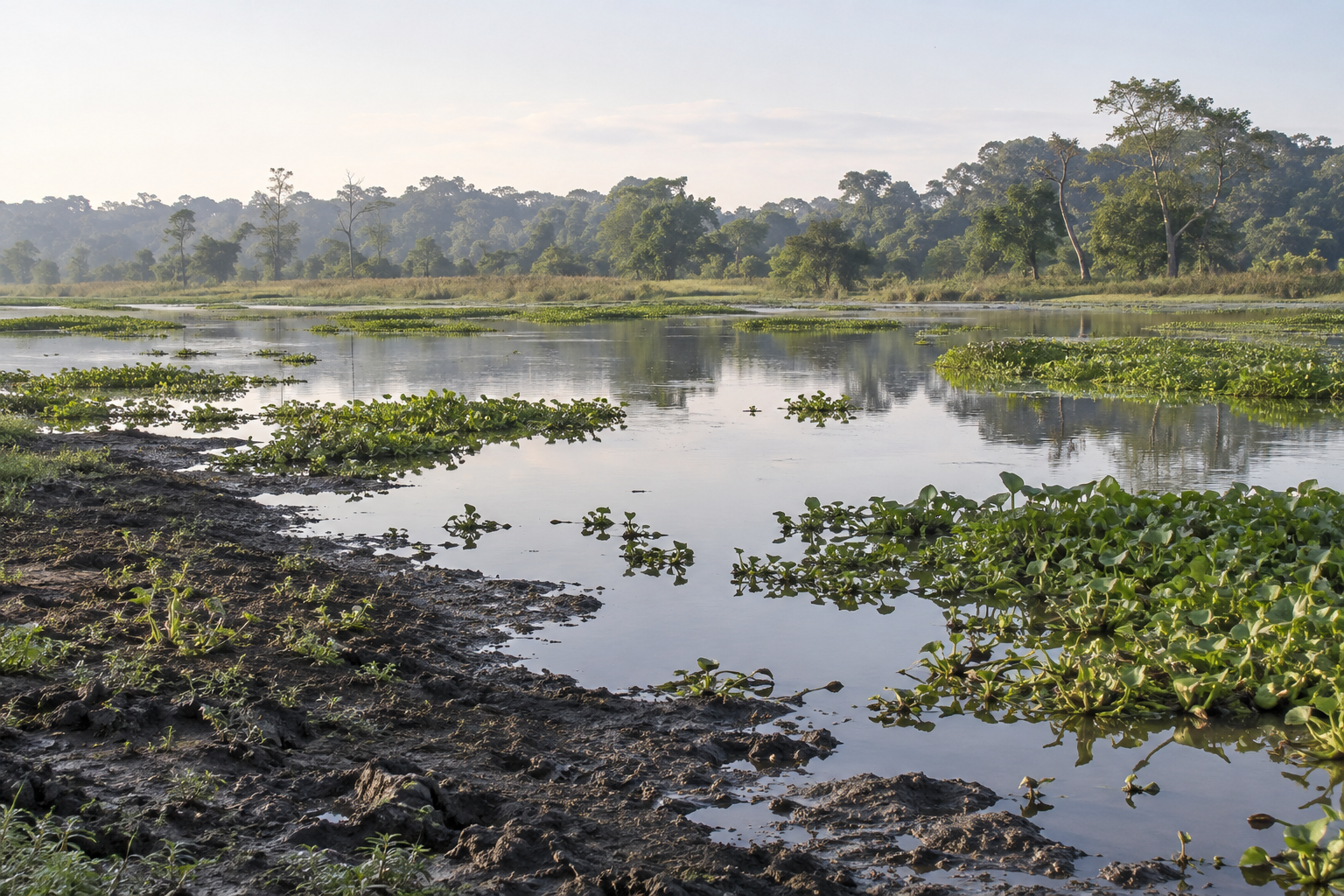
Wildlife & Conservation
When Fire Reaches Chitwan’s Forest Edge: Who Detects It and Who Responds?
EverestBlog AI · Oct 31, 2026 · 8 min read
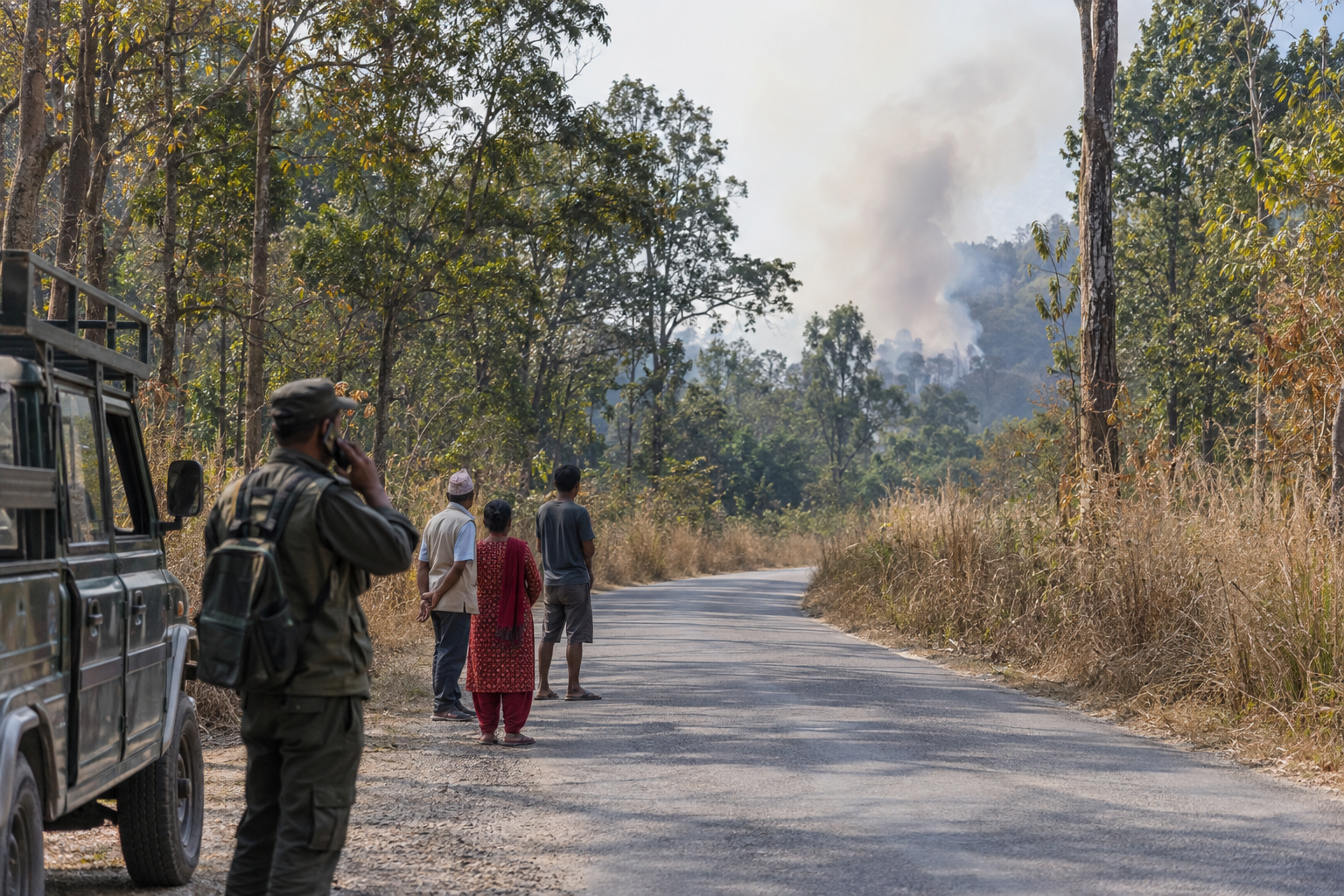
At Chitwan’s forest edge, preparedness means knowing how to report smoke, receive warnings, and keep response routes clear. · AI-generated illustration
A thin column of smoke near Chitwan’s forest edge can raise an urgent question: is someone already dealing with it, or is this the first sign of a fire moving towards homes, paths or grazing areas? For the person who notices it, the next step may not be obvious. A park post, a community forest representative and a local emergency service can each have a role, but they are not interchangeable. Understanding forest fire response Chitwan starts with asking who receives that first report—and how the information reaches people who may be in danger.
“Chitwan’s forest edge” is not a single administrative area. In this article, it means the places where forest associated with Chitwan National Park meets community-managed woodland, farmland, roads and settlements. These boundaries matter because a fire’s location helps determine who should be notified and who can organise action. Smoke seen from a village may rise from inside the park, from a buffer-zone community forest or from land outside either. A distant view alone may not establish which.
National park land falls under the park’s management and protection arrangements. A report about smoke inside the park therefore needs to reach park personnel through an appropriate local contact. Buffer-zone community forests have community user groups and management arrangements within the wider buffer-zone framework; they should not be treated as simply another part of the park’s day-to-day administration. Nearby settlements bring in ward and municipal responsibilities, along with police, fire services and other responders where available. Which office takes a particular call, and what assistance it can send, requires local confirmation.
These distinctions are not a reason for a witness to delay reporting while trying to identify a boundary. They are a reason for responders to clarify location and pass information promptly. A useful report describes where the smoke is visible, a recognisable landmark, whether flames can be seen, and whether people or buildings appear threatened. The caller should distinguish what they can actually observe from what they suspect. They should not enter forest, approach flames or climb into an exposed position merely to obtain a better photograph or a more precise location.
This investigation focuses on three connected issues: reporting, public warnings and human safety. Who acknowledges an initial alert? How is an uncertain location checked? Who warns households, forest users and visitors when conditions could affect them? Those questions are different from asking only who eventually fights the fire. An organised response also depends on keeping people away from danger and avoiding confusion over whether a warning is official, current and relevant to their location.
No verified local incident account is available for this introduction, so it does not reconstruct a particular fire or claim that one reporting chain operates everywhere. Contact numbers, staffing, equipment availability and warning practices can change: check locally with the relevant park post, community forest group and ward office. The central question remains practical: after someone sees smoke, how does that observation become timely, coordinated protection for people at the forest edge?
From First Report to Coordinated Response and Public Warnings
A forest fire response Chitwan can begin with a resident noticing smoke, a community forest watcher spotting flames, or a guide reporting a burning patch beside a trail. The first report should describe the nearest landmark, access route, visible smoke or flames, and any people at risk. Nobody should approach a fire to improve a photograph or confirm its size. Report from safety and give a callback number if possible.
Where the report goes
Inside Chitwan National Park, reports should reach park staff through an official park contact or nearby post. In community forests outside the park, the community forest user group and relevant government forest office are important reporting points. Municipal emergency services and police may also need notification when homes, roads or other public areas are threatened. Buffer-zone forests require particular care: their location and management arrangements must be established rather than assuming that one authority handles every incident.
These are reporting routes, not a verified incident-command chart. The actual chain must be confirmed through interviews with park staff, relevant forest officials, community forest representatives, municipal emergency staff and security personnel where involved. For each jurisdiction, establish who receives the call, who checks the location and severity, who authorises deployment, and who can request additional support. Verification might involve a patrol or field team, but the responsible office must explain its procedure. Residents and tourism workers should be interviewed separately to test whether that procedure works in practice.
Deployment must include a way out
A deployment order is only useful if the team has suitable equipment, training and communications. Ask responders what they actually carry, whether equipment is serviceable, and whether water supplies and vehicle access are dependable. Hand tools, protective clothing, radios and first-aid supplies should be discussed alongside staffing and training—not treated as proof that crews can safely tackle every fire.
Before crews move in, confirm who leads them, how changing wind or fire behaviour is communicated, and who orders withdrawal. Responders need escape routes, safe meeting points and a plan for injuries or lost contact. Volunteer involvement needs explicit rules: who may join, what training and supervision are required, and which tasks are prohibited. Residents should not be encouraged to enter burning forest. Support away from the fire line also needs coordination so that volunteers do not obstruct access or expose themselves to smoke.
Warnings must reach people, not just phones
Trace a warning from its issuing authority to households, guides, lodges and visitors. Confirm which channels are official, how closures or evacuation instructions are updated, and who communicates the all-clear. Test whether messages reach people with poor signal, switched-off phones or limited literacy. Check whether visitors and workers understand the language used, and whether lodges pass warnings to guests already out on excursions. Ask recipients what they understood, not merely whether a message was sent.
No interviews or contact checks underpin this account. Before publication, verify telephone numbers, operating hours, fallback contacts and procedures directly with responsible offices. For current contacts, access restrictions and arrangements, check locally.
Conclusion: What Preparedness Still Needs
The central test of forest fire response Chitwan is not simply whether someone notices smoke. It is whether a warning reaches the right authority, prompts a safe response and gives nearby people clear instructions. A conclusion must distinguish arrangements supported by reporting from questions still unanswered. A listed contact, a response plan and a successful operation are different kinds of evidence; none should automatically stand in for the others.
The reporting available here does not establish a verified account of local procedures, staffing or equipment. It therefore cannot support a claim that coordination works reliably, or that a particular office has failed. Unresolved questions should remain questions: who receives reports outside office hours, who takes responsibility when a fire threatens several jurisdictions, and how warnings reach people who cannot access online updates? These are points to verify, not documented failures.
Before the next fire season, preparedness should be judged through records and practical checks rather than assurances alone. Responsibility for addressing any confirmed weakness should follow the location and the task. Park authorities should answer questions about arrangements within their jurisdiction; the relevant forest office or community forest management body should explain responsibilities elsewhere. Municipal authorities should clarify local emergency coordination and public communication. Where responsibilities meet, the agencies concerned should confirm the handover process together.
- If reporting contacts are outdated or unclear: the responsible authority should publish and maintain current reporting routes, including an alternative when the first contact cannot be reached. Improvement would mean dated notices, consistent information across participating offices and documented checks showing that the published routes work.
- If coordination is uncertain: the authorities sharing responsibility should identify who receives the initial report, assesses the situation, requests assistance and issues public instructions. A jointly reviewed procedure and a recorded exercise would offer stronger evidence than separate statements that each agency is ready.
- If responder readiness is questioned: the organisation deploying personnel should verify training, protective equipment, communications and supervision. Evidence should include current checks and records of practice, not merely an equipment list. Any remaining limitations should be acknowledged when deciding what personnel can safely attempt.
- If public warnings are inadequate: the authority responsible for emergency communication should test ways to reach affected settlements, workers and visitors. Evidence of improvement would include clear warning messages, identified communication channels and feedback showing that intended recipients understood what action to take.
Follow-up reporting should ask whether these checks produced changes, who was assigned to make them and whether unfinished actions remain. An exercise can reveal weaknesses without proving that every real emergency will run smoothly. Equally, a missing public record does not by itself prove that no preparation occurred. The useful standard is verifiable progress, with uncertainty stated openly.
For readers, the takeaway is straightforward: check locally for current reporting contacts and official instructions. Never approach a fire to verify it. Do not join suppression efforts without authorisation and appropriate training; keeping yourself out of danger helps prevent an additional emergency for responders.