
Wildlife & Conservation
What Reaches Chitwan’s Wildlife from Farms at the Park Edge?
EverestBlog AI · Oct 31, 2026 · 21 min read
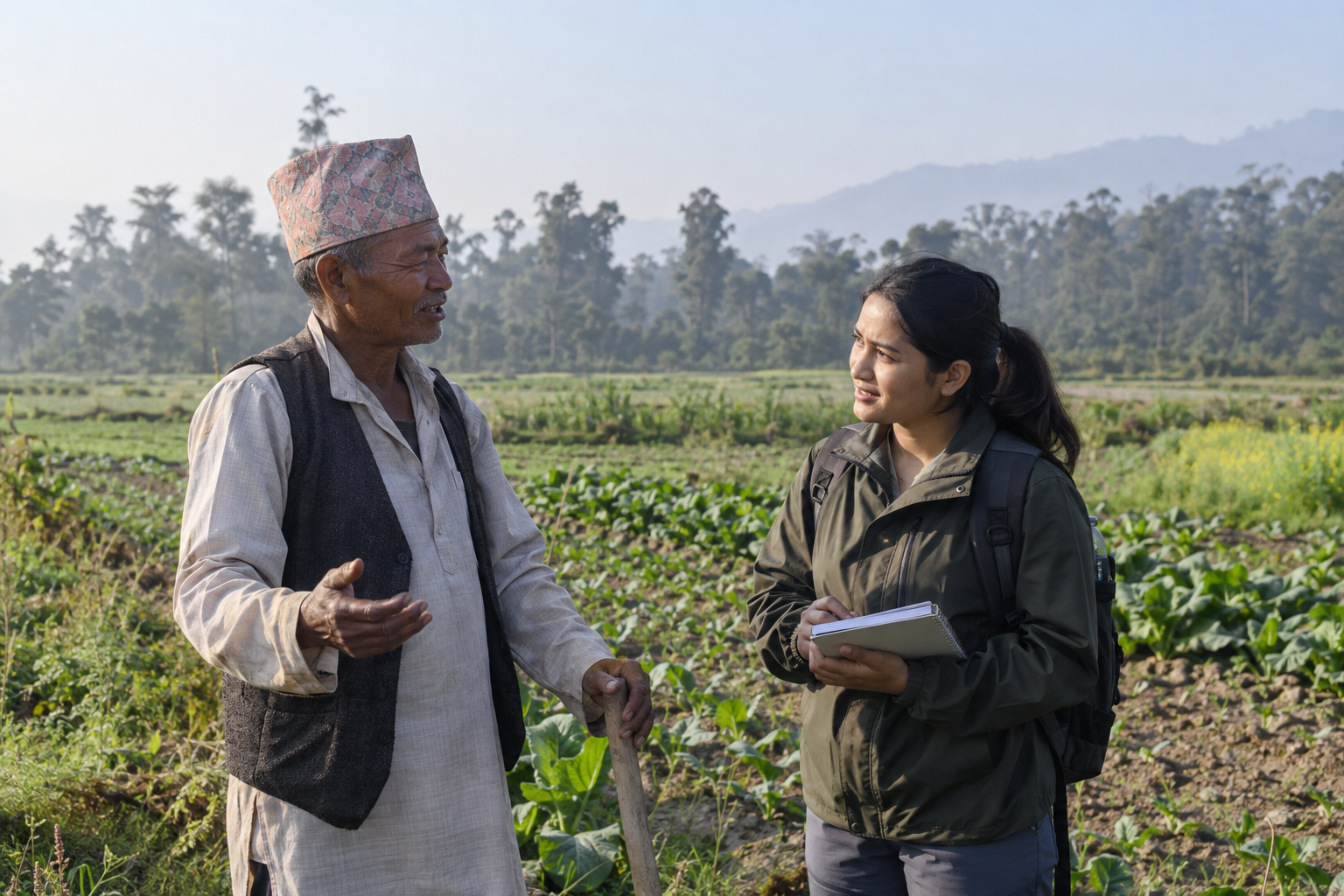
Farmer knowledge and field research can help frame questions about pesticide use near Chitwan’s wildlife habitat; proximity alone does not establish exposure. · AI-generated illustration
A farm near Chitwan National Park and the wildlife habitat beyond it may share water flows, air currents and visiting animals. But a shared landscape does not tell us exactly what moves through it. If a farmer applies a pesticide to a crop, does any of that substance leave the field? Does it reach a river, wetland, grassland or forest used by wildlife? If it does, which animals encounter it, and in what amounts? These are the starting questions for understanding pesticides and wildlife in Chitwan.
The distinction matters because concern can easily become a claim stronger than the evidence supports. A cultivated field beside protected habitat is a reason to investigate, not proof of contamination. Likewise, a pesticide container found near a farm cannot establish that a wild animal has been exposed. A careful account must follow the evidence across several steps rather than jump straight from agricultural activity to wildlife harm.
Chitwan’s park-edge landscape also includes people making practical decisions about crops, income and food security. Farmers may face insects, weeds and crop diseases, while wildlife conservation brings its own responsibilities and challenges. Asking what leaves a field should not begin with blaming the people who work it. It should begin with identifying substances, understanding conditions and checking whether suspected connections can actually be demonstrated.
Four separate claims shape that investigation:
- Use: Was a particular pesticide applied, where, when and to which crop? Purchase records or farmers’ accounts may help establish use, but a product available in a shop is not necessarily a product applied beside the park.
- Movement: Did the substance, or a product formed as it broke down, travel beyond the treated area? Evidence needs to connect a possible source with a route and destination, rather than assume that nearby habitat received it.
- Exposure: Did wildlife encounter the substance through food, water, breathing or physical contact? Finding a residue in habitat may show an opportunity for exposure, but it does not establish the amount reaching an animal.
- Harm: Did that exposure cause an adverse effect? This requires evidence about toxicity, the amount and duration of exposure, and other possible explanations for the observed problem.
Keeping these claims separate does not mean dismissing risk. It makes the questions more useful. For example, detecting a pesticide in water would establish its presence in that sample at that time. On its own, it would not identify the farm it came from, show how long it remained there or demonstrate that it harmed fish. Equally, failing to detect it in one sample would not prove that it had never passed through the site.
The word pesticide also covers substances with different purposes and properties. Insecticides, herbicides and fungicides cannot be treated as though they all move, persist or affect wildlife in the same way. The formulation, application method and local conditions matter too. Rain after application, for instance, could create different opportunities for movement than a dry spell. These are reasons to ask precise questions, not evidence that a particular event occurred in Chitwan.
Wildlife is equally varied. An animal feeding in a field may have a different potential exposure from one living deeper inside forest habitat. Aquatic animals, insect-eating birds and grazing mammals use different resources. A finding about one species or location should therefore not become a statement about all park wildlife.
The central question is not whether farms and wildlife exist close together; they do. It is what evidence connects pesticide use on nearby farms to conditions in wildlife habitat. Answering that honestly means distinguishing what is documented, what is plausible and what remains unknown—without treating either concern or reassurance as a substitute for measurement.
Farmers’ Decisions at the Park Edge
Understanding pesticides and wildlife in Chitwan starts with the decisions farmers face before a product reaches a field. A crop under attack can mean lost food, lost sales or difficulty repaying a loan. Yet farmers near the park do not all grow the same crops, manage the same amount of land or have the same alternatives. Their choices need to be understood through specific, local accounts—not assumptions about careless spraying.
No farmer interview accounts were available for this section, so the questions below are a reporting framework, not testimony. Interviews could begin in farming settlements around Bachhauli, near Sauraha, and in clearly named wards and settlements of Madi Municipality. These locations should be treated separately. For each interview, identify the settlement, crop, season and whether the farmer owns or rents the land. “Near Chitwan National Park” alone is too vague to explain a farm’s circumstances.
Start with the pest and the crop at risk
Ask farmers to describe their most recent pest problem before asking which pesticide they used. What damage did they notice? Who identified the cause? Was it an insect, a disease, a weed or something uncertain? Ask whether they can show affected plants, photographs, packaging or purchase records. A local product name may not reliably identify its active ingredient, and damaged leaves alone do not establish that spraying was necessary.
The next question is what made the problem urgent. Was the crop close to harvest? Had earlier planting costs already stretched the household budget? Was a buyer expecting produce of a particular appearance? These questions help distinguish a response to visible damage from routine spraying or pressure to protect a sale. They also allow farmers to explain what they feared losing in their own terms.
Trace the advice behind the decision
Ask where advice came from: an agricultural technician, a pesticide retailer, a cooperative, another farmer, a product label or a phone-based source. More than one may influence a decision. Establish who recommended the product, who suggested the dose and whether anyone inspected the crop. Do not assume that a purchase from a retailer proves either poor advice or correct use.
Follow up on practical understanding. Could the farmer read the label? Was advice given in a language they understood? Did recommendations explain when not to spray, or offer a way to check whether treatment worked? Access to agricultural support and training can change; check locally rather than describing services as consistently available across the park edge.
Make room for different farm circumstances
A useful interview group would include farmers growing vegetables for sale and households growing grain mainly for their own use, alongside owners and tenants. Include people who mix or apply products, not only the person who purchases them. Ask about hired labour, household labour and who makes spending decisions. These roles may belong to different people.
Labour questions matter because an alternative that sounds simple may demand repeated field visits. Can the household manage hand removal, traps, netting or other crop-appropriate measures? Are materials available nearby? Has the farmer tried them, and with what result? Ask about water, equipment, credit and time without assuming any single constraint determines pesticide use.
Report choices without claiming a district-wide pattern
Ask what would make a lower-risk option workable: reliable pest identification, timely advice, affordable materials or confidence that buyers would accept the harvest. Record unsuccessful experiences as carefully as successful ones. A handful of interviews can reveal decision-making pressures and useful leads, but cannot establish how most Chitwan farmers behave. Attribute each account to its location and circumstances, and keep individual experience separate from broader claims about farming around the park.
What Records Actually Show About Pesticide Use
Records of pesticide use can help identify what might leave farms near Chitwan National Park, but different records answer different questions. A farmer’s recollection describes reported use. A dated spray log documents a recorded application. A shop invoice records a purchase, not necessarily a treatment. For pesticides and wildlife in Chitwan, these distinctions matter: evidence that a chemical was available in Chitwan is not evidence that it reached park habitat.
Farm logs: the closest record of an application
A useful farm log identifies the field, crop, application date, product, amount used and area treated. It should also distinguish a commercial formulation from its active ingredient—the substance intended to control a pest. Recording only “insecticide” or a brand name leaves important gaps. Similar brand names can refer to different formulations, while several brands may contain the same active ingredient.
Logs become stronger evidence when supported by purchase receipts, photographs of labels or observations recorded during fieldwork. Even then, a written entry is not independent proof that spraying happened exactly as described. Missing logs do not prove that pesticides were absent, either. Interviews remain useful, but remembered applications should be labelled farmer-reported, especially when respondents are recalling an entire growing season.
Labels and retailer records show different things
A product label can establish the stated active ingredient, concentration, formulation and labelled uses. It cannot establish where the contents were applied. An empty container photographed on a farm may help identify a product, but does not, by itself, establish the application date, dose or treated crop.
Retailer records can reveal products sold, purchase dates and quantities moving through a particular outlet. Their limits are geographic as well as practical. Customers may farm outside the shop’s immediate area, store products for later use or leave part of a purchase unused. Sales totals must not be presented as application totals, and litres or kilograms of different formulations cannot be compared as though they contain equal amounts of active ingredient.
Registration and restrictions require a separate check against Nepal’s official pesticide information. An old survey, shop listing or container does not establish that a product is currently authorised. Check locally with the responsible plant protection authority for current registration, permitted uses and restrictions.
Surveys and studies need a geographic reading
Agricultural surveys can describe pest-management practices across sampled farms. Before using their findings, check how farmers were selected, which crops were included, when interviews occurred and whether researchers inspected records or relied on recall. A survey of vegetable growers cannot automatically describe rice growers, and findings from one season may not represent another.
Location is equally important. “Chitwan” in a study title may refer to the district, a municipality or selected production areas—not farms adjoining the national park. District-wide findings provide context, but only verified sampling locations can support claims about the park edge. Even a buffer-zone location should not be treated as a field directly beside wildlife habitat without more precise information.
Relevant studies also need separating by method. Farmer interviews describe reported practices; residue testing establishes detections in particular samples. Neither alone establishes a complete application history. A measured residue should be reported with its sample type, collection location and sampling period, rather than converted into a claim that a nearby farmer used that chemical.
What a defensible evidence summary should contain
- Chemical: verified active ingredient and formulation, with the source identified.
- Crop and timing: the recorded crop, application date or clearly stated recall period.
- Place: the actual study or farm location, distinguishing district evidence from park-edge evidence.
- Evidence type: reported use, logged application, purchase, sale or laboratory detection.
Where these details cannot be verified, leave them unknown. Naming specific chemicals without traceable local evidence would create certainty that the records do not support.
Possible Routes from Fields to Wildlife Habitat
A farm boundary does not necessarily stop a pesticide from moving. Spray droplets, flowing water, soil particles and contaminated food can carry some substances beyond the place where they were applied. These are potential pathways for pesticides and wildlife in Chitwan, not proof that chemicals from a particular field have reached park habitat. Establishing that link requires evidence about the product used, its movement and where wildlife could encounter it.
Spray drift through the air
During spraying, droplets can travel away from the target crop. Their movement depends on wind, droplet size, nozzle settings, spraying height and the distance to nearby vegetation or water. Some pesticides can also evaporate after application, creating a different airborne pathway. Neither process should be assumed to occur at harmful levels beside Chitwan without measurements.
Researchers could ask: Do spraying times overlap with winds blowing towards habitat? Do hedges interrupt droplets, or are there open gaps between fields and wildlife areas? To confirm drift, a study would need application records, weather observations and timed sampling of air or deposition along the field-to-habitat boundary. Samples collected before spraying and at comparison sites would help distinguish fresh drift from earlier contamination.
Runoff across the ground
Rainfall or excess irrigation can carry dissolved pesticides and pesticide-bearing soil particles over the surface. Whether water reaches wildlife habitat depends on slope, ground cover, soil condition and the route it follows. A nearby field may have little surface connection to a wetland, while a more distant field might drain towards it through a channel.
Useful questions include: How soon after spraying does heavy rain fall? Where does water collect, and which slopes connect fields to streams or floodplain vegetation? Confirming runoff would require mapped flow paths and samples taken during rain events, not only on dry days. Researchers would need to compare residues in field runoff, suspended sediment and receiving water, alongside rainfall and application records.
Drainage as a connecting route
Farm drains and irrigation channels may move water beyond field edges even when no broad sheet of runoff is visible. They can collect water from several farms, making the source difficult to identify. A channel might discharge towards habitat, enter another irrigation system or retain water without an onward connection.
Researchers should ask where drains actually lead during wet and dry conditions, and whether irrigation practices change those connections. Evidence would include channel maps, flow measurements and repeated sampling upstream and downstream of farm outlets. Matching detected compounds with documented use would strengthen a link, but finding a residue in a drain alone would not establish its source or prove that wildlife encountered it.
Movement through soil
Some pesticides bind strongly to soil; others can move with water into deeper layers. Persistence, soil texture, organic matter and preferential flow through cracks can affect this movement. Reaching groundwater does not automatically mean reaching wildlife habitat: an onward connection to a spring, stream or wetland would also need demonstration.
Researchers could investigate soil profiles, groundwater depth and seasonal water movement. Confirming this route would require samples from different soil depths, suitable groundwater monitoring points and evidence linking groundwater flow to habitat. Testing relevant breakdown products could help track substances that change after application.
Transfer through food webs
Wildlife might ingest residues in plants, seeds, insects or other prey. Food-web transfer is possible without biomagnification: increasing concentrations up the food chain occur only for certain substances under suitable conditions. Researchers should ask which animals feed in treated fields and which carry prey into adjoining habitat.
Confirmation would require residue testing in relevant foods, evidence of wildlife diets and movements, and ethically collected animal samples where appropriate. Even confirmed exposure would need separate assessment before researchers could attribute illness, reproductive effects or population change to it.
What Monitoring Exists—and What It Can Tell Us
Monitoring can turn concerns about pesticides and wildlife in Chitwan into evidence, but only when the records show what was measured, where and how. A report of pesticide use near the park is not proof that wildlife encountered those chemicals. Likewise, a laboratory result from one water sample cannot describe conditions across the park. The first task is to locate records that readers can trace and assess.
Where to look for verifiable records
Start with Chitwan National Park authorities and the Department of National Parks and Wildlife Conservation. Ask for environmental monitoring reports, relevant research permits and any publicly available findings from investigations of wildlife illness or deaths. A research permit confirms that work was authorised; it does not establish that sampling was completed or that results are available.
Relevant government pesticide, food-testing and environmental laboratories are another starting point. Ask whether they hold results for samples collected around Chitwan’s park boundary, and whether those records concern environmental samples or agricultural produce. University departments and thesis repositories may contain field studies absent from agency websites. Conservation organisations working in the landscape may also hold technical reports or support research.
No specific monitoring dataset has been verified for this section. That is a limit on the evidence presented here, not a finding that no monitoring exists. Records may be unpublished, held offline or available only by request. Check locally with the park office, laboratories, universities and conservation organisations for current programmes, recent reports and access conditions.
Routine monitoring or a single snapshot?
A routine programme normally follows a planned schedule, revisits defined sites and uses methods that allow results to be compared over time. A one-off study may instead answer a narrow question at a few locations during one season. Both can be useful, but they support different conclusions.
Repeated sampling can reveal seasonal changes or recurring detections. A small study can identify a chemical worth investigating, yet cannot establish a park-wide pattern. Even a programme described as “regular” needs checking: missing sampling rounds, changed laboratories or a revised chemical list can interrupt comparisons.
What every useful record should show
- Locations: Look for mapped sites or clear descriptions. Samples from farm drains, boundary streams and interior wetlands represent different settings. Reference sites help assess whether detections are associated with particular land uses.
- Dates: Record collection dates, not just publication dates. Note season, recent rain and any documented spraying nearby. These details affect how a result should be interpreted.
- Sample media: Water, sediment, soil, plants, prey animals and wildlife tissues answer different questions. Water testing alone cannot establish residues in an animal’s body.
- Tested compounds: Request the full list, including breakdown products where relevant. A test for a few older pesticides says little about chemicals outside that list.
- Detection limits: Ask for detection and quantification limits for each compound and sample type. “Not detected” means below the method’s reporting threshold, not necessarily absent.
- Quality controls: Look for documented collection and storage methods, sample tracking, blanks, duplicates, calibration and recovery checks. These help identify contamination, sample deterioration and unreliable measurements.
What the findings can—and cannot—establish
A credible detection establishes that a tested compound was present in that sample at collection. It does not, by itself, identify the farm responsible or prove harm to wildlife. Comparisons with environmental benchmarks also need care: the benchmark must suit the chemical, medium, organism and exposure period.
The strongest interpretation keeps three questions separate: Was a pesticide present? Did wildlife encounter it? Did that exposure cause an effect? Environmental sampling mainly addresses the first. Tissue testing, ecological observations and veterinary investigation may help with the others. Clear reporting should state which question the evidence answers—and leave the remaining questions open.
The Wildlife Exposure Questions Still Unanswered
The central unanswered question about pesticides and wildlife in Chitwan is not simply whether a chemical can move beyond a field. It is whether particular animals encounter it, how much reaches them, and whether that exposure affects their health or survival. Answering this requires linked evidence, not assumptions based on how close a farm lies to the park.
Which animals encounter which chemicals?
Research needs to connect named compounds with named species and their habits. A frog using a field drain, a fish feeding downstream, and a bird eating insects along a crop boundary could encounter different substances through different routes. Large mammals may attract more attention, but smaller animals can help reveal pathways that studies focused only on rhinos or deer might miss.
For each species, the questions are specific: is contact through drinking water, food, skin, inhaled spray droplets, or swallowed soil? Does exposure happen during a brief visit to farmland or through repeated feeding in the same place? Researchers also need to consider breakdown products, which may persist or behave differently from the original pesticide. A list of products used nearby cannot answer these questions by itself.
Residues, exposure and harm are different findings
A residue in water, soil or sediment shows contamination of that sampled material. It does not establish the dose received by wildlife. Even a residue in a prey animal does not tell us how much a predator consumes. Matching environmental samples with observations of animal movements and feeding would strengthen the link, while still leaving uncertainty about absorbed doses.
Measurements in wildlife tissues or other biological samples can provide more direct evidence of exposure, but interpretation depends on the sample and the chemical. A feather, blood sample or dropping does not necessarily represent the same exposure window. External contamination can also complicate some results. Sampling should therefore use validated methods, appropriate permissions and procedures that minimise disturbance.
Measured exposure is not the same as demonstrated harm. Detecting a compound does not automatically show poisoning, reduced breeding success or population decline. Equally, failing to detect it once does not rule out an earlier exposure. Health effects require suitable comparisons, measures of dose and timing, and evidence that the proposed chemical pathway fits the finding.
Questions for conservation researchers
- What mixtures should be tested? Animals may encounter several pesticides alongside other pollutants. Can the study assess combined effects, rather than interpreting each detection alone? Where mixture effects are unknown, that uncertainty should remain explicit.
- When should sampling happen? Sampling across crop cycles, application periods, rainfall events and drier months could distinguish short pulses from persistent contamination. Would repeated sampling capture changes that a single visit misses?
- What else could explain poor health? Disease, parasites, nutrition, heat, habitat change and other contaminants may produce overlapping signs. Are comparison sites genuinely comparable, and are these alternative explanations being investigated?
Research that answers farmers’ questions too
Farmers should help shape the next studies, rather than receive only warnings after sampling ends. Researchers should ask which pest problems threaten harvests, what advice growers can access, and which changes are practical within their labour and financial limits. Useful research could test whether safer pest-control approaches maintain crop protection while reducing movement of chemicals toward wildlife habitat.
Before collecting samples, teams should agree how results will be returned to participating communities. Plain-language summaries in locally useful languages should explain what was tested, what was found, what remains uncertain and what actions the evidence supports. Protecting individual farmers’ privacy and avoiding blame can make cooperation more credible. The aim is evidence that helps both wildlife managers and growers make better decisions.
Conclusion
The central question about pesticides and wildlife in Chitwan is not answered simply by showing that farming takes place beside protected habitat. The distinction is between pesticide use, movement beyond a field, exposure of an animal and harm to that animal. These are connected questions, but they are not interchangeable. Evidence for one step cannot automatically establish the next.
Farm records, sales information and accounts from farmers can help describe pesticide use. Their meaning depends on what they actually record: a product purchased, an application reported or an amount used on a known area. None of these, by itself, measures what reaches wildlife habitat. Purchase does not necessarily mean application, and a record from one location cannot represent every farm along the park edge.
Possible movement through runoff, spray drift, soil, drainage water or contaminated food provides a reason to investigate connections between fields and habitat. These are pathways to test, not proof that a particular substance has travelled into Chitwan National Park. Establishing that connection requires evidence tied to the chemical involved, its application, local conditions and the place where it is later detected.
Monitoring also needs careful interpretation. A water, sediment or tissue sample can answer a specific question about the substances tested, at the sampling location and time. It cannot provide a complete account of exposure across seasons and habitats. Equally, a result below a laboratory’s detection limit does not establish that a substance was entirely absent. It describes what that test could detect under its stated limits.
The unresolved wildlife questions therefore remain important. Which animals encounter pesticide residues, through which routes, and how often? Are exposures brief or repeated? Do substances occur together? Are any measured concentrations relevant to effects on health, behaviour or reproduction? Without evidence addressing these questions, proximity to farmland cannot serve as a substitute for exposure data, and exposure cannot serve as a substitute for demonstrated harm.
Several stronger claims cannot yet be supported by the evidence described here. It would be unjustified to attribute a wildlife death, breeding problem or population change to nearby pesticide use without a sound investigation. It would also be unjustified to declare local wildlife safe because harm has not been documented. A gap in evidence leaves a question open; it does not settle it in either direction.
The same caution applies to assigning responsibility. Identifying agricultural activity near a sampling site does not establish which field, application or source produced a detected residue. Nor does concern about environmental movement establish that a farmer ignored product instructions. Conclusions about sources and practices need their own supporting evidence, rather than assumptions drawn from location alone.
Transparency makes these distinctions useful rather than merely cautious. Readers should be able to see where records came from, what period they cover, which substances were tested and what the methods could miss. Findings should distinguish direct observations from possible explanations. Clear limits allow a modest result to retain its value without being stretched into a broader claim about the whole park.
Continued farmer–researcher dialogue matters for the same reason. Farmers’ knowledge of applications, rainfall, drainage and pest pressures can help researchers ask better questions, while accessible results can give farmers a clearer basis for discussing concerns. That exchange works best without predetermined blame or promises of safety. For Chitwan, the strongest conclusion is a commitment to transparent evidence: showing what is known, keeping uncertainties visible and allowing further investigation—not reassurance or accusation—to determine what can responsibly be said about wildlife.
Up next

Wildlife & Conservation
Fishing Gear and Wildlife in Chitwan: What Happens After an Accidental Catch?
Wildlife & Conservation
What Is Growing Over Chitwan’s Wetlands? Investigating Invasive-Plant Removal
Wildlife & Conservation