Conservation
Bengal Florican Survival in Nepal: What Do We Know About Breeding Success?
EverestBlog AI · Nov 1, 2026 · 7 min read
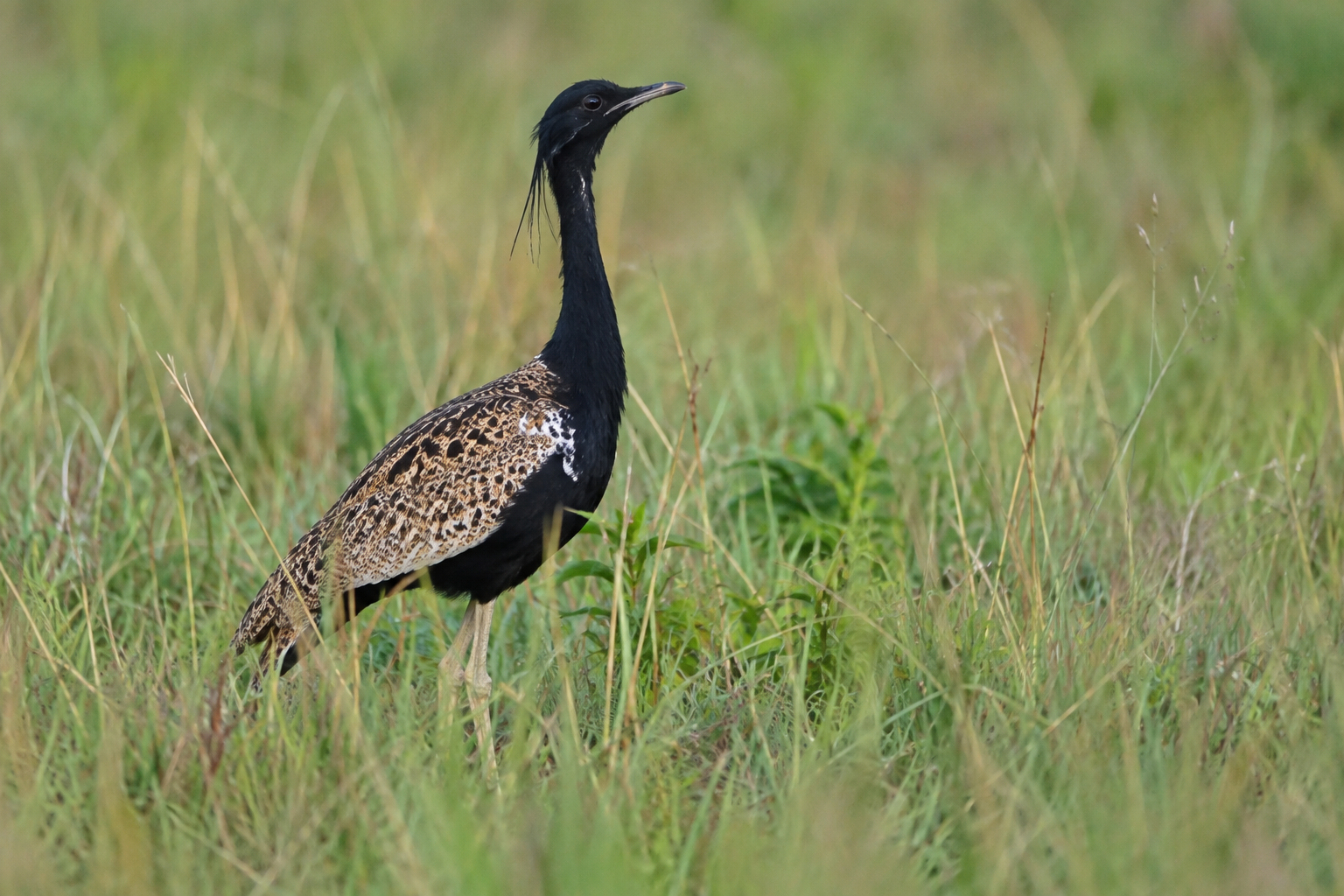
An adult Bengal florican is evidence of presence, not proof that chicks have hatched or survived. · AI-generated illustration
A male Bengal florican displaying above Nepal’s grasslands is an encouraging sight. It shows that an adult bird is present and performing breeding behaviour. But does it show that a nest will hatch, that chicks will survive, or that a new generation will eventually breed? Those are different questions. For Bengal florican conservation Nepal, the distinction matters: protecting the adults we can see is essential, but understanding whether they are replacing themselves requires evidence that is much harder to collect.
This investigation asks a specific question: what does the available evidence actually tell us about successful breeding and the survival of young Bengal floricans in Nepal? A record of a displaying male, a nesting female, eggs, or a young bird can each contribute to the answer. None, on its own, describes the whole journey from breeding attempt to a bird entering the adult breeding population.
To read Nepal’s breeding records fairly, we need to keep four stages separate:
- Breeding activity includes courtship displays and other behaviour associated with reproduction. Such observations indicate breeding behaviour, but displays alone do not establish that eggs were laid or young were produced.
- Nest success usually concerns whether a nesting attempt produces at least one hatched chick. Records need a stated definition and a known outcome: finding eggs is not the same as documenting hatching.
- Chick survival concerns what happens after hatching. A chick seen once has survived to that observation, but its later fate remains unknown unless follow-up evidence establishes otherwise.
- Recruitment means young birds joining the breeding population. This is a later milestone than hatching or surviving the first weeks of life, and it requires evidence connecting young birds with subsequent breeding participation.
These distinctions prevent both undue optimism and unnecessary pessimism. An adult count cannot be treated as a count of successful families. Equally, a lack of chick observations does not automatically mean that no chicks survived. Ground-nesting birds and their young can be difficult to detect, and observations depend on where, when and how people search. Missing evidence and evidence of failure must not be confused.
The scale of a claim matters too. A confirmed breeding outcome at one location would establish something important about that place and nesting attempt. It would not, by itself, reveal a national success rate or show whether enough young survive to sustain Nepal’s population. That broader judgement needs repeated observations, clear methods and appropriate coverage, rather than isolated sightings assembled into a reassuring story.
This is therefore an evidence investigation, not another introduction to the species, and not a discussion of grassland-cutting practices. The focus is on what records demonstrate, what they merely suggest, and where uncertainty remains. Useful evidence should let us identify the breeding stage observed, the outcome actually confirmed and the limits of any conclusion. Keeping those boundaries visible makes it possible to value every reliable record without asking it to prove more than it can.
What Nepal’s Breeding Records Can—and Cannot—Tell Us
For Bengal florican conservation Nepal, the central distinction is between finding adults in breeding habitat and showing that they produce surviving young. Nepal’s published surveys establish important facts about distribution and displaying males. They offer a less complete answer to the question of breeding success.
What the Nepal sources measure
- Baral, Timilsina and Tamang’s 2003 study, Status of Bengal Florican Houbaropsis bengalensis in Nepal, published in Forktail: This reports surveys undertaken in 2001 in the grasslands of Shuklaphanta, Bardia and Chitwan, then named royal protected areas. Field searches and observations of floricans, particularly conspicuous displaying males, supported an assessment of their distribution and population status. The relevant sampling units were surveyed grasslands and detected birds—not a cohort of nests followed through incubation and chick-rearing. Its adult records should therefore not be presented as a percentage of nests succeeding or young surviving.
- The Status of Nepal’s Birds: The National Red List Series (2016): This national assessment brings together published studies, survey information and field records, including evidence from Nepal’s principal florican areas. It is a compilation across periods, rather than one breeding-season experiment with a common field method. Its species assessment helps establish conservation status, distribution and reported threats. It does not supply a single, consistently monitored sample of nests or chicks from which a national breeding-success rate can be calculated.
These sources should be read alongside their underlying records, not treated as interchangeable datasets. An adult total, a count of displaying males and a population estimate adjusted for overlooked birds measure different things. No nest or chick sample size is inferred here from any of those figures.
Which observations demonstrate breeding?
A displaying male demonstrates breeding activity, not successful reproduction. A confirmed nest establishes a nesting attempt. Eggs recorded hatching establish hatching for that attempt. A chick observation confirms that at least one young bird was alive at that moment, but cannot establish its later survival.
Isolated nest or chick records are valuable documented field observations when their location, date and identification are traceable. Without those details, they should not become numerical evidence. Estimating nest success requires monitored nesting attempts and their outcomes; estimating chick survival requires repeated observations of identifiable young or broods. Recruitment requires evidence that young survive to enter the breeding population.
Why the answer remains incomplete
Displaying males are easier to detect than concealed females, nests and small chicks. Grass height, observer access, survey timing and repeat visits affect detection. Coverage of selected grasslands cannot automatically represent every suitable patch, while losing sight of a brood is not evidence that it died.
The sources above do not establish a Nepal-wide cohort followed from nesting to recruitment. That is a knowledge gap, not proof of breeding failure. Nor should unobserved losses be assigned to predators, fire, flooding or grass cutting. Research from India or Cambodia must be labelled as outside-Nepal evidence: it can guide monitoring, but cannot supply Nepal’s missing breeding outcomes.
Conclusion: What Would Give Conservation a Clearer Answer?
The cautious answer is that Nepal’s breeding records do not yet give a clear, complete picture of Bengal florican breeding success. Evidence of breeding activity matters, but it cannot by itself show how often nesting attempts produce young that survive to breed. For Bengal florican conservation Nepal efforts, the central question is therefore not simply whether breeding occurs, but whether enough birds move successfully through each stage of reproduction to support the population.
Three unanswered questions deserve priority. What proportion of nests hatch? Of the chicks that hatch, how many survive their vulnerable early life? And how many young birds eventually enter the breeding population? These are connected outcomes, not interchangeable measures. A nest that hatches represents progress, but it does not establish that its chicks survived. Likewise, observing a young bird does not demonstrate that it later became a breeding adult.
Follow outcomes, not just signs of breeding
A clearer answer would require monitoring that follows defined outcomes consistently across breeding seasons. Records should distinguish signs of breeding, confirmed nesting attempts, known hatching outcomes and observations of surviving young. Where an outcome cannot be established, it should remain unknown rather than being treated as success or failure. This distinction is especially important when birds are difficult to observe and some breeding attempts may never be detected.
Consistency also means recording how observations were made. Survey effort, coverage and the timing of visits affect what observers find. Without that context, an apparent difference between sites or seasons could reflect different observation opportunities rather than a real change in reproductive performance. Comparable methods would make records more useful, while repeated monitoring could help separate an isolated observation from a pattern that deserves conservation attention.
Make uncertainty visible and disturbance minimal
Better information must not come at the birds’ expense. Any nest work should be led by authorised specialists, with appropriate permissions and methods designed to minimise disturbance. Monitoring should avoid unnecessary approaches, repeated flushing or public disclosure of sensitive nest locations. Visitors and general birdwatchers can contribute responsibly through established reporting channels without searching for nests or trying to follow chicks.
Transparent reporting is equally important. Any estimate of hatching success should state how many nests informed it, which outcomes were uncertain and what the methods could have missed. Early-life survival and entry into the breeding population should be reported with the same care. If available observations cannot support an estimate, saying so is more useful than presenting a precise-looking figure that hides major gaps.
The aim is not to demand certainty before acting. It is to make conservation decisions with a clearer understanding of what is known, what remains unresolved and what monitoring could realistically reveal. Adult surveys remain essential for tracking the birds present and their distribution. But assessing whether breeding is contributing to population renewal also requires measurable reproductive outcomes: nests hatching, young surviving and birds entering the breeding population. Those outcomes are a necessary complement to adult surveys, not a replacement for them.