Conservation
Who Decides When Chitwan’s Grasslands Are Cut?
EverestBlog AI · Nov 1, 2026 · 11 min read
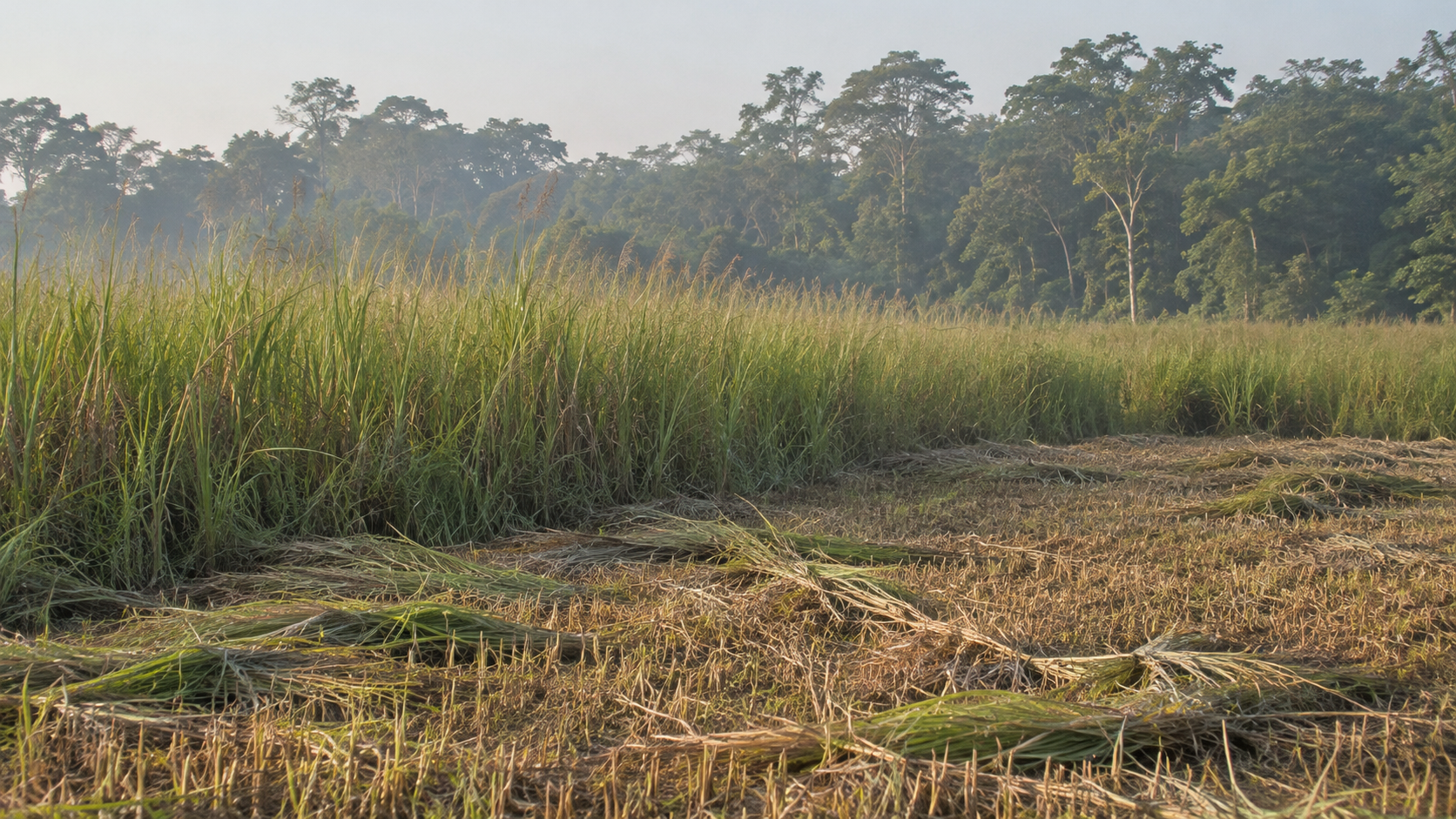
Cut and uncut patches offer different habitat conditions. The reporting will examine how managers choose their timing, extent and location. · AI-generated illustration
If one patch of Chitwan’s grassland is cut short while the patch beside it remains tall, what explains the boundary? Is it a plan to encourage fresh growth, a decision to retain wildlife cover, or the result of people collecting grass? This is a question, not a reported scene from a field visit. But it offers a useful starting point for understanding a landscape where an apparently simple act—cutting grass—can serve different purposes and affect different species.
Grasslands are an important part of Chitwan National Park’s mosaic of rivers, wetlands and forests. They provide feeding areas and shelter for wildlife, including greater one-horned rhinos and deer. Yet “good grassland” does not mean the same thing everywhere, or for every animal. Short vegetation can offer accessible new growth to grazing animals; taller stands can provide concealment and habitat for birds and other wildlife. The value of either depends on the species, the season and the surrounding landscape. A freshly cut area is therefore not automatically an improvement, and an uncut area is not automatically neglected.
Chitwan grassland management is a set of choices about habitat, not simply a task of clearing vegetation. Cutting changes the height and structure of grass immediately. Its longer-term effects depend on factors such as regrowth, moisture, grazing pressure and whether woody plants or invasive species are spreading. Timing matters because wildlife may be using a patch for feeding, shelter or breeding when work begins. The size and location of a cut also matter: leaving nearby cover creates a different habitat pattern from cutting a broad area uniformly.
That brings us to the central question: who decides when and where to cut? The park’s conservation responsibilities make its management authorities central to planned habitat work. But identifying an institution is only the beginning. An accountable explanation needs to distinguish the people who set priorities, those who approve work and those who carry it out. It also needs to ask whose knowledge informs the choice: observations from park staff, ecological advice and local experience may each help explain what a particular patch needs. Their actual roles should be established, not assumed.
Another distinction is essential. Planned habitat cutting and community grass collection are not interchangeable activities. Habitat work is intended to achieve a conservation outcome. Community collection involves access to grass as a useful resource, including material used for thatching. Both can remove vegetation, but that shared physical result does not mean they have identical objectives, permissions, schedules or restrictions. Any current arrangements for community access, including permitted locations and collection periods, should be verified with the park and relevant local institutions; check locally rather than relying on an old visitor account.
For readers, the useful question is therefore not just whether grass has been cut, but under which decision and for what purpose. A visible patchwork cannot answer that by itself. To understand it, we need to connect the condition of the habitat with the authority behind the work, while keeping resource access separate from conservation planning. That distinction is the foundation for asking whether a cutting decision serves wildlife, acknowledges people’s needs and can be explained to those affected by it.
How a Cutting Schedule Becomes a Decision
A cutting date is the visible end of a longer decision. In Chitwan grassland management, the important questions are who proposed the work, who could change it, who authorised it and what happened on the ground. A management plan can explain the intended approach, but it cannot, by itself, prove why one grassland patch was cut on a particular day.
A complete, verified decision trail requires local records. No patch-level proposal, approval, work record or interview material was available for this account, so naming a completed operation would create false certainty. To follow one documented decision, start with a named grassland patch and a specific work season, then connect the following steps. Current procedures and collection arrangements: check locally.
From a field proposal to permission
The first link is the proposal. Ask the park office for the relevant management-plan provision and annual work programme, followed by any field assessment identifying the patch. What problem was the cutting meant to address: woody growth, ageing grass, access or another stated need? The record should identify who recommended cutting, its proposed extent and timing, and whether alternatives were considered.
Field staff can explain conditions that a broad plan misses, including wet ground, wildlife activity and routes for workers or machinery. Technical advisers may contribute habitat assessments or recommendations about leaving uncut cover. However, advice is not approval. Establish whether their input was requested, recorded and adopted, rather than assuming that every operation receives a separate scientific review.
Community representatives can raise concerns about thatch or fodder collection, entry arrangements, livelihoods and safety. Ask which buffer-zone bodies or user groups participated, whom they represented and whether their suggestions changed the proposal. Consultation does not automatically confer decision-making authority. A meeting attendance list shows participation; minutes recording a change provide stronger evidence of influence.
For approval, find the signed work authorisation or equivalent record. Management inside the national park falls under park authorities, but the responsible signatory and any further administrative or financial clearance must be confirmed for the particular operation. Separate permission to undertake habitat work from permission for residents to enter and collect material: they are not necessarily the same decision.
Why the approved date may move
Next, compare the approved programme with the budget and deployment records. Was funding released when needed? Were enough trained staff available to supervise safely? Did equipment, fuel or repairs limit the area that could be treated? Ask whether access routes could support machinery and whether rain, flooding or unusually dry conditions forced a delay or a different method.
Implementation records should show the actual dates, location, method and area treated, alongside any departure from the approved work. Interview the supervising field worker and, where relevant, community participants separately. Their accounts can clarify delays, but should be checked against records rather than treated as substitutes for them.
Finally, confirm collection rules directly with the park and relevant local representatives: eligible collectors, permits, charges, entry points, tools, supervision and whether cut material may be removed. These arrangements can change; check locally. Only after matching proposal, approval and completed work can a report reliably say who decided—and explain why the cutting happened when it did.
Which Habitat Needs Count—and How Results Are Tested
A cut grassland can offer tender new shoots while removing the cover another animal needs. In Chitwan grassland management, “better habitat” therefore needs a clear definition: better for which species, during which season, and for how long? Fresh forage for rhinos and deer matters, but so do nesting places, insect-rich feeding areas and shelter for less visible wildlife.
Fresh Growth Is Only Part of the Habitat
Timing shapes that trade-off. Cutting before dependable rain may leave exposed ground without rapid regrowth; cutting during breeding can destroy nests or remove protective vegetation. Seasonal needs are not identical across species, and breeding activity may shift with weather. A sound assessment should identify the birds and other animals using a proposed cutting area, rather than assume one calendar window protects everything.
Cutting height matters too. A low cut removes more standing cover, while retained stems can preserve some structure. Yet taller stubble is not automatically adequate nesting habitat or shelter. Its value depends on the species, vegetation density and conditions around the patch. Managers should explain what a chosen height is intended to achieve and whether field observations support that choice.
Patch size determines how far animals must move between feeding areas and refuge. Large, uniformly cut blocks may produce extensive short grass but leave little nearby concealment. Smaller cuts interspersed with retained vegetation can offer a habitat mosaic, although their value depends on placement and connectivity. Uncut strips should not be treated as sufficient simply because they appear on a map: their width, continuity and actual use matter.
Whose Needs Are Recorded?
The practical question is whether management records name the species and seasonal needs being considered. Alongside rhinos and deer, assessments should examine grassland birds, small mammals, reptiles and invertebrates. Ground-nesting birds need particular attention where active nests could be disturbed. Dense-cover specialists may respond differently from animals attracted to open feeding patches.
These are questions to investigate, not proof that every group is currently monitored. Ask park staff and researchers which surveys inform cutting plans, what habitats remain uncut, and whether findings change subsequent work. Where local monitoring records are unavailable, say so rather than presenting a recommended practice as an established Chitwan programme.
Testing Results Beyond a Greener Appearance
Useful monitoring starts before cutting and returns to the same locations afterwards. It should track vegetation height, cover and composition, including recovery of forage plants and changes in invasive plants. Greener growth alone cannot show whether habitat quality improved: vigorous regrowth may include unwanted species.
Wildlife monitoring should distinguish sightings, feeding signs and camera records from evidence of breeding success or sustained habitat use. More visible animals after cutting do not necessarily mean more animals; reduced cover can make detection easier. Comparisons with similar uncut patches, surveyed using the same methods and effort, provide a stronger test than photographs or impressions.
Even then, attribution needs care. Rainfall can drive regrowth, fire can alter vegetation, and grazing can keep shoots short or change plant composition. Records should therefore include these influences and acknowledge differences between comparison sites. A measured result states what changed, where and over what period; a cautious interpretation explains whether cutting probably contributed, without claiming it was the only cause.
Conclusion: What Makes a Cutting Decision Accountable?
Accountability in Chitwan grassland management begins with a clear distinction: helping to cut grass is not the same as holding authority over the cutting decision. Within Chitwan National Park, responsibility rests with the park administration under Nepal’s Department of National Parks and Wildlife Conservation. Community representatives, conservation partners, researchers and field workers may contribute knowledge or carry out agreed work, but their involvement does not remove the park authority’s responsibility to explain and review its decisions.
A defensible schedule needs more than a date and a list of grassland blocks. It should connect each proposed cut to a habitat objective, explain why that timing and method were chosen, and identify who approved the work. Where operational choices are delegated, the chain of responsibility should remain visible. That matters because a cut intended to improve feeding habitat can also affect shelter, nesting cover and the movement of animals between patches.
The strength of a decision depends on the evidence behind that particular decision. A general management plan can establish useful goals, but it does not, by itself, demonstrate why one patch should be cut before another. Equally, evidence that grass was successfully removed does not establish that wildlife benefited. A stronger account links the schedule to field observations and then checks whether the intended habitat changes occurred, including any effects that argue for leaving more cover next time.
The available material does not establish how consistently those links are documented for Chitwan’s individual cutting operations. That is a limit on what can be concluded, not proof that decisions lack ecological judgment. Staff may hold relevant records that are not published, and field experience may inform choices without appearing in a public summary. Nevertheless, accessible explanations would allow readers and affected communities to distinguish a reasoned adjustment from an unexplained change.
The remaining transparency questions are therefore specific. Can people obtain the current cutting schedule, its habitat rationale and a record of later changes? Is there an accessible account of who was consulted, what concerns were raised and how those concerns were addressed? Are monitoring findings available in a form that connects results to the next decision? The current contact point and process for requesting these records should be checked locally.
Consultation also needs to mean more than attendance at a meeting. Local feedback can help identify access difficulties, wildlife encounters or changes in grass availability that a habitat survey may miss. But consultation is not necessarily consent, and local observations do not replace ecological assessment. Accountability requires showing how both kinds of information were considered, including why a requested change was accepted, modified or declined.
The clearest answer, then, is that the park administration holds responsibility, while the quality of support must be demonstrated through decision records and follow-up evidence. A documented feedback route would name who receives monitoring results and community concerns, when they are reviewed, and how any resulting revision enters the next cutting schedule. Such a route cannot be confirmed from the material available here. Its existence and use remain questions to verify—not grounds to assume failure, but essential tests of whether learning can genuinely change the next cut.