Conservation
Domestic Dogs at Chitwan’s Park Edge: Who Monitors Disease Risks to Wildlife?
EverestBlog AI · Nov 1, 2026 · 21 min read
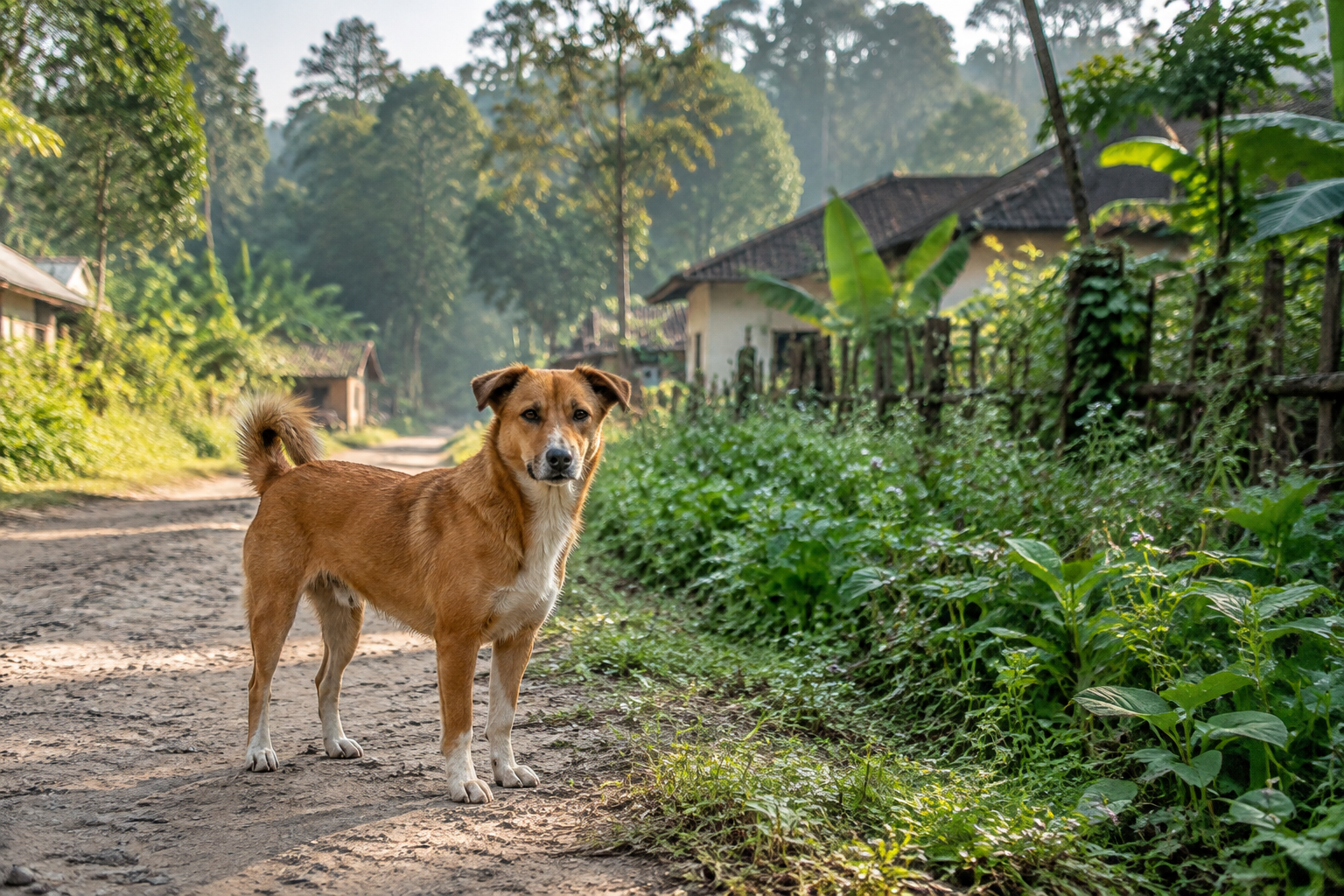
A domestic dog near Chitwan’s park edge. Proximity to wildlife raises monitoring questions but does not establish disease transmission. · AI-generated illustration
At the edge of Chitwan National Park, wildlife habitat meets a lived-in landscape of homes, farms, roads and livestock shelters. Domestic dogs share this space with people, while wild mammals may move through nearby forest patches, grassland and settlement margins. These overlapping movements raise an important question: who watches for disease risks when animals do not stay within the boundaries drawn on a map?
The issue of domestic dogs and wildlife disease in Chitwan begins with that shared landscape, not with an assumption that dogs are causing an outbreak. A dog walking near forest does not necessarily meet a wild animal. Even when animals use the same place, they may do so at different times. An encounter, in turn, does not automatically lead to infection. Each step—from sharing space to exposure, infection and onward transmission—requires its own evidence.
Still, the question deserves attention. Domestic dogs can carry infections that affect other mammals. Rabies and canine distemper are two relevant examples, although they differ in how they spread, which animals they affect and what a response requires. Naming these diseases identifies reasons for surveillance; it does not establish that either is currently spreading between dogs and wildlife in Chitwan. That distinction matters for residents, visitors and anyone interpreting reports of a sick or dead animal.
Nor are park-edge dogs a single, uniform group. Some are owned and closely supervised. Others belong to households but roam, while some may receive food from several people without having one clearly responsible owner. Those differences can affect whether a dog is vaccinated, whether illness is noticed and whether someone can provide a useful history. Appearance alone cannot reliably tell an observer who owns a dog, whether it has been vaccinated or whether it carries an infection.
This investigation asks how possible disease risks become visible—and what happens after someone raises a concern. It will examine where dogs and wild mammals could cross paths, how animal-health teams assess suspected exposure, and what vaccination records can establish. It will also follow the reporting question: which office receives information about an ill dog or an unusual wildlife death, who can investigate, and who has responsibility for taking action?
Answering that question means looking beyond any single institution. Park authorities, municipal animal-health services, veterinary professionals, laboratories and community organisations may hold different pieces of information or contribute to a response. Their involvement should not be mistaken for proof of a coordinated monitoring system. The investigation needs to distinguish routine surveillance from occasional treatment, vaccination campaigns or investigations triggered by a particular report. Current reporting contacts and service arrangements can change; check locally rather than relying on an old contact list.
The scope here is specific: disease risks at the domestic dog–wildlife interface around Chitwan. Dogs chasing wildlife, concerns about bites and the welfare of roaming dogs are related issues, but none by itself proves disease transmission. Likewise, an animal behaving strangely offers a reason to seek professional assessment, not a diagnosis. Establishing the cause of illness may require a clinical examination, suitable samples and laboratory testing; connecting cases across species requires further evidence.
Above all, this inquiry separates a plausible risk from a demonstrated event. Shared space can create opportunities for exposure, but potential exposure is not evidence of a local outbreak or confirmed transmission. Even finding the same pathogen in a dog and a wild mammal would not, on its own, establish which animal infected the other. The aim is neither to blame dogs nor to dismiss concern. It is to identify what is being monitored, where responsibilities lie and how confidently the available evidence supports claims about wildlife health.
Where Dogs and Wild Mammals Could Cross Paths
Understanding domestic dogs and wildlife disease in Chitwan starts with a practical question: where could dogs and wild mammals use the same space? Along the park edge, settlement margins, grazing routes, waste sites and forest access points are useful places to investigate. These are possible contact settings, not confirmed disease hotspots. A dog near forest cover does not, by itself, show that wildlife contact or infection has occurred.
A useful field map should record the location, time, habitat and activity at each observation point. Notes should explain whether an observer saw a dog and a wild mammal together, saw them separately at the same location, or only heard about an encounter. These distinctions prevent a map of possible overlap from being mistaken for evidence of disease transmission.
Settlement margins: follow movement, not labels
At settlement margins, observers can look for dogs moving between homes, fields, drainage channels and nearby vegetation. Interviews with household members can help establish where dogs sleep, whether they are fed regularly and how far they usually travel. Ask about particular dogs rather than relying on a general claim that “many dogs go into the forest.”
A roaming dog is not automatically a stray. An owned dog may spend much of the day outside without supervision. A dog seen alone may also receive food or care from several households. Unless ownership has been checked, record it as a dog of unknown ownership. Appearance, a missing collar or distance from a house cannot reliably settle that question.
Grazing routes: note who travels together
Routes used to move livestock can also carry dogs towards vegetation, water or grazing areas. Fieldwork should establish which routes are actually used and whether dogs accompany herders, follow livestock independently or merely pass through. Access rules and permitted grazing areas may differ by location; check locally before planning observation visits.
Interviews with herders can identify places worth watching, but their accounts need clear attribution. “A herder reported that dogs chased a wild mammal here” is different from “an observer recorded a chase.” If the animal could not be identified confidently, leave its identity uncertain. Record the reported timing and location without turning an approximate memory into a precise event.
Waste sites: distinguish attraction from exposure
Food scraps, discarded animal remains and other accessible waste may attract dogs. Some wild mammals may investigate the same material. Observers should record what is present, which animals actually visit and whether access changes when waste is removed or covered. Do not assume that every dump attracts wildlife, or that animals using one site necessarily meet.
Shared use can suggest an exposure route worth assessing, but it does not establish one. A bite, contact with saliva, or contact with contaminated material has different significance depending on the pathogen involved. Seeing a dog eat waste cannot prove that it carries an infection or has passed one to wildlife.
Forest access points: watch without drawing animals in
Paths, gates and other forest access points can help observers understand dog movement. Record entry and exit directions, group size and any visible interaction with wild mammals. Observation must follow local access rules. Do not bait animals, leave food or encourage dogs towards wildlife to obtain an encounter.
Across all four settings, keep three evidence categories separate: observed encounters, residents’ accounts and hypothetical exposure routes. Repeat visits at different times can improve coverage, while interviews can reveal movements missed during short visits. Even then, not seeing contact does not prove it never happens. The result should be a clearly labelled map of where further investigation is justified—not a claim that every roaming dog threatens wildlife.
How Animal-Health Teams Assess Disease Risk
Assessing domestic dogs and wildlife disease in Chitwan requires more than counting roaming dogs or spotting a sick wild animal. Animal-health teams need to identify which pathogens could be present, which species are susceptible, and how contact might allow infection. Veterinarians and wildlife-health specialists should also consider the consequences of missing a dangerous case, especially when people may have been exposed.
Which hazards deserve urgent attention?
A useful question for specialists is: “Which diseases would you investigate first here, and what evidence guides that choice?” Rabies demands urgent attention because it can infect mammals, threatens human health and is almost always fatal once clinical signs appear. It usually spreads when infected saliva enters a bite wound or contacts broken skin or mucous membranes. A suspected rabid animal therefore requires a different response from a dog with an uncomplicated skin condition.
Canine distemper raises a different set of questions. The virus affects dogs and various wild carnivores, but susceptibility and disease severity differ among species. Transmission commonly involves respiratory droplets and close contact with infected secretions. Specialists should explain which local wildlife species could be vulnerable and whether observed contact creates a plausible exposure route. A shared landscape alone does not establish an equal risk for every mammal.
Priorities also depend on unusual deaths, clusters of illness, vaccination history and opportunities for contact. Ask whether the concern involves bites, close encounters, shared resting places or another route. These distinctions help teams select useful samples rather than test broadly without a clear question.
From clinical signs to safe sampling
Clinical assessment starts with an animal’s history and observable condition: changes in behaviour, difficulty walking, excessive salivation, breathing problems, discharge from the eyes or nose, diarrhoea or seizures. None of these signs, by itself, identifies a pathogen. Poisoning, trauma and other infections can resemble parts of the same picture. Wildlife may also hide illness or be observed too briefly for a reliable assessment.
Teams should record where and when the animal was found, its species, symptoms and known contacts. For dogs, ownership and vaccination information can help interpret findings. For wildlife, observation from a safe distance may come before any decision to capture or immobilise it. Those decisions require trained personnel and the relevant permissions; current arrangements should be checked locally.
Residents and visitors should not restrain sick animals, collect saliva or handle carcasses. Qualified teams choose protective equipment, restraint methods and samples according to the suspected disease. Distemper investigations may use swabs, blood or tissues, depending on the clinical stage and laboratory guidance. Animal rabies confirmation generally relies on brain tissue collected after death by trained personnel. Any possible human rabies exposure needs prompt medical assessment, without waiting for an animal’s test result.
What a test result can establish
Laboratory testing is only as useful as the sample and its handling. Correct labelling, suitable storage, timely transport and a reliable case history matter. A negative result may not exclude infection if sampling occurred at the wrong stage or the material deteriorated. Antibody findings require particular care: depending on the test, they may reflect vaccination or previous exposure rather than current illness.
- Suspected illness: signs and circumstances justify investigation, but the cause remains unconfirmed.
- Confirmed infection: appropriate laboratory evidence identifies infection in the sampled animal; interpretation still depends on the test.
- Transmission direction: establishing who infected whom requires additional evidence, including timing, contact opportunities and, where available, genetic comparison of pathogens.
Finding the same pathogen in a dog and a wild carnivore does not automatically prove dog-to-wildlife transmission. Wildlife-to-dog transmission, or exposure from another source, may also be possible. Even closely related pathogen sequences need supporting field evidence before teams assign direction.
What Vaccination Records Actually Show
Vaccination records are a useful starting point for understanding domestic dogs and wildlife disease in Chitwan, but their meaning depends on the detail behind each entry. A campaign total shows activity. It does not, by itself, show how many individual dogs were protected, where those dogs lived or whether roaming animals near the park boundary were reached.
Request dated, geographically specific records from the relevant municipal veterinary or livestock service and the organisations that ran vaccination campaigns. Ask for ward-level information and, where available, settlement names, vaccination locations and the areas where dogs were caught or brought from. A vaccination site beside a park-edge settlement may also serve dogs from elsewhere. The site address should not automatically be treated as the animal’s home or roaming area.
Ask what was given, not just how many injections
“Vaccinated dogs” is too broad a category for careful reporting. Request the vaccine name, the disease or diseases it targets, the administration date and whether the entry represents an initial vaccination or a repeat dose. Rabies vaccination should not be described as protection against canine distemper or parvovirus. If a combination vaccine was used, ask staff to identify its components from the product or campaign record rather than guessing.
A useful records request should seek:
- Reporting period: exact campaign dates and dates covered by routine clinic records.
- Location: the ward, settlement and recorded origin of each dog, where available.
- Vaccine details: product, diseases targeted and administration dates.
- Animal identification: an individual record number and any supporting photograph, tag or other identifier.
- Dose history: earlier vaccinations, repeat doses and the basis for any next-dose date.
- Population estimate: how organisers estimated the number of eligible dogs in the same area.
Separate doses from individual dogs
Ask how teams link a returning dog to its earlier record. An owner-held vaccination card can help, but cards may be lost, and community-cared-for dogs may be presented by different people. Where several providers work in the same wards, ask whether their records are reconciled. Adding municipal, charity and private-clinic totals without checking for overlap can count the same animal more than once.
Repeat doses are not necessarily duplication or waste: they may be appropriate under the vaccination schedule. The reporting question is whether totals distinguish doses administered from unique dogs vaccinated. Also ask how entries with unknown vaccination histories are labelled. An undocumented earlier dose should not quietly become either a confirmed first vaccination or a confirmed booster.
Coverage needs a credible population estimate
Coverage requires both a numerator and a denominator: the number of eligible individual dogs vaccinated and the estimated eligible dog population within a defined place and period. Eligibility should follow the relevant vaccine guidance or programme criteria, including age where applicable. Ask whether the population estimate came from household visits, registration lists, street counts or another method, and when it was last updated.
Each approach can miss animals. Household lists may overlook unowned dogs; street counts can miss dogs resting out of sight or count moving animals twice. Owned dogs may also roam, so ownership and roaming status should be recorded separately where possible. Births, deaths and movement between settlements can make an older denominator unreliable.
For park-edge reporting, present any coverage figure with its boundaries, dates and limitations. A large dose total cannot establish coverage among roaming dogs unless those dogs were identified and meaningfully included in the population estimate. Vaccination records document delivery; they do not by themselves prove immunity or reduced disease transmission to wildlife. For current campaign schedules, vaccine availability and services, check locally.
Who Receives Reports—and Who Acts?
Monitoring domestic dogs and wildlife disease in Chitwan involves several services, not one reporting desk. A sick dog, a dead wild mammal and a person bitten by an animal need different responses, even when they belong to the same incident. The first office contacted may refer the report elsewhere. Current telephone numbers, duty officers, laboratory arrangements and jurisdiction must be confirmed locally, especially around municipal boundaries and the park’s buffer zone.
Who is responsible for what?
- Park staff: Chitwan National Park’s administration and field posts are the appropriate first contacts for sick or dead wildlife in the park and for guidance on wildlife incidents along its boundary. They can coordinate wildlife assessment and authorised response. Outside their jurisdiction, another responsible forest office may need to act; check locally.
- Local veterinary services: The municipality’s livestock or animal-health section is a practical starting point for a sick domestic dog. Its veterinary personnel can assess the case or arrange referral to the relevant government veterinary service. Treatment, isolation advice and disease investigation require veterinary oversight; reporting does not guarantee that a collection team is available.
- Government laboratories: Nepal’s Central Veterinary Laboratory under the Department of Livestock Services is a relevant national animal-disease diagnostic institution. Provincial veterinary laboratories may also be involved. The referring veterinarian must confirm which laboratory currently accepts the suspected disease, species and sample type. A laboratory tests suitable submissions; it does not replace the field authority responsible for managing the incident.
- Conservation partners: Organisations working with the park may support veterinary expertise, transport, equipment or field investigation when requested. They should not be presented as the statutory reporting authority or as an automatic emergency rescue service.
- Public-health services: Health facilities assess human exposures and provide or refer patients for rabies prevention and wound care. Municipal health sections and district or provincial public-health authorities may help coordinate follow-up where a wider exposure concern exists.
Three reporting routes
For a sick dog, contact local veterinary services. Give the location, whether the dog has an owner, signs observed from a safe distance, and any known bites or wildlife contact. Do not assume that aggression, drooling or weakness proves rabies. Ask who will assess the animal, whether referral is needed and whom to update if it moves or dies. Do not attempt capture or transport without professional instructions.
For sick or dead wildlife, notify the nearest park post or park administration. If the animal is outside the park, ask which park or forest authority has responsibility rather than assuming that the boundary ends the reporting obligation. Share a location pin or clear landmark, the time seen and a photograph only if it can be taken safely. Keep people and domestic animals away. Do not touch, move, bury or burn a carcass before receiving official advice.
For a human bite or other possible rabies exposure, seek health care immediately. Wash bites and scratches thoroughly with soap and running water for at least 15 minutes. Saliva entering broken skin, eyes or the mouth also needs urgent assessment. Do not wait for animal capture, observation or a laboratory result before seeking care. Report the animal separately through the veterinary or wildlife route.
Samples and feedback need a named lead
Only trained, authorised personnel should collect samples. The receiving laboratory should confirm requirements before collection or dispatch, including packaging, labelling, temperature control, paperwork and safe transport. These differ by test; residents should never collect brain tissue or carry an animal carcass to a clinic themselves.
Ask for a case reference or named contact, the receiving office and the next update point. Laboratory findings should return to the submitting professional for interpretation and response. Where people were exposed, veterinary, wildlife and health teams need timely communication. Reporters may receive practical advice rather than confidential case details; if no update arrives, follow up with the named lead.
What the Local Evidence Can—and Cannot—Prove
Evidence about domestic dogs and wildlife disease in Chitwan needs a clear address, date and diagnosis. A sick dog near the park, a positive laboratory result and a confirmed infection in a wild mammal are different findings. Even together, they do not automatically prove transmission between species. The key question is whether records connect the same pathogen, overlapping places and a plausible sequence of exposure.
A verified, linked set of Chitwan dog and wildlife surveillance records is not established here. Without that, it would be misleading to claim that local reports demonstrate a dog-to-wildlife outbreak—or that they rule one out. Any review should identify the underlying report or paper, its sampling locations, collection dates, diagnostic methods and species tested. A summary mentioning “Chitwan” is not enough to establish exposure at the park boundary.
Local findings need local boundaries
Chitwan District, Chitwan National Park and the park’s buffer zone are not interchangeable study areas. Samples collected from dogs in an urban neighbourhood may reveal something about those animals, but not necessarily about dogs visiting forest edges. Likewise, wildlife examined through a rescue facility may have originated elsewhere. The animal’s actual collection or exposure location matters more than the address of the laboratory processing its sample.
Evidence from elsewhere in Nepal can show that a pathogen occurs nationally or that a testing method is useful. Research abroad can explain how dog-associated infections threaten susceptible wildlife. Neither establishes transmission in Chitwan. Peer review strengthens scrutiny of methods, but it does not make a small or geographically distant sample representative of this landscape. Conversely, a local surveillance report may contain valuable observations even if it has not appeared in a journal.
What samples and tests really represent
Surveillance records should distinguish active searches for disease from reports received after an animal becomes visibly ill. Complaint-based surveillance tends to capture accessible animals, conspicuous symptoms and places where people know whom to contact. Vaccination clinics sample dogs that handlers or catching teams can reach. Neither approach necessarily represents unhandled dogs, remote settlements or animals moving through forest margins.
Laboratory findings also need careful interpretation. Antibodies may indicate previous exposure or vaccination, depending on the pathogen and test; they do not automatically show current infection or infectiousness. Detection of pathogen genetic material provides different evidence, but still does not identify the source by itself. For suspected rabies, clinical signs alone should not be treated as laboratory confirmation. Negative results depend on suitable samples, collection timing, storage and test performance.
Missing dog population estimates weaken landscape-wide conclusions. A count of positive samples cannot establish how common infection is among all local dogs when the total population and selection process are unknown. Repeated sampling of accessible animals can distort results. Useful estimates would distinguish owned, loosely supervised and unowned dogs while accounting for movement and turnover. Categories should describe management and behaviour, not assume disease status.
Testing a transmission claim
Dog and wildlife records can be compared meaningfully only when their locations, time periods, case definitions and tests are compatible. A dog antibody survey from one period cannot directly explain an unrelated wildlife death years later. Missing wildlife reports are also uncertainty, not proof of absence: carcasses may go undiscovered, deteriorate before sampling or never reach a diagnostic service.
Stronger evidence would combine repeated dog surveys across different park-edge settings, credible population estimates, timely wildlife carcass investigations and coordinated testing for the same pathogens. Genetic comparisons between detected pathogens could help assess relatedness, alongside animal movement, contact opportunities and the timing of illness. Even closely related sequences may not establish transmission direction without those details. The defensible conclusion must match the evidence: local exposure, confirmed infection and demonstrated cross-species transmission are separate claims.
Conclusion
The clearest answer to who monitors domestic dogs and wildlife disease in Chitwan is that no single kind of monitoring can cover the whole risk. Veterinary services, park and wildlife personnel, and public-health teams each have a relevant role. Dog vaccination records describe preventive work; veterinary assessments investigate sick animals; wildlife observations can flag unusual illness or deaths. These activities become a useful monitoring system only when information moves between them. Their existence alone does not establish that Chitwan’s park edge has continuous, coordinated disease surveillance.
Responsibility should therefore be understood as a chain, not simply a list of offices. A report about an ill domestic dog needs veterinary assessment. A sick or dead wild mammal requires notification through park or wildlife authorities and safe handling by authorised personnel. A possible human exposure, especially a bite, needs prompt medical assessment rather than waiting for an animal investigation. These are distinct response needs. What remains unresolved without a documented local procedure is who connects them, who requests further investigation, and who checks that a referral was received and acted upon.
That distinction matters for accountability. Receiving a phone call is not the same as assessing an animal, collecting a suitable sample, obtaining a laboratory result or deciding what action follows. A useful local reporting arrangement would identify a lead contact for each type of incident, a backup when that contact is unavailable, and a way to record the outcome. Current contact details and service availability should be checked locally. Residents should not have to work out institutional boundaries while trying to report an animal that appears seriously ill.
Vaccination records need equally careful interpretation. A recorded vaccination is evidence of a preventive intervention, not proof that transmission risk has disappeared. Its value depends on whether the record identifies the animal, the vaccine administered and the administration date, and whether repeat entries can be distinguished from newly vaccinated dogs. Campaign totals alone cannot establish coverage without a credible estimate of the relevant dog population. Nor can vaccination against one disease demonstrate protection against others. Auditable records would make prevention easier to assess without overstating what any campaign has achieved.
The same restraint applies to wildlife evidence. Dogs and wild mammals using nearby places creates a reason to investigate possible exposure, but it does not demonstrate infection or transmission. An animal’s appearance, a photograph or an unexplained death may justify a report; none by itself identifies the cause. Even detecting the same pathogen in domestic and wild animals would require further investigation before assigning a transmission route or direction. The appropriate conclusion is a need for evidence, not an assumption of an outbreak or a claim that dogs caused wildlife illness.
The practical priorities follow from these limits. Clearer referral links would help reports reach the right team. Auditable vaccination records would allow preventive work to be reviewed. Coordinated surveillance would bring veterinary and wildlife observations into a shared assessment, with public-health involvement when human exposure is possible. That coordination should include agreed triggers for investigation, safe sampling arrangements where feasible, and feedback to the person or office that first raised the concern. It should also distinguish an unconfirmed report from a clinically assessed or laboratory-confirmed finding.
Ultimately, protecting wildlife and caring for domestic dogs are compatible aims. The test of accountability is whether a concern can be followed from report to assessment, decision and recorded outcome—not whether one institution can be named in isolation. At Chitwan’s park edge, the responsible approach is to strengthen that chain while keeping claims proportionate to the evidence. Better prevention and clearer information can reduce uncertainty without blaming dogs, alarming communities or presenting a possible risk as an established disease event.