Conservation
Should You Share That Nest Location? A Chitwan Wildlife Photography Publishing Guide
EverestBlog AI · Nov 1, 2026 · 16 min read
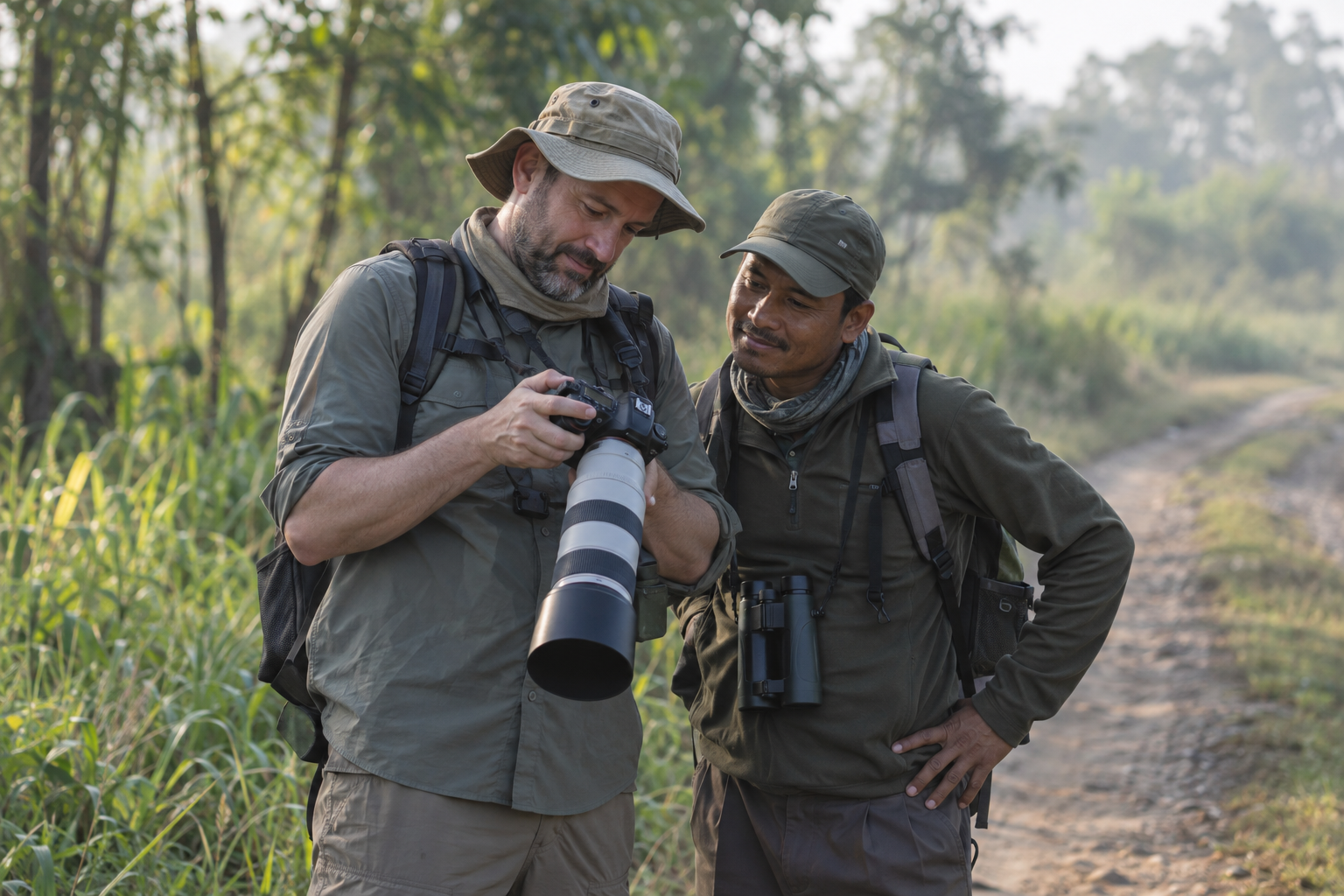
Responsible sharing starts before publication: consider what a photograph and its accompanying details could reveal. · AI-generated illustration
A photograph from Chitwan can make someone care about wildlife they have never seen. A bird carrying food to its young, a rhinoceros moving through grassland, or a crocodile resting beside a river can turn a distant landscape into something personal. Sharing that moment can celebrate Nepal’s natural heritage and recognise the patience of local guides. But a photograph can also do something its maker never intended: help strangers find a place where an animal needs space, shelter or an undisturbed routine.
That is the tension at the heart of Chitwan wildlife photography ethics. The same post that inspires admiration may invite attention to a sensitive site. A nest is an obvious example, but the concern can also apply to a roost, a den or another repeatedly used refuge. When an animal is tied to one place, it cannot simply avoid every visitor without a possible cost. Extra attention may interrupt feeding, resting or care of young, although the effects depend on the species, circumstances and visitor behaviour.
Publishing is therefore a separate ethical decision from taking the photograph. You may have stayed on an approved route, followed your guide’s instructions and made an image without causing an obvious disturbance. Those choices matter. Yet they do not automatically make every detail of the encounter suitable for public release. A quiet observation shared with a few companions can become a searchable reference for people you do not know. Your conduct at the site and the consequences of your post are related, but they are not the same question.
This guide focuses on what happens when photographs leave your camera and enter public view. It concerns social posts, online galleries, blog articles and other published material that could help an audience locate wildlife. It is not a guide to identifying birds, approaching animals, choosing lenses or making sharper images. Nor does it cover the design or management of camera-trap research, which involves different permissions, responsibilities and data decisions. Here, the subject is the publishing choice: what information your audience receives alongside, or through, a wildlife photograph.
The central question is simple to ask and sometimes difficult to answer: does helping others find this place outweigh the potential risk to wildlife? There can be genuine benefits to sharing location information. Visitors need practical guidance, responsible tourism can support local livelihoods, and public interest can strengthen appreciation for conservation. But those broad benefits do not mean that revealing a particular nest or refuge is necessary. Helping someone discover Chitwan is different from directing them to the exact spot where an animal is raising young.
Intent alone cannot settle that balance. Most photographers sharing an exciting sighting are not trying to cause harm. Their audience may also be well meaning. Even so, a public post can travel beyond its intended circle, lose its original context or remain discoverable long after the encounter. You cannot assume that everyone who finds it will arrive with a knowledgeable guide or understand why keeping a distance matters. The ethical task is not to predict every outcome; it is to consider foreseeable consequences before making access easier.
Nor is this a demand to hide every wildlife experience. Chitwan’s stories deserve to be told, and thoughtful photographs can build affection for its habitats and the people who help protect them. The useful distinction is between sharing an experience and exposing a vulnerable place. A compelling story does not always require directions. As you prepare to publish, think of location detail as a choice with consequences, rather than an automatic courtesy to followers. The aim is to keep the wonder of the encounter while asking whether your audience truly needs the information that could lead them back to its source. That pause is part of responsible storytelling, not a failure to share.
How a Photograph Can Give a Location Away
A wildlife photograph can reveal more than the animal in the frame. A nest hole beside a distinctive river bend, a location sticker or a caption describing a short walk from a lodge may help someone find the same spot. For Chitwan wildlife photography ethics, the useful question is not simply, “Did I share coordinates?” It is, “Could someone work out this location from what I published?” Several separate routes can expose a site, even when none seems precise on its own.
Embedded GPS metadata
Some phones and cameras save latitude and longitude inside an image file, often within EXIF metadata. This information is not visible in the picture, but someone receiving the file may be able to inspect it. Whether coordinates are recorded depends on the device, its settings and sometimes a connected app. Do not assume that using a dedicated camera means a photograph contains no location data.
Before sharing, inspect the exported file for GPS fields, not just the original in your library. Export settings may preserve information you thought you had removed. Platforms handle metadata differently: a service may strip some information from a displayed image while handling downloads or original files differently. Features and policies can change, so check locally available settings and current platform guidance. Never treat uploading as proof that location metadata has disappeared.
Platform location tags
A location added through a social app is separate from the coordinates stored inside the image. Removing GPS metadata does not remove a place tag, map pin, check-in or location sticker that you add to the post. Some publishing tools may also suggest a location; review these suggestions rather than accepting them automatically.
The level of detail matters. Naming the wider Chitwan area generally gives less direction than tagging a particular wetland, watchtower or accommodation property near an active nest. However, even a broad tag can narrow the search when the image contains other clues. Review the published post as a viewer would, including any map link or clickable place name.
Captions that become directions
Words can locate wildlife without an address. “Behind our lodge,” “just past the second bridge” or “five minutes from the canoe landing” may be enough for someone familiar with the area. Naming a route and describing where you stopped can turn an otherwise general caption into practical directions.
Timing adds another layer. Saying that chicks are currently being fed, or that an animal returns to a den each evening, tells readers that the site may still be active. Replies to comments count too: a cautious caption offers little protection if a later answer names the exact tree.
Recognisable landmarks inside the frame
Look beyond the subject. A signboard, bridge, building, unusual tree, riverbank profile or distinctive combination of tracks and vegetation may identify the spot. People who live or guide nearby may recognise features that look anonymous to a visitor. Check wide images, video backgrounds and every frame in a carousel; the close-up may reveal little while the opening landscape gives the site away.
Clues assembled across several posts
Separate posts can form a trail. A morning lodge photo, a route update and an afternoon nest image may together narrow the location. Companions’ tags, older trip reports and public comments can add missing pieces. Review the surrounding posts, not only the wildlife photograph.
Disclosure does not automatically cause harm. The risk depends on the species, breeding stage, access and visitor behaviour. But extra attention can bring repeated approaches, noise, crowding or blocked movement routes. Nesting adults may hesitate to feed young; roosting animals may lose resting time; denning wildlife may alter their movements or avoid a site. These are possible consequences, not certain outcomes. Recognising how information travels helps you judge whether a photograph could invite pressure to a sensitive place.
Ask Guides and Conservation Practitioners What Is Sensitive
Good decisions about sensitive wildlife locations begin before publication, ideally before the camera comes out. For Chitwan wildlife photography ethics, a conversation with a guide can reveal concerns that a visitor might miss. Conservation practitioners can add context about breeding, disturbance and protection work. Treat these conversations as fact-finding, not as permission to share a location simply because one person says it is safe.
Plan conversations around risk, not secret places
Arrange interviews with experienced Chitwan guides and practitioners whose work relates to the wildlife you photographed. Depending on the question, that might mean a bird specialist, a conservation researcher or an authorised park representative. Explain where the article will appear, what photographs it includes and whether readers could identify the setting. Do not ask anyone to list vulnerable sites for publication.
Send questions ahead when possible. Ask which types of places warrant discretion: active nests, denning areas, breeding grounds, roosts or frequently used wildlife routes, for example. These are discussion prompts, not claims that every such place has the same restrictions. Ask what makes a site vulnerable and whether the concern is crowding, repeated disturbance, illegal collection, hunting or interference with conservation work.
- Which wildlife activities make location sharing particularly risky?
- Can a normally visited place become sensitive during breeding, nesting or other vulnerable periods?
- What signs should prompt a photographer to stop approaching and seek advice?
- What broad location wording would describe the photograph accurately without directing visitors to the site?
Ask how sensitivity changes
A location is not permanently safe to disclose just because it was suitable for visitors on an earlier trip. Ask how advice changes when birds begin nesting, young animals appear or wildlife starts using a quieter area. Also ask whether visitor pressure, access changes or an ongoing conservation operation affects publication advice. Check locally for current guidance; an old interview is not a reliable statement of present conditions.
Avoid treating departure as proof that risk has ended. A nest or shelter may be reused, and nearby habitat may remain important. Ask who can assess whether delayed publication reduces the concern, and what information they need. Record when the advice was given and its limits, without including sensitive coordinates in interview notes that may be circulated widely.
Separate rules from precautionary advice
Ask explicitly whether each instruction is a formal restriction, an access condition or a precautionary recommendation. A guide’s request for discretion can be valuable without being law. Equally, personal reassurance cannot override an applicable restriction. For claims about park rules, permits, photography access or prohibited activities, seek confirmation from the responsible authority and consult current official material where available.
In the article, name the basis of the guidance accurately. Write that a practitioner recommends withholding detail when that is what they said; do not turn advice into a legal ban. If sources disagree, clarify whether they are discussing different species, activities or jurisdictions. Where the uncertainty remains, say so and avoid presenting disclosure as cleared.
Agree on wording and private reporting
Test broad wording with your sources, such as “in the Chitwan area,” rather than assuming a nearby landmark is harmless. Confirm that the phrase is geographically accurate. Do not describe a photograph as taken inside Chitwan National Park if it was made elsewhere.
For uncertain cases, ask whom to contact before publishing. Ask separately about appropriate private channels for reporting disturbance, suspected offences or wildlife observations. Check locally that the contact is current, authorised and suitable for that report. Public comments and open photography groups are not substitutes for confidential reporting.
Publish only verified, attributed responses, with agreed names and roles. Confirm quotations and factual summaries against your notes or recording. Remove example-site details even when they make an answer more vivid: readers need the reasoning, not directions to the wildlife.
Choose What to Publish, Edit, Delay or Withhold
Before you publish, judge the photograph and everything attached to it as one package. A nest image without a map pin can still reveal its location through a caption, a nearby landmark or a companion’s post. A practical rule for Chitwan wildlife photography ethics is to share only what lets people enjoy the story without making a sensitive site easier to find.
Run a pre-publication check
- Remove GPS data from the files you share. Check the exported photograph, not just the original in your camera or editing library. Use your device or editing software to remove location metadata, then inspect the resulting file to confirm it is gone. Do not assume a social platform will strip it for you. Downloads, messaging services and cloud albums may handle metadata differently.
- Leave out precise tags and directions. Avoid map pins, trail junctions, watchtower names, river bends, nearby accommodation names and descriptions such as “five minutes beyond the bridge.” Together, small details can become a route. A broad label such as Chitwan may be enough, provided the rest of the post does not narrow the search.
- Read the caption as a visitor looking for the site. Remove directions hidden inside your storytelling: where you parked, which path you followed or what stood opposite the nest. Check hashtags, album titles, location stickers, image descriptions and filenames too. Keep useful natural-history context, but avoid details that let a stranger reconstruct your approach.
- Inspect the whole frame. Signs, distinctive buildings, viewing platforms and recognisable combinations of trees and riverbanks may expose a location. Crop a landmark only when doing so meaningfully reduces that exposure. A tighter frame does little if another identifying feature remains. Do not treat a crop as proof that the picture is now safe.
Choose an outcome, not just an edit
Publish when the image and its surrounding information do not give a useful lead to a sensitive site. Keep the focus on the bird’s behaviour, the habitat or what you learned about observing quietly. Broad location labels can preserve regional context without advertising a particular nesting tree.
Edit when removing metadata, rewriting a caption or cropping an identifying feature genuinely resolves the problem. Review the finished post again, including every image in a carousel. An apparently harmless wide shot beside a close-up may supply exactly the missing clue.
Delay only when timing meaningfully changes the risk. Waiting until young birds have left may reduce immediate pressure, but it does not automatically make disclosure safe. Some birds reuse nest sites, cavities or nesting areas. A durable landmark remains searchable long after your visit. If reuse is possible or uncertain, keep the location private even when publishing later.
Withhold when revealing clues remain, or when you cannot confidently judge the consequences. You can tell the encounter in words or use a less revealing habitat photograph instead. Keeping a strong image offline is a valid editorial decision, not a wasted opportunity.
Check what others can connect
Before posting, review publicly visible posts from your outing companions. Your anonymous close-up and their tagged trail photograph may identify the same place. Ask companions not to tag the site, share directions or upload identifiable behind-the-scenes views. Agreeing on this before anyone publishes is easier than trying to undo a location trail afterwards.
Keep watching after publication. Hide or remove comments that name the nesting tree, provide directions or disclose coordinates, using the moderation options available. Decline public coordinate requests politely: “I’m keeping this site private to reduce disturbance; a local guide can advise on responsible birdwatching options.” Do not move the same sensitive directions into a private message simply because the request sounds friendly. If a location leak cannot be contained, reassess whether the post should remain online.
Conclusion: Share the Story, Protect the Site
A wildlife photograph can bring Chitwan closer to someone who has never walked beside its rivers or listened to birds in its forests. It can reveal a moment of care, tension or quiet that words alone cannot capture. But the story you share and the location you reveal are not the same thing. Publish the least location detail needed to tell the story, and pause when sensitivity is uncertain. That is a practical foundation for Chitwan wildlife photography ethics.
This principle does not ask you to make your work vague or less engaging. A photograph of a bird carrying food can tell a rich story about parental effort without identifying the tree where its young are waiting. An image of an animal resting can communicate stillness, vulnerability or the value of undisturbed habitat without pointing people towards that resting place. The detail that makes a photograph meaningful is often the behaviour, the setting or the moment—not a set of directions.
There is a difference between helping people appreciate wildlife and helping them approach a particular animal. A broad sense of place can support the first without enabling the second. Naming Chitwan may give readers enough context to understand the landscape and its importance. Adding a recognisable landmark or describing exactly where you stood may serve a different purpose. When that extra precision contributes little to the story, leaving it out is not a failure of openness. It is an editorial choice about what deserves protection.
That choice matters because an online audience is larger and less predictable than the circle you know. A post intended for fellow bird lovers can reach people with very different levels of patience, field knowledge or concern. You cannot control every response, and you are not responsible for every decision another person makes. You can, however, take responsibility for how much your own publication helps someone locate a sensitive site. Good intentions behind the camera do not automatically make every detail harmless on the screen.
Uncertainty is a reason for restraint, not a demand that you become an expert in every species. You may have a beautiful image and still lack a clear understanding of how vulnerable its subject is at that place and time. Holding back a detail does not mean claiming that harm is certain. It means recognising that the consequences of being wrong may fall on wildlife, while the benefit of publishing more precisely may be little more than satisfying curiosity. Sometimes an unanswered location question is an acceptable part of a responsible story.
Nor does a strong photograph need to prove the photographer’s access. The value of your work is not measured by how closely another visitor can recreate your encounter. Light, composition, truthful context and respect for the subject can carry an image further than a promise of an easy sighting. A compelling wildlife photograph does not need a route to its subject. Leaving that route out allows the animal to remain the centre of the story rather than becoming a destination attached to your name.
Sharing less precise location information can also express something important about Chitwan: its wildlife has a life beyond our visits and our photographs. A nest is not simply a photographic opportunity; it is a place where an animal is trying to raise young. Protecting that distinction keeps enthusiasm connected to care. The aim is not silence about wildlife, but storytelling that invites attention without treating every encounter as an invitation to follow.
As you consider your next post, keep the story and the site separate. Share what helps readers understand why the moment matters; be comfortable leaving out what merely makes it easier to reach. Before you publish, ask yourself: What will this post enable someone else to find—and does my story really need to give them that?