Conservation
Can Birds See the Glass? Auditing Collision Risks at Chitwan’s Tourist Lodges
EverestBlog AI · Nov 1, 2026 · 7 min read
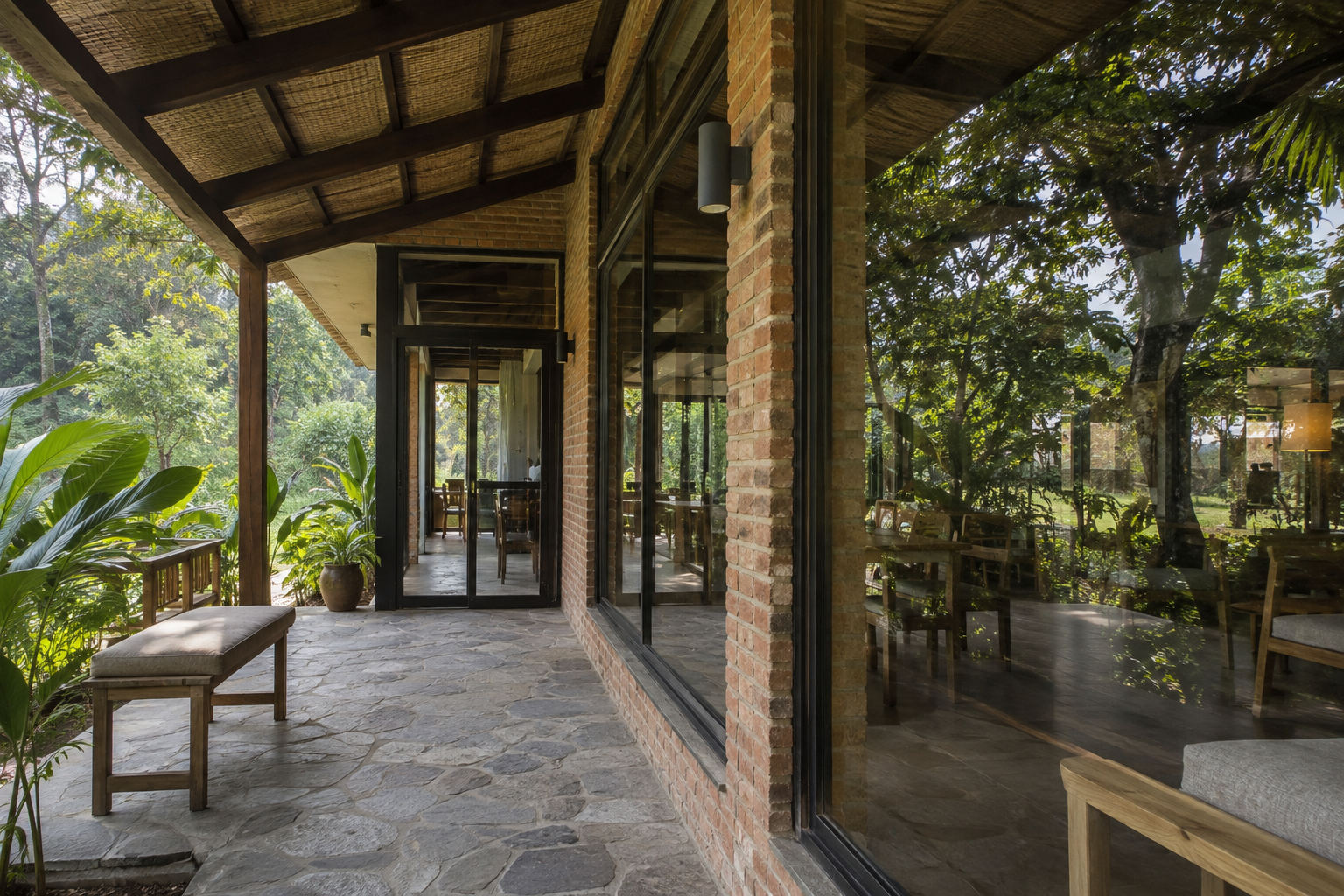
Reflections and transparent sightlines are features to examine during a lodge glass audit; their presence alone does not establish that collisions have occurred. · AI-generated illustration
A lodge window can frame a beautiful view of Chitwan: trees moving in the breeze, a planted courtyard, or birds crossing between patches of green. But what does that same window look like to a bird? This investigation begins with an unanswered local question: could the glass and building designs at tourist lodges create collision risks that guests and managers have not yet assessed? It does not begin with a claim that collisions are established at any particular property.
The distinction matters. A window that appears risky is not proof that a bird has struck it. Equally, a lodge with no reported incidents is not automatically free of risk. Birds may hit glass when nobody is watching, and an injured bird may move out of sight. Understanding conditions at a property therefore requires more than a quick look or a reassuring answer at reception.
Birds do not reliably recognise glass as a solid barrier. Reflective panes can show trees, shrubs or sky, making a building surface appear to continue the surrounding habitat. Transparent glass presents a different problem: a bird may see vegetation, daylight or another window beyond it and interpret that clear sightline as an open flight route. The issue is not simply whether a pane is clean or shiny. It is what the whole scene appears to offer from a bird’s approach.
At a tourist lodge, that scene might include a glazed dining room beside garden trees, a glass corridor with daylight at both ends, or a transparent balcony railing. These are examples of features worth examining, not findings about Chitwan’s lodges. Their relevance depends on the layout, nearby vegetation, viewing angle and changing light. A pane that looks dark from a guest’s chair may reflect greenery strongly when seen from outside.
Our scope is deliberately narrow: lodge glass and building design. We are asking how windows, doors, railings, corners and passages interact with the spaces birds use around a property. This is not a general ranking of wildlife tourism, hospitality or environmental performance. A lodge may support conservation in other ways while still having glass that deserves closer attention. Conversely, a building’s modest appearance tells us little about how safely birds can navigate around it.
Travellers searching for bird friendly lodges Chitwan may be hoping to find accommodation that takes these concerns seriously. Here, that phrase is a search term, not a verified certification. It should open a conversation about specific building features and evidence, rather than serve as a label awarded on the strength of a garden, bird photographs or a broad commitment to nature.
The useful starting point is curiosity without accusation. What might a bird see when approaching a lodge’s glass? Which design choices could create misleading reflections or apparent passageways? And what information would justify confidence that those risks are being addressed? Keeping those questions open allows a fair investigation—one that neither assumes harm nor mistakes a lack of observations for proof of safety.
The Audit: Glass Hazards, Staff Records and Remedy Evidence
Assessing bird friendly lodges Chitwan requires more than spotting a few stickers on reception windows. Walk the property with a staff member, mark each glass surface on a simple sketch, and give it a location code. Include guest rooms, dining areas, walkways and balconies, not just the main building.
Map what a bird might see
Flag reflective panes that mirror trees or sky, transparent corners that appear open, and opposing windows that create an apparent flight route through a room. Glass railings also deserve attention, especially beside planted terraces. Record nearby vegetation, its distance from the glass, and any feeders or water sources that attract birds.
Repeat the walk in morning, midday and late afternoon where possible. Changing light can turn a seemingly clear pane into a strong reflection. Photograph each hazard from likely bird approach directions, safely from ground level, and record the time and weather. A single inspection cannot represent every lighting condition or season.
Separate observations from assumptions
Ask reception, housekeeping, gardening and security staff about strikes, stunned birds and carcasses. Keep three evidence categories: firsthand observations, suspected incidents and unverified recollections. Someone seeing a bird hit a named window is different from finding feathers nearby or remembering that “birds sometimes fall here.” Review existing notes or photographs without treating missing records as proof of safety.
Propose consistent checks along a fixed route, ideally before routine cleaning, with permission and staff coordination. Use a log that records:
- Location code, date, discovery time and observer.
- Search effort: route, duration, areas checked and inaccessible places.
- Evidence category, photographs and the bird’s condition, without guessing its species.
- Actions taken and outcome, including “unknown” when follow-up is unavailable.
- Checks with no birds found, so monitoring effort remains visible.
Agree on safe response procedures with local wildlife professionals before monitoring begins—check locally for contacts and instructions. Keep people and pets away from injured birds; do not feed, water, handle or release them without appropriate advice. Scavengers may remove carcasses, cleaning may erase evidence, and injured birds may fly away before dying elsewhere. Recorded incidents are therefore a minimum, not a complete count.
Demand evidence for each remedy
Assess exterior screens, closely spaced exterior markings, independently tested patterned glass and design changes against independent collision research. Designs that remove transparent passageways or reduce exposed glass can address the hazard itself. Exterior treatments act on the surface birds encounter; isolated decals leave dangerous gaps, while interior blinds may leave exterior reflections intact.
Widely used guidance recommends marking gaps no greater than about five centimetres in both directions. Verify current guidance for spacing, contrast, coverage and the particular application before installation. Ask for independent results for the exact product, not a general “bird-safe” claim. Controlled flight tests compare materials under set conditions; field monitoring shows performance at installed buildings, with different limitations. Seek both where available. Check locally for availability and installation costs, then continue consistent monitoring after treatment to assess outcomes.
Conclusion: Evidence Before Claims
A useful glass audit should end with a clear account of what is known, not a verdict that a lodge is “safe” or “unsafe.” A brief visit can reveal credible collision hazards, but it cannot establish how often birds strike a building. For travellers searching for bird friendly lodges Chitwan, the strongest evidence is a transparent record of hazards, incidents, action and follow-up—not a reassuring label.
Keep the findings in three distinct groups so that observations do not quietly become conclusions:
- Observed design hazards: Describe the glass, its position and the conditions seen during the visit. Note reflected vegetation, apparent flight paths through transparent corners, or planting close to windows. Identify each pane or building face clearly, with photographs where permission allows. These observations show potential danger; they do not prove a collision occurred.
- Recorded incidents: List dated reports of birds striking glass, stunned birds and bodies found near windows. Distinguish direct observations from staff recollections, and note photographs or other supporting evidence. Keep uncertain species identifications uncertain. A report without a date or location can still be useful, but its limits should remain visible.
- Unresolved questions: State what could not be checked, including inaccessible areas, missing records, unknown carcass removal practices and unobserved lighting conditions. Explain whether anyone routinely looks for injured or dead birds, rather than treating silence in a logbook as evidence of absence.
Recommendations should then follow the most credible hazards. A pane with documented strikes deserves prompt attention, while a large, clear passage between planted areas may justify preventive action even without a recorded incident. Explain the reason for each priority and the proposed remedy. Avoid ranking whole properties from a short walkthrough: a lodge may have both well-treated windows and untreated problem areas.
Any treatment should be evaluated through comparable before-and-after monitoring. Use the same mapped windows, search areas, checking schedule and recording method wherever possible. Record search effort, including missed checks, and note changes in access, cleaning, vegetation or lighting. Seasonal changes in bird activity can affect findings, so comparing different seasons without qualification may give a misleading impression of success. Where feasible, observations from comparable untreated windows can help interpret wider changes, without delaying action at known problem panes.
Monitoring also needs modest conclusions. Fewer recorded strikes after treatment may be encouraging, but interpretation depends on comparable effort and conditions. Bodies can be removed by scavengers or cleaning, and injured birds may move out of sight. Report these detection limits alongside results, rather than presenting a simple incident count as a complete measure of harm.
Lodges can build trust by sharing audit dates, search methods, incident summaries, treatment details and remaining gaps. Visitors should reward that openness, not demand certainty the evidence cannot support. No recorded collisions does not prove no risk. Equally, research elsewhere can inform prevention but does not establish Chitwan’s collision rate. The responsible claim is specific: what was checked, what changed, and what monitoring has—or has not—shown.