Conservation
Open Wells at Chitwan’s Park Edge: Are Wildlife Entrapment Risks Being Checked?
EverestBlog AI · Nov 1, 2026 · 16 min read
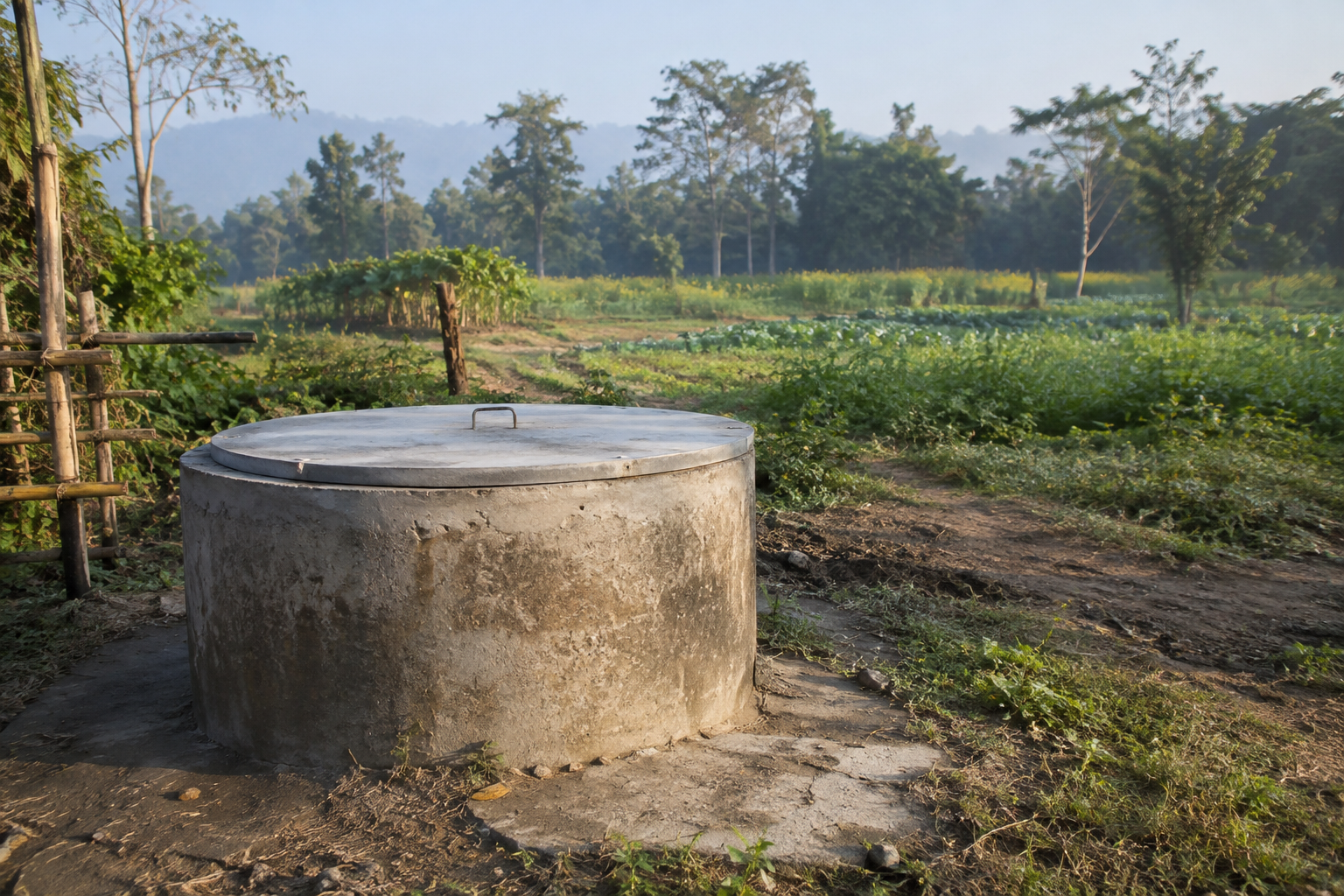
Securely covered structures illustrate a preventive approach; this image does not document an entrapment incident or establish local inspection practices. · AI-generated illustration
An open well can be useful to a household and dangerous to an animal that cannot climb out. Near wildlife habitat, that possibility deserves attention before an emergency occurs. The central question behind Chitwan wildlife open well safety is therefore a preventive one: are potentially dangerous openings being identified and assessed where animals may encounter them? Asking this does not mean claiming that wildlife has already fallen into local wells. It means examining whether an avoidable risk is being taken seriously.
At the edge of Chitwan National Park, the boundary between wildlife habitat and land used by people is not simply a line on a map. Animals can move beyond protected forest into surrounding landscapes, while people use nearby land for homes, farming, water storage and other daily needs. An opening built for a practical purpose may become a hazard if it lies along an animal’s route and offers no secure barrier or way out.
For this inquiry, “open wells” is a starting point, not a narrow limit. The scope includes wells, water tanks, excavated pits and similar open structures near wildlife habitat. These may hold water, remain dry or change with use and weather. What matters is whether an animal could enter or fall in and then become trapped. A water-filled structure may pose a drowning risk; a dry one may still leave an animal unable to escape, exposed to injury, heat or prolonged distress.
Not every opening presents the same level of danger. Depth, wall steepness, surface grip, the strength of any cover and the condition of the surrounding ground all affect the situation. So does access: a structure inside a secure enclosure differs from one beside an accessible forest margin. Vegetation may hide an edge, and a cover that appears adequate from a distance may not be secure. These are reasons to examine individual sites rather than treating every well or pit as equally hazardous.
The size and behaviour of an animal also matter. A small opening might exclude a large mammal while still exposing smaller wildlife to danger. Conversely, a barrier intended to discourage people from approaching may not prevent an animal from reaching the edge. This makes “covered” or “fenced” an incomplete description without context. The useful opening question is whether the structure is safe for the wildlife reasonably likely to encounter it, not merely whether some protective feature is present.
There is an important evidence boundary here. The presence of a potential hazard does not, by itself, establish that an entrapment incident has occurred. A photograph of an uncovered well can show an opening, but it cannot prove that an animal fell into it. A nearby wildlife sighting does not establish contact with that structure either. Claims about actual entrapment require separate supporting evidence, such as a documented rescue or a verified account that clearly identifies what happened and where.
The reverse distinction matters too: an absence of reported incidents is not enough to demonstrate safety. It may reflect a genuinely low risk, but without knowing how reports are gathered, it cannot settle the question. A careful introduction to this issue should hold both possibilities open. It should neither turn every exposed pit into a presumed wildlife tragedy nor dismiss an accessible, steep-sided opening simply because no incident has been confirmed.
This is also a question about shared space, not an invitation to blame residents who depend on water infrastructure or work near the park. Useful scrutiny begins with the structure and its setting. For readers, the test is straightforward: separate what can be observed from what remains unknown, and distinguish a plausible danger from a proven event. That approach allows prevention to be discussed on its own merits, without waiting for harm or making claims the available evidence cannot support.
What Is Mapped, Inspected and Recorded?
Assessing Chitwan wildlife open well safety starts with a basic question: what information exists about wells and other potentially hazardous openings near the park? A useful inquiry should seek records showing where structures are, when they were checked and what inspectors found. An assurance that hazards are “monitored” is not enough to establish inspection coverage, but an unanswered records request does not establish that monitoring is absent.
Request the inventory and its boundaries
Ask park officials, relevant local governments and buffer-zone bodies for any inventory of open wells, abandoned wells, water-storage pits and similar structures that could trap wildlife. Request the original field sheets or database entries where available, not only a summary. Each organisation should also explain the geographical area covered and the criteria used to decide which structures belong in the inventory.
The scope matters as much as the number of entries. Does the list include both private and public structures? Are wells on farms, household plots, tourism properties and community land recorded? Does it include disused structures concealed by vegetation, or only working water points known to local staff? If private land was not accessed, ask how those gaps are marked rather than assuming the inventory represents every property.
Request a coverage map alongside the list. It should distinguish surveyed areas from areas not yet surveyed and, where possible, link each mapped structure to a record identifier. A map of known wells is not automatically a map of completed inspections. Ask whether locations came from field visits, residents’ reports or older documents, and whether uncertain positions are labelled. Published maps should avoid unnecessary disclosure of household details or sensitive wildlife locations.
Check what an inspection actually records
Seek the inspection checklist, written guidance and a sample of completed, dated field records. These documents can show whether inspections follow a consistent method. If no standard form is used, ask what information staff are expected to record and how observations from different teams are compared.
- Identification: a structure’s location, record number, type, use and public or private status.
- Visit details: inspection date, inspecting team and whether access restrictions prevented a full check.
- Physical condition: an open mouth, damaged cover, gaps in fencing, unstable edges or vegetation hiding the opening.
- Surroundings: nearby paths, habitat or other features relevant to possible animal access, without treating proximity alone as proof of danger.
- Supporting evidence: dated photographs, measurements where safely obtainable and a clear distinction between direct observations and information supplied by others.
- Follow-up: any recommended action, referral, later visit and evidence supporting a change in the recorded condition.
Do not treat a checklist entry marked “safe” as self-explanatory. Ask what standard supports that judgement and whether the inspection assessed wildlife entrapment, human safety or both. A cover’s presence, for example, says little unless its condition and gaps were also examined. Records should make clear what was checked and what remained uncertain.
Establish whether records stay current
Ask who maintains the inventory, who can amend entries and how updates reach other organisations holding copies. Do repeat checks occur on a schedule, after reported damage or following changes such as abandonment or construction? Request successive records for the same structures. Comparing dated visits is more informative than assuming that an old inspection still describes present conditions.
Separate evidence from assurances
Report findings under three clear categories: records reviewed, interview claims and requests still unanswered. State each reviewed record’s date, area and limits. Attribute verbal accounts to the relevant office or role, and say whether documents corroborate them. For unanswered requests, note what was sought and any explanation provided. Missing documentation limits what can be verified; it is not proof that no checks happen. Equally, a few completed forms cannot establish comprehensive coverage across Chitwan’s park edge.
Who Is Responsible for Fixing a Hazard?
A dangerous well at Chitwan’s park edge may sit on private farmland, beside a community water point or within public infrastructure. Each setting raises different questions: who controls access, who can order safeguards, and who will pay? Chitwan wildlife open well safety depends on a clear chain of responsibility, not simply on identifying the nearest government office. Ownership, operating arrangements and the site’s legal location need to be checked separately.
Private land: ownership is only the starting point
For a well on private land, establish the owner and whether a tenant, farmer or other operator manages it. Land records, lease terms and any water-use agreement can help distinguish ownership from day-to-day control. Ask who can approve a cover, barrier or other alteration, and whether anyone else depends on access to the water. An owner’s consent to an inspection is not necessarily permission to carry out construction.
Do not assume that private ownership alone establishes a specific legal duty to install wildlife safeguards. Any claimed requirement should be traced to an applicable law, local bylaw, permit condition or binding agreement. Nepal’s Local Government Operation Act, 2074 (2017) and the relevant municipality’s rules are starting points for checking local powers, but neither should be presented as proof of a well-specific obligation without identifying the relevant provision. Current local requirements: check locally.
Community facilities: find the actual operator
A community well may have been built by one organisation, handed over to another and maintained informally by nearby households. Its location does not establish who owns or operates it. Request the handover document, user committee constitution, maintenance agreement and any relevant municipal record. These can reveal whether a water users’ group, community institution or local government accepted responsibility for upkeep.
Ask whether that responsibility covers safety improvements as well as keeping the water supply working. A maintenance fund may exist without allowing expenditure on a wildlife-resistant barrier. Similarly, a committee may manage daily use but need another body’s approval for structural changes. Record who can approve the design, release funds and assign future inspections. Where documents are missing or contradictory, describe the responsibility as unresolved rather than naming a convenient committee.
Public infrastructure: separate oversight from asset control
For wells associated with roads, irrigation systems, public buildings or other public works, identify the agency that owns the asset and the office currently responsible for it. Construction by a contractor does not, by itself, settle responsibility after handover. Check the contract, completion records, defect-correction terms and maintenance assignment. The office receiving a complaint may only be able to forward it.
Location also matters. Establish whether the site lies inside Chitwan National Park, within its legally designated buffer zone or outside both; “near the park” is not a jurisdiction. Nepal’s National Parks and Wildlife Conservation Act, 2029 (1973), applicable buffer-zone rules and site-specific permissions should be consulted before assigning powers to park authorities or buffer-zone bodies. Wildlife expertise, permission to undertake work and authority to compel a landholder are distinct roles.
Make the responsibility gaps explicit
For each hazard, seek written answers to four questions:
- Who can require action? Identify the competent authority and the legal provision, notice or agreement supporting its demand.
- Who can authorise the work? Confirm landholder consent and any technical or regulatory approvals needed.
- Who will fund it? Name an approved budget or written commitment, not merely a possible donor.
- Who will maintain it? Identify the responsible operator, inspection arrangements and responsibility for replacing damaged safeguards.
A rescue contact is not automatically a repair authority, and a promise to “coordinate” does not answer these questions. If agencies disagree, report what each says and which document is still needed to resolve the dispute. The practical test is whether someone has accepted the job, has lawful permission and resources to do it, and remains accountable after installation.
What Prevention and Reporting Could Look Like
Practical prevention for Chitwan wildlife open well safety should begin with a qualified assessment, not an improvised lid. A well beside a footpath, field or settlement may serve people while also posing a fall risk to wildlife. Before changing it, seek advice from someone competent in well construction and structural safety, alongside the relevant local authority. The aim is to prevent falls without creating another danger or cutting off an essential water source.
Match the protection to the structure
A suitable cover must be designed for the opening, its supporting edges and the loads it could reasonably face. Those loads may include people, livestock or wildlife; vehicle access needs separate consideration. Loose boards, thin sheets or unsecured slabs should not be treated as dependable protection. Ask a qualified adviser how the cover will be anchored, how water will be drawn safely, and how damage or movement can be detected without removing it.
Where a secure barrier is appropriate, its design should account for both people and animals. A barrier needs stable foundations, controlled access and a layout that does not funnel wildlife into another hazard. Warning signs can support protection, but they cannot replace it. Avoid improvised fencing with sharp projections or loose material that could injure or entangle animals. Keep paths and water collection areas clear, especially where children or people carrying containers pass.
Unused wells and similar openings deserve a decision about permanent closure. Simply hiding an opening under soil, vegetation or scrap can leave a concealed void. Seek qualified advice on safe decommissioning, including structural stability, groundwater protection and any permissions required. Confirm whether anyone still relies on the water before work begins. If access must stop temporarily, agree on a safe alternative with users rather than leaving them to bypass a barrier.
Confirm the reporting route before an incident
Reporting arrangements should be verified for the particular settlement and its relationship to the park boundary. Ask the ward office, the relevant park or buffer-zone office, and any recognised local conservation group which contact receives hazard reports and which receives urgent reports of trapped wildlife. Check locally for current contacts, operating hours and out-of-hours arrangements. Do not assume that a number shared in an old social media post still reaches the right team.
Also confirm the escalation steps: whom to contact if the first number does not answer, when an unresolved hazard should be referred onward, and who can coordinate a site assessment. Keep these instructions somewhere residents can find them. A routine report about an uncovered well and an urgent report about an animal already inside need clearly distinguished routes, even if the same office initially receives both.
Report clearly, without moving closer
Residents can provide useful information from a secure position. Nobody should approach an unstable edge, lean over an opening, enter a well or chamber, or attempt wildlife rescue. Keep other people and domestic animals away without placing yourself between wildlife and an escape route. If an animal is present, avoid crowding, shouting or throwing anything into the structure.
- Location: Share the settlement, nearby public landmark and a map pin if available. Obtain it from a safe place; do not move closer for accuracy.
- Observation: Describe the opening, any missing cover or damaged barrier, and whether an animal is visible. State uncertainty rather than guessing its species or condition.
- Timing and access: Say when you noticed the problem and describe a known approach route without testing unsafe ground.
- Evidence: Send a photograph only if it can be taken safely from your existing position.
Ask for confirmation that the report was received and note any reference provided. Follow up through the verified escalation route if necessary, without returning to inspect the opening yourself.
Conclusion: What Would Demonstrate Readiness?
The answer to the headline question is limited: this investigation does not establish whether open wells along Chitwan’s park edge are being systematically checked for wildlife entrapment risks. No verified inspection register, mapped inventory or completed repair record has been supplied for this conclusion. That is an evidence gap, not proof that inspections never happen. It also gives no sound basis for describing the park edge as either safe or unsafe. The question remains open until records show what is checked, by whom and with what result.
Confirmed arrangements must be separated from expected practice. The material available here does not verify a well-specific inspection schedule, a designated lead office, a reporting route or a funded programme for correcting hazards. Those arrangements should therefore not be presented as established facts. Equally, their absence from the available material should not be treated as evidence that local officials, residents or conservation workers are doing nothing. Informal action may occur, but it cannot demonstrate consistent coverage without a traceable record.
For Chitwan wildlife open well safety, readiness would mean more than having people willing to respond after an animal falls in. It would mean being able to identify a reported hazard, assign responsibility, take an appropriate preventive step and verify that the work remains effective. Rescue capacity and prevention are related, but one does not prove the other. A successful rescue, for example, would establish a response to that incident; it would not establish that nearby wells had been surveyed or secured.
The most useful follow-up would seek a small set of documents and explicit commitments, rather than another general assurance that wildlife protection matters:
- A defined survey area and inventory. Request a dated map or register showing which settlements and land parcels were covered, which wells were assessed and which areas remain unchecked. The record should distinguish accessible wells from sites where access or ownership could not be confirmed. Sensitive location details need not be published to demonstrate coverage.
- An inspection standard and dated findings. Ask what inspectors look for, how they record well openings and protective features, and how they decide that corrective work is needed. A blank checklist shows an intended method; completed entries, with dates and an identifiable inspecting team, show that the method was used.
- A written allocation of responsibility. Seek confirmation of who receives reports, who assesses them, who contacts the landholder and who can authorise or fund corrective work. Where responsibilities cross administrative boundaries, request a named coordinating office and a clear referral process, rather than assuming one institution controls every site.
- A corrective-action register. Request a list linking each identified hazard to an agreed action, a responsible party and a target completion date. Follow-up should distinguish work proposed, work started and work verified as complete. Where action is delayed, the record should explain the obstacle and any interim precaution.
- A reporting and review commitment. Ask the responsible bodies to confirm a current public contact route, how reports are acknowledged and when unresolved cases are reviewed. Contact details can change, so check locally before publishing them. Request a dated update that reports outstanding hazards as well as completed work.
These records would still need careful interpretation. An inventory is only as complete as its stated coverage, and a repaired well is only a verified result for that location and inspection date. Claims of wider readiness should account for unvisited areas, newly identified wells and maintenance needs. Follow-up reporting should make those limits visible instead of turning a partial exercise into a park-wide assurance.
The fair conclusion, then, is neither reassurance nor alarm. Readiness would be demonstrated by documented coverage, assigned responsibility and verified corrective action. Until those elements can be checked, the strongest defensible finding is that systematic prevention has not been established by the evidence available here.