Culture
The Hidden History of Nepal’s Ancient Traditions: How Old Are the Customs We Call Ancient?
EverestBlog AI · Nov 1, 2026 · 21 min read
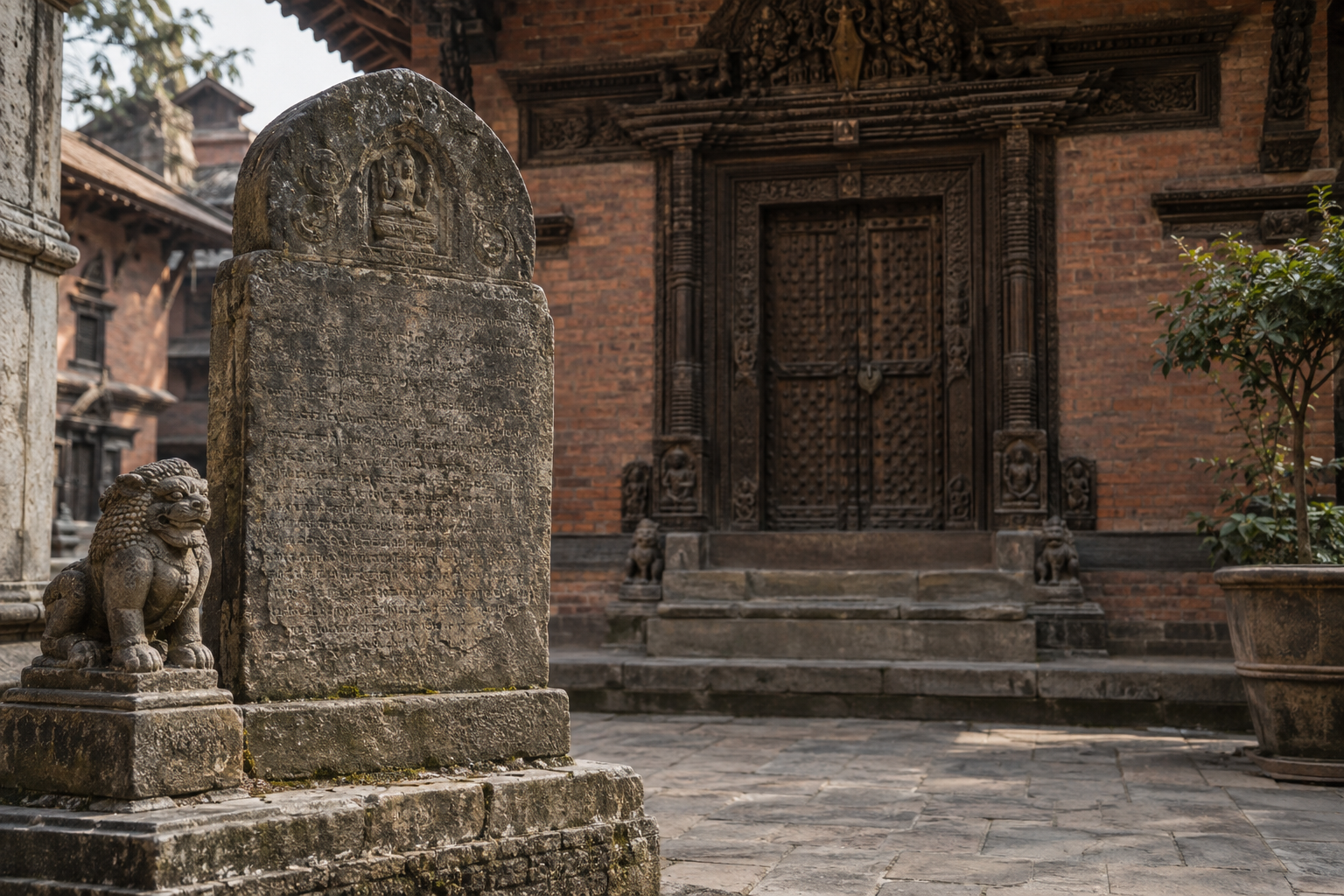
Inscriptions and historic buildings preserve clues to the past, but dating a custom requires more than dating its surroundings. · AI-generated illustration
What do we mean when we call a custom “ancient”? Do we mean that people have followed it without interruption, that its roots reach into a distant past, or simply that nobody remembers when it began? The word can suggest permanence: a practice handed down intact, untouched by changing times. Yet the customs that shape daily life rarely have such tidy histories. They survive through people, and people adapt what they inherit.
Exploring Nepal traditions therefore requires more than searching for the earliest possible date. It means asking whose practice we are describing, where it is followed, and what has changed along the way. A method of shaping clay, an arrangement for sharing water, or a household rule about preparing food may carry deep historical knowledge. But each can have a different history, even within the same settlement.
Nepal has no single cultural inheritance shared in exactly the same way by everyone. Communities across the Himalayan highlands, middle hills and Tarai have developed practices through their relationships with land, livelihood, religion and neighbours. Differences also run through villages, towns and households. Language, caste, ethnicity, gender and access to resources can influence who learns a skill, who performs a task, and who has authority to explain its meaning.
These differences matter because broad labels can hide the people who keep a tradition alive. Calling something “a Nepali custom” may be convenient, but it can turn a local practice into an apparent national rule. Even descriptions such as “Newar craftsmanship” or “mountain hospitality” need care: they encompass varied experiences, not a fixed script followed by every person within a community.
This investigation focuses on everyday customs, craft knowledge and community institutions, rather than festivals. Its subjects include how practical skills pass between generations, how households organise familiar routines, and how groups maintain shared responsibilities. These quieter forms of heritage often receive less attention than public celebrations, yet they can reveal how history works in ordinary life.
Consider the knowledge involved in making a useful pot. The finished vessel is only one part of the practice. Someone must understand the clay, judge its readiness, control its shape and manage the firing. Someone must also teach those decisions, whether through close instruction or years of watching and helping. A change in tools or fuel does not automatically erase that inheritance. Equally, an old-looking pot does not guarantee that every step used to make it is old.
Community institutions raise related questions. In some Newar settings, guthi organisations connect collective duties with religious, social or heritage responsibilities. Their arrangements are not identical everywhere. To understand such an institution, we need to look beyond its name and consider membership, work, resources and obligations. An established name may persist while the organisation’s daily role changes.
None of this makes tradition less meaningful. A living practice is not a failed attempt to preserve the past unchanged. Adaptation can be the reason knowledge remains useful. Migration, schooling, new markets and changing family arrangements can reshape how people learn and participate. Those changes deserve attention without assuming either that everything old has vanished or that everything familiar has remained untouched.
The aim here is not to award customs a certificate of antiquity. It is to ask better questions about continuity, change and the limits of what we know. “Ancient” may point towards a long history, but it should begin an inquiry rather than end one. Looking carefully at Nepal traditions allows us to respect their depth without flattening their differences—and to recognise the present-day people whose choices keep them alive.
Which Part of a Tradition Are We Dating?
When someone says a custom is “ancient,” the first question should be: which part of it? A festival, craft or household ritual is rarely one unchanged thing passed down through time. It may combine an old skill, a newer name, a changing social role and arrangements introduced within living memory. Dating Nepal traditions carefully means separating these layers before assigning an age to the whole.
Four Layers That May Have Different Ages
- The name: A familiar name may appear in writing long after people began doing something similar. Names can change between languages, communities and generations. Conversely, an old name can remain in use while the activity it describes changes. The age of a word is therefore not automatically the age of the custom.
- The technique: The method behind a practice—shaping clay, weaving cloth or preparing a ritual food—may be older than its current ceremonial use. Yet a similar technique does not prove an unbroken line of teaching. People may adopt a method from neighbours, learn it again from surviving examples or develop comparable solutions independently.
- The social purpose: A gathering may serve religious devotion, seasonal work, neighbourhood cooperation or public celebration, often at the same time. These purposes can shift. A practice once organised mainly through households might later become a community event. Its history includes those changes, not just its earliest recognisable action.
- The present-day form: Today’s version includes particular participants, materials, routes, schedules and rules. Some features may be inherited; others may reflect migration, new roads, available supplies or changing expectations. Dating the current arrangement is a different task from dating the practice’s oldest known elements.
Consider a hypothetical harvest offering. The act of giving part of a crop could be old, its local name more recent, and its present public procession newer still. Calling all three equally ancient would hide the history we are trying to understand.
The Earliest Evidence Is Not Necessarily the Beginning
The first surviving mention of a custom tells us that it was known by that point. It does not usually tell us when it began. People may have practised it for generations before anyone recorded it, and earlier records may have disappeared.
Equally, a gap in the record is not permission to assign a much earlier origin. “It could be older” and “we know it is older” are different claims. A careful account keeps that boundary visible. It also asks exactly what the evidence establishes: a name, a particular action or something close to the celebration seen today.
Continuity Is Different from Revival
Continuity means a practice has been transmitted over time, though not necessarily without change. Families may alter ingredients, craftspeople may replace tools, and organisers may adjust a festival while maintaining shared knowledge and obligations.
Revival means people renew a practice after an interruption or a substantial decline. They might draw on elders’ memories, written descriptions, photographs or objects. A revived custom can be deeply meaningful, but its renewed performance should not be presented as proof that it continued without a break. Nor does an interruption erase the older history on which the revival draws.
Why a Range Can Be the Better Answer
A founding year is defensible only when evidence supports a specific beginning—and identifies what began. Otherwise, a date range or a qualified phrase is more useful: “documented by this point,” “its present form developed during this period,” or “revived after a break.” A range should reflect evidence, not guesswork. These distinctions do not weaken a tradition’s story. They make clear which parts we can date, which have changed and which remain uncertain.
What Dated Records Can Establish
A dated record can give the history of Nepal traditions a firm foothold. An inscription naming a water channel, a land grant assigning income to its upkeep, or an account recording payment for cleaning it can place a particular activity in a particular period. But each supports a different claim. An order to maintain a channel proves that maintenance was formally required; a payment entry offers evidence that someone was paid to do the work. Neither automatically proves when the practice began.
A Verified Example: The Lumbini Pillar Inscription
The inscription on Ashoka’s pillar at Lumbini provides a useful example outside festival history. Written in Prakrit using Brahmi script, it records a royal visit in the twentieth year after Ashoka’s consecration. It identifies the place as the birthplace of the Buddha and describes a change in the fiscal status of Lumbini village. This is evidence about the administration of a living settlement, not simply a sacred place.
The fiscal passage is commonly translated as making the village free from a levy and liable for only an eighth share of produce. However, the precise meanings of its revenue terms have been debated. A careful account should therefore distinguish the inscription’s clear announcement of a fiscal concession from less certain explanations of how that concession worked. It does not tell us whether every household received the benefit in practice.
The date also needs care. The inscription gives a regnal year, not a Common Era year. Its usual placement around 249 BCE depends on the accepted chronology of Ashoka’s reign and consecration. Presenting that conversion as approximate is more accurate than treating it as a modern date written on the stone. The inscription establishes a recorded royal decision at Lumbini; it does not establish an unbroken local tax custom from that time onward.
Check the Record Before Using Its Date
Provenance means the record’s origin and history: where it was found, what it was written on, and whether we have an original, a copy, or only a later transcription. The Lumbini text survives on the pillar at the site. For other records, a stone moved into a courtyard or a loose manuscript page may have lost important context. Published photographs, reliable editions and information about discovery help readers assess the evidence.
Calendar conversion is especially important in Nepal, where documents may use Nepal Sambat, Vikram Sambat, regnal years or other dating systems. A year number without its era is not enough. Lunar months, fortnight designations and calendar conventions can affect conversion. Translation requires similar caution: an old term for a levy, occupation or institution may not match its present-day meaning.
Different Archives Answer Different Questions
- Land grants can identify property or revenue assigned to a monastery, water facility or other institution. They establish an intended arrangement, not necessarily uninterrupted support.
- Household documents such as deeds, receipts and inheritance agreements can reveal property transfers, debts and obligations. A surviving transaction is evidence of that transaction, not automatically a universal custom.
- Institutional records, including guthi accounts and membership lists, may document contributions, maintenance duties and payments. Repeated entries can show continuity across the years actually covered.
A contemporary document was produced near the event it describes. A later chronicle may preserve valuable information, but its account of earlier centuries needs separate corroboration. The date when a chronicle was copied is not the date of every event within it.
Finally, written archives are uneven witnesses. Rulers, donors, landowners and institutions often appear more clearly than labourers, tenants, women or people excluded from literacy and authority. Their work may be visible only indirectly—or not at all. Absence from a surviving record is not proof that a practice, or the people sustaining it, did not exist.
What Objects and Buildings Can—and Cannot—Prove
A clay pot, a carved roof strut or a stone water spout can bring the history of Nepal traditions within touching distance. Unlike a story passed down through generations, an object preserves physical traces of making, handling and change. Yet material evidence answers some questions more clearly than others. It may help establish when something was made without revealing exactly who used it, what they believed or which rules shaped its use.
Why the findspot matters
Archaeologists study an object’s context: where it was found, the soil layer around it and its relationship to other remains. A pottery fragment recovered from a sealed floor deposit offers different evidence from one picked up beside a path. The first may belong to a reasonably clear sequence of occupation. The second may have arrived in soil brought from somewhere else.
Even a carefully excavated deposit needs interpretation. Older pottery can become mixed into later building fill. A pit dug through an earlier layer can carry newer material downward. Objects found together are therefore not automatically the same age. Researchers examine how a deposit formed before using it to support a historical claim.
What pots and tools reveal
Pottery can preserve clues in its clay, shape, surface treatment and firing technique. Comparison with securely dated examples may suggest a period of manufacture. Soot, worn surfaces or food residues can offer evidence of use, although each requires careful analysis. A vessel shaped for cooking might later have held grain, while a broken piece might have served as a scraper.
Tools present similar problems. Wear on a blade or grinding stone may help identify the work it performed, but a familiar shape alone cannot establish an unchanged custom. Similar tasks can produce similar tools across long periods. Finding an old agricultural implement does not prove that today’s planting ceremonies accompanied its earliest use.
Dating methods also measure particular events. Radiocarbon analysis of suitable organic material associated with pottery may help date a deposit, provided that association is secure. Luminescence methods can estimate when pottery was last strongly heated. Neither result directly dates the beginning of a household practice or ritual.
Buildings hold several histories
A temple, courtyard house or carved wooden element rarely belongs to just one moment. Foundations may survive while walls are rebuilt. A damaged roof strut may be replaced by a carving that follows an older design. Conversely, an old carved panel may be moved into a newer building. Style is useful evidence, but it is not a reliable construction date on its own.
Repair and reuse are not flaws in heritage; they are part of its history. They do, however, complicate dating. The age of timber is not necessarily the date when a carving was installed. Even evidence for when a tree was felled must be considered alongside possible storage or reuse. Building joints, tool marks, inscriptions and repair records can help separate these stages.
A water spout is not a rulebook
Nepal’s traditional stone water spouts, often called hiti in Nepal Bhasa and dhunge dhara in Nepali, illustrate this distinction well. A carved outlet, supply channel and surrounding basin may have different construction and repair histories. An inscription may record a donation or restoration rather than the system’s first use.
An old spout does not, by itself, prove that current water-collection rules are equally old. Queuing arrangements, cleaning duties, ritual restrictions or rules about access require their own evidence. Physical wear may show repeated use, but it cannot explain every social boundary around that use. To date those customs, researchers must connect the structure with records and community testimony, while remaining open to gaps and change.
Community Memory and Origin Stories
Ask an elder how a custom began, and the answer may start with a grandparent, a teacher, a deity or a particular place. Each starting point tells us something different. Community accounts of Nepal traditions can explain how people learned a practice, who had the right or duty to perform it, and why it matters. Their value extends beyond supplying a date. They reveal relationships and meanings that a written record may never mention.
Listening for Different Kinds of Knowledge
Remembered experience concerns events a teller personally witnessed or took part in. A potter might describe learning to prepare clay beside a parent; a musician might recall joining a festival procession for the first time. Such memories can illuminate teaching methods, working routines and changes within a lifetime. When timing matters, ask what helps the person place the event: their age, a move, a marriage or another remembered occasion. Keep any uncertainty visible rather than converting an approximate memory into an exact year.
Inherited testimony is knowledge passed on by others. “My grandmother told me that her teacher worked this way” carries a different connection to the past from “I watched my grandmother do this.” Both deserve careful attention, but they support different claims. Ask who shared the account, when the teller first heard it, and whether it was taught during work, at home or at a ceremony. Naming that chain, where permission allows, helps readers understand how the account travelled.
Sacred origin narratives may connect a practice to divine action, a revered ancestor or a foundational encounter. They can explain why a place is sacred, why a ritual follows a particular order or why a community holds a responsibility. They should not be turned into verified calendar dates. Nor should they be dismissed as useless evidence: they offer insight into sacred authority, belonging and the meaning of continuity.
These categories are listening tools, not a ranking of cultural worth. One account may weave all three together, moving from a teller’s childhood to an ancestor’s teaching and then to a sacred beginning. A careful writer makes those shifts clear without stripping the account of its meaning.
Consent Is Part of Good Documentation
Before recording or quoting, explain who you are, what you are writing and where it may appear. Consent to talk is not automatically consent to publish a name, photograph, recording or ritual detail. Ask separately, and respect limits on knowledge that is private, restricted or appropriate only in certain settings. Where possible, offer the speaker a chance to check quotations, translations and attribution before publication.
Questions that invite explanation are often more useful than asking, “How ancient is this?” Try:
- Who taught you, and what do you remember about learning?
- Which parts of this account did you witness, and which were passed down?
- Are there other versions that people here tell?
- What may I share, and how would you like to be identified?
Keep the Tellers Visible
Avoid turning one conversation into “the community believes.” Attribute an account to the speaker, family, practitioner group or setting it actually represents, using only agreed identifying details. If translating, preserve important local terms and explain them rather than forcing a misleading English equivalent.
Differences between tellers are worth preserving. Two elders may name different teachers or explain the same ritual differently. Those variations might reflect separate learning lineages, changing responsibilities or distinct experiences; do not assume the reason without asking. Present the accounts alongside one another when relevant, and state what remains unresolved. Community memory helps us understand not only claims about beginnings, but also how people carry a tradition forward.
Putting the Evidence Together: A Pottery Case Study
Pottery-making in Thimi, in the Kathmandu Valley, offers a practical way to investigate the history of Nepal traditions without treating “ancient” as a settled date. The study should begin with one narrow question: How is wheel-throwing taught in selected Prajapati pottery workshops in Thimi, and what evidence shows whether that teaching practice has changed? This investigates a particular skill and its transmission, not the age of every vessel, kiln or ritual associated with local pottery.
Define the Practice Before Following Its History
Choose a small group of participating workshops and, where possible, follow the making of one comparable vessel form. Record how a learner centres clay, opens it and raises the walls. Note whether the teacher demonstrates first, guides the learner’s hands, gives spoken corrections or assigns repeated exercises. Ask who is allowed to learn and when learners begin working independently.
These observations establish what happens in those workshops during the research period. They do not automatically describe every potter in Thimi. Record the wheel’s power source and other equipment separately: a change in machinery may alter the rhythm of instruction without ending teacher-to-learner transmission.
Give Each Source a Specific Job
- Verified scholarship: Locate published ethnographic or technical studies that explicitly describe Thimi’s pottery production. Check the full text, publication details, fieldwork dates and relevant pages. A broad cultural history, such as Mary Shepherd Slusser’s Nepal Mandala, can help frame the Valley’s historical setting, but it should not substitute for workshop-level evidence. Only use a study to support a teaching claim if it actually documents instruction.
- Documented objects: Seek museum or research collections containing vessels securely attributed to Thimi. Read accession records alongside the objects. Separate the collection date from the manufacture date, and distinguish a recorded maker from a collector’s general place label. Photographs of production can be especially useful when their location, date and subject are documented.
- Attributed practitioner accounts: Commission interviews with experienced potters and learners, with consent for recording and publication. Ask each person to describe a particular learning episode, identify their teacher and explain which steps they now teach differently. Publish names and workshop affiliations only with permission; do not turn an anonymous recollection into a community-wide claim.
Compare Evidence Without Making It Say Too Much
Build a comparison sheet around individual claims. For “learners practise centring before making saleable vessels,” place the relevant passage from scholarship beside current observations and interview testimony. Record dates and scope for each entry. Agreement would show that a teaching sequence was documented at separate moments; it would not prove uninterrupted use between them.
An older vessel may preserve forming marks consistent with wheel use. That can support a conclusion about manufacture, subject to technical examination. It cannot reveal whether its maker learned from a parent, another craftsperson or a formal course. Likewise, a practitioner’s account of learning from a grandparent establishes an attributed memory of transmission, not the starting date of pottery-making in Thimi.
Differences deserve equal attention. If an earlier description records one wheel type while a participating workshop uses another, investigate when and why the change occurred. Ask whether demonstration, correction or practice time changed too. Do not assume that new equipment erased older knowledge—or that similar-looking pots prove unchanged methods.
Publish the Gaps Alongside the Findings
The final account should separate documented findings, attributed memories and unanswered questions. If no dated source describes earlier teaching, say so and commission further interviews rather than supplying imagined testimony. A defensible conclusion may establish continuity in one learning exercise, change in equipment and uncertainty about earlier generations. That modest result is more revealing than assigning an unsupported age to the whole craft.
Conclusion: Age Is Only One Part of Heritage
How old are the customs we call ancient? For Nepal traditions, the most honest answer is that some elements can be dated, while others remain uncertain. A written record may establish that a festival existed by a particular period. An inscription may date a donation connected to worship. Neither necessarily reveals when the practice began, or whether its earliest form resembled what people do today. The history of a living tradition is rarely a single, unbroken line with a clear starting point.
This does not leave us with nothing useful to say. It allows us to make more precise claims. We might know that a place has long held religious importance while knowing less about the age of a procession held there. We might trace a craft through surviving objects without being able to date every technique used by present-day makers. A partial history is still valuable when its limits are clear. Uncertainty becomes a problem only when it is hidden behind a confident story.
It also matters whose account is being heard. A priest, potter, musician, household elder and younger participant may understand the same custom differently because they carry different responsibilities within it. Their accounts need not agree on every detail to offer insight. Rather than treating one voice as the final word for an entire community, readers can notice who is speaking, what experience informs their account, and which other perspectives might be missing.
Adaptation belongs in this picture. Materials become harder to obtain. Families move, working hours change, and skills pass between people in new ways. A ceremony may be shortened, a tool replaced, or a gathering organised around the availability of participants living elsewhere. Such changes do not automatically make a practice less meaningful. They may be the very reason people can continue it. The important question is not simply whether something has changed, but how those involved understand and negotiate that change.
Continuity and loss can also exist together. A festival may remain lively while fewer people learn a demanding musical role. A craft may find new buyers while an older use for its products fades. Celebrating adaptation should not mean overlooking these pressures. Equally, protecting heritage should not require people to freeze their lives for visitors. Communities need room to decide what they wish to preserve, what they can sustain, and what they want to do differently.
Great age is not a measure of cultural worth. A recently established community celebration can create belonging. A revived practice can help people reconnect with language, family knowledge or a place. An old custom may carry deep affection while also prompting debate over participation and responsibility. Calling something ancient does not settle whether it is fair, meaningful or worth continuing. Those questions require attention to people’s lives, not just to a timeline.
For travellers and readers, this offers a better way to approach Nepal’s heritage. Treat words such as ancient, unchanged and timeless as invitations to look closer, rather than as complete explanations. Ask whether a date refers to a building, an object, a recorded event or a claim about origins. When sharing what you learn, keep that distinction intact. “Recorded by this period” is often more accurate than “began in this period.” Careful wording preserves both the interest of the story and the limits of the evidence.
Nepal’s traditions do not need an exact birthday to deserve attention. Their histories matter, but so do the relationships, skills and commitments that keep them alive. To understand them with both curiosity and respect, ask two questions together: “What supports this history?” and “What does this practice mean to its community today?”