
Culture
The Origin of the Tharu People: What History Can—and Cannot—Tell Us
EverestBlog AI · Nov 1, 2026 · 11 min read
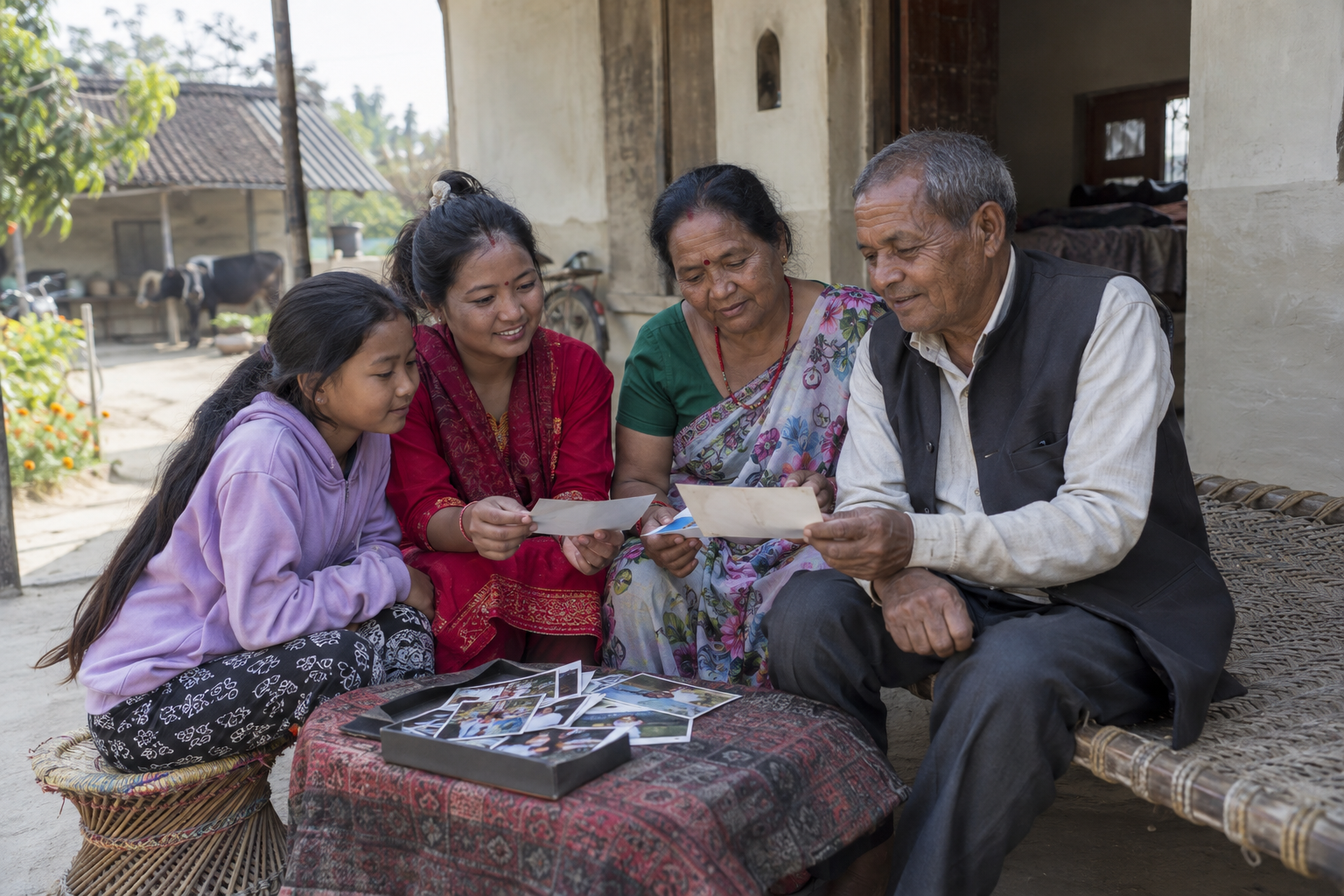
Family memories offer one perspective on the past; tracing Tharu origins also requires careful reading of historical sources. · AI-generated illustration
Where did the Tharu people come from? The question sounds as if it should lead to a place on a map. Yet Tharu origin is better approached as a historical question than as a search for one definitive ancestral homeland. A community’s past may involve long residence, movement, marriage, changing political boundaries and the gradual adoption of shared names. These processes do not necessarily point to a single departure point or a single founding population.
Even the word “origin” can hide several different questions. Are we asking about the ancestors of people who identify as Tharu today? About when particular families moved into a valley or stretch of the plains? About the earliest surviving use of the name “Tharu”? Or about how distinct communities came to understand themselves, and be understood by others, under that name? Each question requires different evidence. Answering one does not automatically answer the others.
Ancestry concerns lines of descent, which can be multiple and overlapping. Migration concerns movement: who moved, from where, under what circumstances and over what period. Settlement concerns residence in a particular place, including continuity that may leave little written trace. The formation of a shared identity concerns how belonging develops through relationships, institutions, language, self-identification and outside classification. These processes can intersect, but they should not be treated as interchangeable explanations.
A record showing Tharu settlement in one location, for example, establishes something about presence there; it does not by itself identify the community’s earliest ancestors. A migration account may explain the history of a particular group without describing every Tharu community. Likewise, the first surviving written mention of a name marks a point in the available record, not necessarily the beginning of the people named. Keeping these distinctions clear helps prevent small pieces of evidence from carrying claims they cannot support.
This article separates its evidence into three broad categories. Documented history includes written records that can be examined for their date, purpose, authorship and geographical reach. Such sources can establish aspects of settlement, administration or social classification, but they also reflect the priorities and assumptions of those who produced them. Their silences matter: an absence of written evidence is not proof that a community was absent.
Oral traditions preserve accounts of descent, movement and belonging. They deserve attention as historical sources and as expressions of how communities understand their past. However, a remembered journey or ancestral connection should not automatically be read as a literal, independently dated event. Unresolved interpretations include explanations proposed by researchers or others where the evidence remains incomplete, contested or open to more than one reading. These will be presented as interpretations, not settled facts.
Regional diversity is essential to this approach. Tharu communities across Nepal’s Tarai and adjoining areas of India do not necessarily share identical settlement histories or origin accounts. Evidence from one region cannot simply stand for all the others. The aim, then, is not to select one story and declare the question closed. It is to identify what can reasonably be established, explain what different traditions claim, and show where uncertainty remains—without mistaking an uncertain beginning for an absence of historical belonging.
The Documentary Record: What Can Be Established
The documentary record gives the study of Tharu origin a firmer footing, but it answers some questions better than others. Written sources can show that people identified as Tharu lived in particular lowland areas, cultivated land or held a recognised position within a state’s social order. They rarely establish when those communities first arrived, and they cannot, by themselves, reveal a single ancestral homeland.
Reading Historical Accounts in Context
Francis Buchanan Hamilton’s An Account of the Kingdom of Nepal, published in 1819, includes references to Tharu inhabitants of the lowlands. Its geographical scope extends across Nepal and neighbouring territories, although Hamilton did not personally visit every place he described. The work drew partly on information gathered during his stay in Nepal in 1802–1803 and on accounts supplied by others.
Hamilton’s purpose was to describe the kingdom’s geography, population, resources and political history for an outside readership. His references support the presence of communities called Tharu in the landscape he described. They do not independently prove how long every community had lived there. Observations, informants’ statements and the author’s interpretations must be distinguished rather than treated as equally secure evidence.
What Law and Land Records Establish
The 1854 Muluki Ain, Nepal’s national legal code, offers a different kind of evidence. It placed Tharu within the category commonly translated as “enslavable alcohol-drinkers.” This was a state-imposed rank in a discriminatory caste hierarchy, not an account of Tharu ancestry or a neutral description of their society.
The code’s scope was the kingdom of Nepal, and its purpose was to regulate legal and social relations. It demonstrates that the state recognised Tharu as a named population within its governing framework. It does not establish that all Tharu communities shared identical customs, accepted that classification or descended from one migrating group.
For landholding, Mahesh Chandra Regmi’s Landownership in Nepal (1976) provides an important scholarly guide to historical tenure and revenue systems. Covering Nepal rather than one Tharu settlement, it draws on administrative documentation to explain rights over land and the extraction of revenue. It is a later historical study, not a contemporary witness to early settlement.
Such scholarship helps readers interpret grants, revenue orders and tenancy records involving Tharu areas. These documents were generally produced to allocate income, recognise claims or organise cultivation—not to investigate origins. A dated entry may establish a household’s recorded presence or obligations at that moment. It cannot automatically establish first occupation, uninterrupted ownership or the absence of earlier residents.
Allowing for Labels and Silences
Names and spellings require care. Older accounts may use “Tharoo,” while local, regional and administrative identities do not always align neatly. A broad label can conceal differences between communities; a missing label does not necessarily mean a population was absent.
The archive is also uneven. Officials recorded taxpayers and disputes more readily than everyday life. Outside observers sometimes repeated hearsay or interpreted lowland societies through caste and racial assumptions. Communities with limited access to writing appear largely through other people’s categories.
No source here should be called the earliest reference without specialist support. Together, these records establish historical presence and relations with state power more securely than they establish ultimate origins.
Origin Traditions and Competing Interpretations
Accounts of Tharu origin differ across the Tarai. Some explain a journey from elsewhere; others locate belonging in ancestral settlements, sacred places and relationships with the land. These are not necessarily competing answers to one historical question. A migration story may explain family status, while a ritual account explains why a community belongs in a particular valley.
Different Regions, Different Accounts
In his work on Tharu communities, especially in Chitwan, anthropologist Arjun Guneratne discusses claims of Rajput ancestry. One recorded narrative describes high-status women fleeing conflict in India with servants, with later unions accounting for their descendants. Versions connect the flight to Muslim conquest. Such accounts should be attributed to their tellers and settings, not presented as the shared history of all Tharu people.
The details matter because this narrative also speaks about gender and rank. It can preserve a claim to prestigious ancestry while explaining customs or relationships that outsiders considered unusual. Its references to flight may contain memories of movement, but they do not, by themselves, establish a particular departure point, invasion or founding generation. Nor should its portrayal of religious conflict be accepted as an independently verified event.
For the Dang Valley, Gisèle Krauskopff’s ethnographic work offers a different emphasis: ancestral belonging expressed through village ritual, spirits and relationships with territory. Here, accounts connecting ancestors and sacred authority to settled places deserve attention alongside migration genealogies. They help explain belonging without requiring a single arrival story. This does not prove that ancestors never moved; it shows that geographical rootedness can be remembered through ritual rather than a dated itinerary.
How Stories Travel and Change
Oral accounts pass through families, ritual specialists and community gatherings. Their wording and emphasis can change when told to children, researchers, officials or neighbouring groups. Printed histories and cultural organisations can also circulate one version more widely than others. A useful comparison therefore asks: who told the account, where, in which language, and under what circumstances?
Neither change nor social purpose makes a tradition worthless. Stories can preserve place names, remembered relationships and experiences of displacement. But claims to noble descent can also respond to caste hierarchies and struggles for recognition. Guneratne’s Many Tongues, One People is useful here because it examines regional differences alongside the growth of a broader Tharu identity.
What Other Evidence Can Test
Linguistic research can trace relationships among Tharu speech varieties and neighbouring languages, suggesting long contact and possible movements. Yet language shift is common: speaking a related language does not establish descent from one founding population.
Archaeology can reveal settlement, farming and exchange in the Tarai. Connecting an excavated object or ancient settlement specifically to Tharu ancestors, however, requires independent evidence. Material styles can spread through trade or imitation, not only migration.
Genetic research can investigate population relationships and admixture, but findings depend on sampling and methods. A sample from one Tharu locality cannot represent every community. Genetic ancestry is not a test of cultural authenticity.
What remains unresolved includes the timing, routes and relative importance of different migrations, and how these intersected with existing populations. Tradition and research can illuminate each other, but neither currently supplies one origin story that explains every Tharu community.
Conclusion: Uncertain Origins, Meaningful Belonging
The question of Tharu origin matters, but it cannot carry the whole weight of Tharu identity. A community’s belonging is not a puzzle that becomes valid only when every missing piece is found. It is also expressed through language, relationships with land, shared memory, cultural practice and collective life. These connections do not depend on every family or regional group telling the same story about the distant past.
Historical uncertainty should therefore encourage care, not suspicion. A gap in written evidence tells us about the limits of the surviving record; it does not establish that a people lack roots. Written sources were produced for particular purposes, often by authorities whose interests differed from those of the communities they described. Oral traditions preserve other kinds of knowledge, although they too require attention to context, interpretation and change.
No single origin narrative is required to validate belonging. Communities can carry different memories of movement, settlement and ancestry without losing their collective identity. Nor does movement automatically erase Indigenous belonging: histories of migration, displacement and changing boundaries need to be understood in context. Treating identity as a test of complete geographical immobility imposes a standard that historical evidence rarely allows anyone to meet.
This distinction is especially important when discussing Indigenous identity and rights. In Nepal, Tharu are recognised as an Indigenous nationality, commonly described as Adivasi Janajati. That recognition should not be confused with a claim that every question about their earliest ancestry has been settled. Historical uncertainty does not itself negate Indigenous identity or rights, and an unresolved origin debate is not a sound reason to dismiss claims concerning land, language, representation or cultural continuity.
Responsible historical inquiry asks what a source can support, how an interpretation was reached and where uncertainty remains. It welcomes correction and distinguishes evidence from inference. A demand that a community prove its legitimacy does something different: it makes dignity or rights conditional on producing an uncontested ancient pedigree. Writers should recognise that difference, particularly when a seemingly neutral question carries consequences for people facing exclusion or dispossession.
For readers, this means resisting two tempting shortcuts. One is to accept a compelling ancestral story as established history simply because it offers a clear beginning. The other is to assume that disagreement makes all accounts worthless. A more useful approach asks what each account means to those who share it, what evidence supports its historical claims, and what it cannot explain. Cultural significance and documentary certainty are related questions, but they are not identical.
Presenting contested histories well requires community participation and clear attribution. Tharu scholars, cultural workers, elders and other community members should help shape the questions, not merely supply colourful details. Participation should also reflect differences within Tharu communities rather than treating one voice as universal. Writers should distinguish a recorded tradition from a researcher’s hypothesis or an established finding, identify whose interpretation they are presenting, and acknowledge disagreement without manufacturing consensus. When sharing sensitive knowledge, they should seek permission and respect limits on publication. The aim is not to produce a final verdict on who belongs, but to make the evidence, its limits and the people connected to it visible.