Culture
How Did the Shah Dynasty Unite Modern Nepal? Strategy Beyond the Battlefield
EverestBlog AI · Nov 1, 2026 · 16 min read
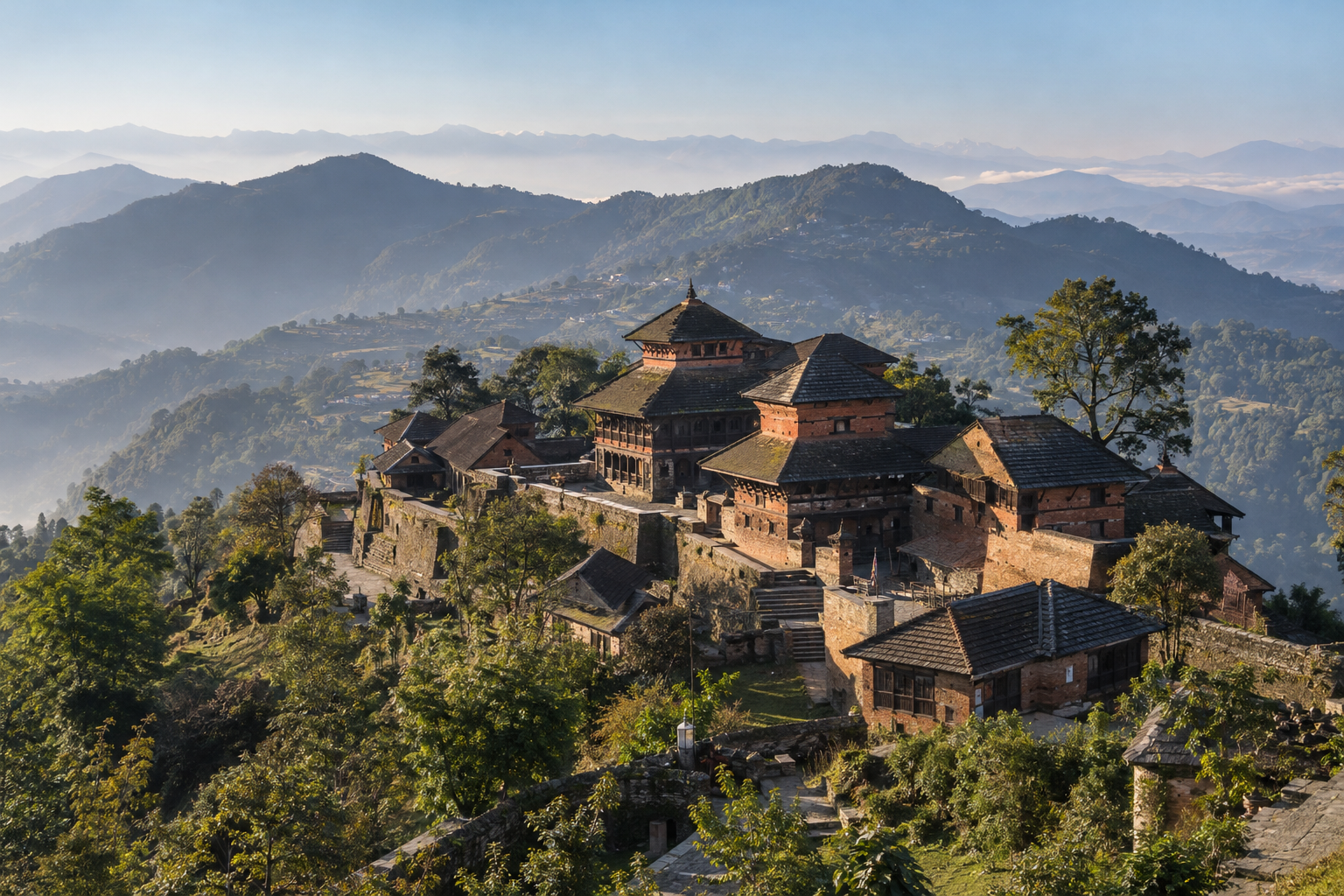
Gorkha Durbar, associated with the Shah dynasty’s ancestral seat, overlooks the hill country from which its expansion began. · AI-generated illustration
The unification of Nepal is often remembered through one ruler and one achievement: Prithvi Narayan Shah bringing divided lands under a single crown. That account captures his importance, but it makes a long, uncertain struggle sound too simple. Nepal did not emerge from one decisive battle, nor did its present borders appear at the moment of conquest. Its formation involved repeated campaigns, negotiation, resistance and the difficult work of governing people whose loyalties did not automatically change when their rulers fell.
Prithvi Narayan Shah became king of Gorkha in 1743. From that relatively small hill kingdom, he pursued an ambitious expansion that made the Kathmandu Valley a central objective. The valley offered more than fertile land and wealthy towns. It was a major centre of political authority, religious life, craftsmanship and trade connecting the Himalayan hills with Tibet and the plains to the south. Gaining control of it could transform Gorkha’s position, but doing so required patience as well as force.
His early failures matter because they challenge the image of an unstoppable conqueror. Expansion was neither easy nor inevitable. Rival courts had their own interests, fortified settlements could resist attack, and mountain terrain complicated movement and supplies. Shah’s eventual success grew partly from his ability to respond to these obstacles. To understand his leadership, the useful question is not simply which battles he won, but how he kept a larger political project alive through setbacks and changing circumstances.
The conquest of the Kathmandu Valley in 1768–1769 was a turning point. It placed its principal cities under Shah’s authority and helped establish the foundation of a larger Gorkhali state. Yet a turning point is not an endpoint. Prithvi Narayan Shah died in 1775, while expansion and consolidation were still unfolding. His successors, regents and commanders carried the project further, sometimes following opportunities and ambitions that belonged to their own political circumstances rather than to a fixed plan left by the founder.
Present-day Nepal’s borders were not established by Prithvi Narayan Shah alone. Later Gorkhali expansion reached well beyond the country’s current boundaries. War with the East India Company and the Treaty of Sugauli in 1816 then sharply reduced that territory. Subsequent agreements also affected the frontier, including the return of some western Tarai lands in 1860. The modern map therefore reflects conquest, defeat and negotiation across several generations, not the completed design of a single eighteenth-century ruler.
The word unification also deserves careful handling. It describes the creation of a shared state, but it can suggest a willing union where military conquest and unequal power were often involved. Communities experienced the expanding kingdom differently. For some, the change opened new relationships with a larger court and its networks. For others, it meant lost political autonomy or obligations to unfamiliar authorities. Recognising these differences does not diminish Shah’s historical significance; it makes the story more accurate and gives the people being incorporated a place within it.
Nor should a common crown be confused with an immediately shared national identity. The expanding state brought together communities with different languages, religious traditions and social arrangements. Political control could advance faster than acceptance of that control. Calling the process “the unification of Nepal” is useful, provided we do not project today’s sense of nationhood backwards onto every participant. Many people were defending local interests, serving a ruler or protecting livelihoods, rather than acting for a nation understood in modern terms.
This history is best approached as state-building rather than a list of victories. Battlefield success mattered, but so did access to resources, room for diplomatic manoeuvre and the ability to turn possession into durable authority. Prithvi Narayan Shah supplied decisive leadership and a powerful foundation. Understanding what followed requires keeping his achievements distinct from later expansion—and remembering that conquering territory, governing it and defining a country’s borders were connected but different tasks.
Military Strategy: Learning from Setbacks and Controlling Access
The military side of the unification of Nepal was not simply a series of victories by a stronger army. Prithvi Narayan Shah’s forces faced defended towns, difficult terrain and opponents who knew their ground. Early failures showed that courage alone could not secure the Kathmandu Valley. Success depended on preparation, control of routes and sustained pressure on places that could not easily be taken by direct assault.
Nuwakot: A Gateway Worth Fighting For
An early Gorkhali attempt to capture Nuwakot failed. Its capture in 1744 was therefore more than a recovery of military pride: it gave Gorkha a position with lasting strategic value. Northwest of the Kathmandu Valley, Nuwakot stood along an important trade corridor connecting the valley with routes toward Tibet through the Trishuli region and the northern passes.
This geography mattered because commerce travelled through a limited number of practical corridors. Steep hills, rivers and mountain crossings shaped where merchants, porters and armies could move. Holding a strongpoint near such a route offered opportunities to monitor traffic, collect revenue and interfere with an opponent’s access to goods. Nuwakot also provided a forward base closer to the valley than Gorkha itself.
The contrast between failure and success points to a central lesson: preparation and positioning mattered as much as fighting ability. Rather than treating a fortified settlement as an isolated target, the expanding Gorkhali state had to consider approaches, reinforcements and supply. Nuwakot’s importance lay not only in taking the place, but also in what possession allowed the army to do next.
Kirtipur and the Limits of Direct Assault
Kirtipur exposed those limits even more clearly. Built on a ridge southwest of Kathmandu, the town had strong natural defences as well as determined defenders. Its elevated position made attackers vulnerable on the approach. Repeated Gorkhali setbacks there showed that an army seeking to dominate the valley could still struggle against a single well-defended community.
The fighting was costly for the Gorkhali leadership too. The commander Kalu Pande died during an early assault, and Prithvi Narayan Shah’s brother Surapratap Shah lost an eye in a later attack. These losses underline how dangerous direct attacks could be. Kirtipur did not fall at the first determined push; its eventual submission followed repeated campaigns and growing pressure around the valley.
It would be misleading, however, to turn these events into a neat story in which one defeat immediately produced a perfect new plan. Direct fighting and wider efforts to restrict movement overlapped. The broader pattern is clearer than any single turning point: Gorkhali expansion increasingly combined attacks on defended places with efforts to weaken the connections that helped those places hold out.
Pressure Beyond the Town Walls
Control of passes and surrounding strongholds helped turn scattered gains into pressure on the Kathmandu Valley’s Malla kingdoms. Positions around the valley could obstruct reinforcements, threaten merchant traffic and make journeys for supplies more difficult. Holding a town was useful; holding the approaches that linked several towns could have much wider effects.
Supply disruption was not the same as battlefield victory. Defeating an army meant overcoming an armed force in combat. Restricting trade and provisioning worked differently: it reduced an opponent’s resources and narrowed its options over time. Such pressure could make continued resistance harder without immediately breaching a wall or defeating the main defending force.
These methods also carried civilian costs. Traders could lose livelihoods, porters could face dangerous or blocked routes, and households could struggle to obtain necessities. Restrictions did not affect only rulers and soldiers. Understanding this strategy therefore requires looking beyond military success: control of access helped Gorkha advance, but the burden also fell on communities whose daily lives depended on movement and exchange. The valley’s eventual conquest cannot be explained by battlefield performance alone.
Diplomacy: Securing Room to Expand
The unification of Nepal depended on more than defeating armies. Prithvi Narayan Shah also needed to prevent neighbouring rulers from acting together against Gorkha. Alliances, marriage connections and temporary agreements helped create that opportunity. Diplomacy could keep one frontier quiet while attention shifted elsewhere, provide useful contacts or discourage assistance to a rival. These arrangements were rarely permanent friendships. They were bargains between courts whose interests could change as Gorkha became stronger.
Keeping Rivals Apart
Gorkha belonged to a crowded political landscape of hill kingdoms, while the Kathmandu Valley was divided among competing Malla courts. This fragmentation offered openings, but it also created danger: several rulers cooperating against Gorkha could seriously restrict its expansion. An agreement did not have to win a neighbour’s active support to be valuable. Securing neutrality, or simply delaying opposition, could give Prithvi Narayan Shah room to pursue another objective.
His dealings with Lamjung illustrate the importance of managing nearby rivals. Lamjung stood close enough to threaten Gorkha’s security, making accommodation useful before deeper involvement towards the Kathmandu Valley. Agreements with neighbouring courts helped reduce the risk of pressure from several directions at once. Yet it would be misleading to describe every understanding as part of an unchanging master plan. Shah diplomacy developed through negotiation, changing circumstances and responses to other rulers’ decisions.
Contacts with the Malla courts also mixed personal relationships with political calculation. Prithvi Narayan Shah’s ritual friendship with Bhaktapur’s prince Bir Narsingh Malla, for example, linked him to a Valley court before its conquest. Such ties could support communication and access without removing conflicting ambitions. The wider lesson is that friendship between rulers and competition between their states could exist at the same time.
Makwanpur: The Limits of Marriage Diplomacy
Prithvi Narayan Shah’s marriage to Indra Kumari, a princess of Makwanpur’s Sen ruling house, connected Gorkha with an important kingdom south of the Valley. Makwanpur’s position near routes between the hills and the plains made relations with its court strategically significant. A marriage connection offered a channel for negotiation and the possibility of cooperation, but it did not make either kingdom subordinate to the other.
The relationship later deteriorated, and Gorkha conquered Makwanpur despite this family connection. Accounts of the estrangement include personal quarrels and disputes surrounding the marriage, but these should not obscure the larger political stakes. Both courts had interests in territory, access and independence. Kinship was a diplomatic resource, not a guarantee of lasting cooperation. Makwanpur shows why the unification of Nepal cannot be explained as either a chain of family alliances or a purely military undertaking: negotiation and coercion repeatedly overlapped.
A Contest Reaching Beyond the Hills
Diplomacy also extended beyond neighbouring kingdoms. As Gorkha’s pressure increased, Kathmandu’s ruler, Jaya Prakash Malla, appealed to the East India Company for help. His request sought to bring an outside power into the struggle and alter the balance between the Valley and Gorkha. For the Company, the question involved commercial interests and political influence as well as the appeal of a threatened ruler. Trade through Nepal towards Tibet gave events in the Valley wider significance.
The Company sent an expedition under Captain George Kinloch in 1767, but it failed to reach Kathmandu and provide the intended relief. Its importance here is diplomatic rather than tactical. The appeal demonstrates that Valley rulers were not passive targets: they sought partners beyond the immediate region. The response likewise shows that Gorkha’s expansion was already attracting outside involvement.
The failed intervention left Kathmandu without the support it had sought, but it did not establish permanent Company acceptance of Gorkha’s ambitions. Instead, it revealed a wider contest in which local courts, an expanding hill kingdom and a commercially driven foreign power pursued different goals. Diplomatic success meant creating room to act, not eliminating every future threat.
Political Consolidation: Turning Conquest into Government
The conquest of the Kathmandu Valley gave the Shah kingdom more than territory. Kathmandu and Patan fell to Prithvi Narayan Shah in 1768, followed by Bhaktapur in 1769, ending the rule of the Valley’s three Malla kingdoms. These victories brought established towns, productive farmland, trading connections and experienced administrators under Gorkhali authority. Yet possession was only a beginning. The next challenge in the unification of Nepal was to make conquered places provide regular revenue, recognise royal authority and support a state that continued to expand.
Kathmandu became the political centre of the enlarged kingdom. Moving the royal seat there shifted power away from the hill stronghold of Gorkha towards the Valley’s richer economic and administrative base. The court could draw on existing markets, craft production and routes linking the Himalayan region with the plains. Governing from Kathmandu also placed the Shah monarchy within a landscape of temples, festivals and royal traditions. Military victory established control, but working within that landscape helped the new rulers present themselves as legitimate kings.
The Shah court did not create an entirely new administration overnight. It appointed trusted officers while also drawing on existing knowledge and institutions. Royal representatives needed people who understood local landholding, customary dues, irrigation and village disputes. Local headmen, revenue intermediaries and other influential figures could therefore remain useful after a change of ruler. Their position depended on circumstances: some retained responsibilities under new supervision, while others lost authority or property. What mattered to the expanding court was that orders travelled outward and resources came back.
Revenue collection linked conquest to everyday government. Agricultural dues helped maintain the court, support soldiers and reward service. Trade duties also mattered, especially in the commercially active Valley. Rather than imposing one identical system everywhere, the state often worked through arrangements it inherited or adapted. This reduced the need to administer every settlement directly, but it also left considerable power with collectors and local intermediaries. For cultivators and traders, incorporation into the kingdom could mean a different authority demanding payment, labour or supplies, not simply a new name at the top.
Land grants were another important instrument. Assignments commonly described as jagir supported officials and soldiers through revenue rights attached to land, while birta grants could reward service or favour religious and other beneficiaries. These categories covered arrangements that changed over time; a grant did not always mean ownership in the modern sense. By distributing claims to land revenue, the monarchy connected service and loyalty to the state’s resources. Such rewards helped hold a ruling coalition together, though they could also strengthen privileged interests and increase burdens on those working the land.
Relationships with local elites required negotiation as well as commands. Former ruling families, landlords, religious institutions and community leaders had influence that Kathmandu could not always replace. Recognition of selected privileges or customary practices could make submission workable. Elsewhere, resistance brought punishment, dispossession or tighter supervision. Incorporation combined accommodation with coercion, and its terms varied between regions and communities. The emerging kingdom was therefore neither a uniformly administered state nor simply a collection of willing partners.
After Prithvi Narayan Shah’s death in 1775, expansion continued under his successors and regents. Rajendra Lakshmi, acting as regent during her son Rana Bahadur Shah’s minority, helped sustain the kingdom’s westward advance. Bahadur Shah, Prithvi Narayan Shah’s younger son, later directed further expansion as regent. Their rivalry also shows that continuity did not mean harmony within the court. New campaigns depended on the governing machinery behind them: officials mobilising resources, land revenues supporting service, and local power holders accepting or being compelled to accept Shah authority. These arrangements connected the Valley conquests to later territorial growth. The kingdom could keep expanding because conquest was followed, however unevenly, by mechanisms for collecting income, rewarding supporters and exercising authority beyond the royal capital.
Conclusion: Unification Was a Process, Not a Finished Map
The Shah dynasty united much of what became modern Nepal through four connected mechanisms: military force, control of strategic routes and resources, diplomacy, and political consolidation. None was sufficient alone. Armies could capture territory, but they needed supplies and secure approaches. Diplomacy could reduce opposition, but agreements depended on changing interests. Conquest became lasting rule only when the expanding kingdom could collect revenue, manage local power and make its authority felt beyond the battlefield.
This is why the unification of Nepal is best understood as a process rather than a single victory. Prithvi Narayan Shah gave Gorkha’s expansion its decisive direction, but he did not personally complete the kingdom’s later territorial growth. Successors, regents, commanders and administrators continued that work. The result emerged across generations, through decisions made both at the royal centre and in places where royal authority still had to be negotiated or enforced.
Military success mattered, but so did the ability to sustain it. Learning from failure made campaigns more effective, while control of movement and essential supplies could weaken opponents before a final assault. Diplomacy helped the growing state manage the dangers of fighting too many enemies at once. Political consolidation then linked these achievements: without workable arrangements for governing conquered areas, expansion risked producing a chain of vulnerable possessions rather than a durable kingdom.
Turning conquest into government did not mean creating a uniform administration overnight. The Shah state extended its authority through a mixture of central demands and local arrangements. Existing relationships, officials and influential groups could remain important even after sovereignty changed. This unevenness was not simply a failure to finish the task. It reflected the practical difficulty of ruling varied landscapes and communities with limited communications. Royal power depended partly on people who could translate its commands into local action.
The creation of an expanding Shah state must also be separated from the later settlement of its territorial limits. Its rulers did not begin with today’s national outline and steadily fill it in. Expansion carried the kingdom beyond some of Nepal’s present borders, bringing greater demands and new conflicts. Looking backwards from a modern map can therefore make the outcome seem more planned and inevitable than it was. The state’s reach remained contested, and military ambition could exceed its ability to hold territory.
The Anglo-Nepalese War of 1814–1816 exposed those limits in conflict with the British East India Company. The Treaty of Sugauli in 1816 curtailed expansion and required major territorial cessions. It marked a decisive change from the earlier momentum of conquest, although later agreements also affected Nepal’s boundaries. Modern Nepal was thus shaped by both the growth of Shah power and the restrictions imposed upon it. Neither conquest alone nor the treaty alone explains the country’s territorial history.
This distinction changes the answer to the article’s central question. The Shah dynasty united a kingdom by combining coercion with negotiation and building institutions capable of surviving individual campaigns. Yet the borders of the country that followed were also shaped by defeat, diplomacy and subsequent adjustments. “Unification” describes an important historical transformation, but it should not imply that every boundary was settled at once, or that political authority became equally secure everywhere.
Nor did political unification erase Nepal’s cultural diversity. Languages, religious traditions, social institutions and regional identities continued within the kingdom, under unequal relationships of power. A shared state did not automatically create equal participation or a single experience of belonging. The same expansion could be remembered as national state-building, the loss of local sovereignty, or a mixture of opportunity and dispossession. Nepal became politically connected without becoming culturally uniform. Recognising those different memories makes the history more complete: it explains how a lasting state emerged while leaving room for the communities whose pasts cannot be reduced to the dynasty’s achievements.