Culture
The Untold Story of the Licchavi Dynasty in Nepal: Who Held Power Beyond the King?
EverestBlog AI · Nov 1, 2026 · 11 min read
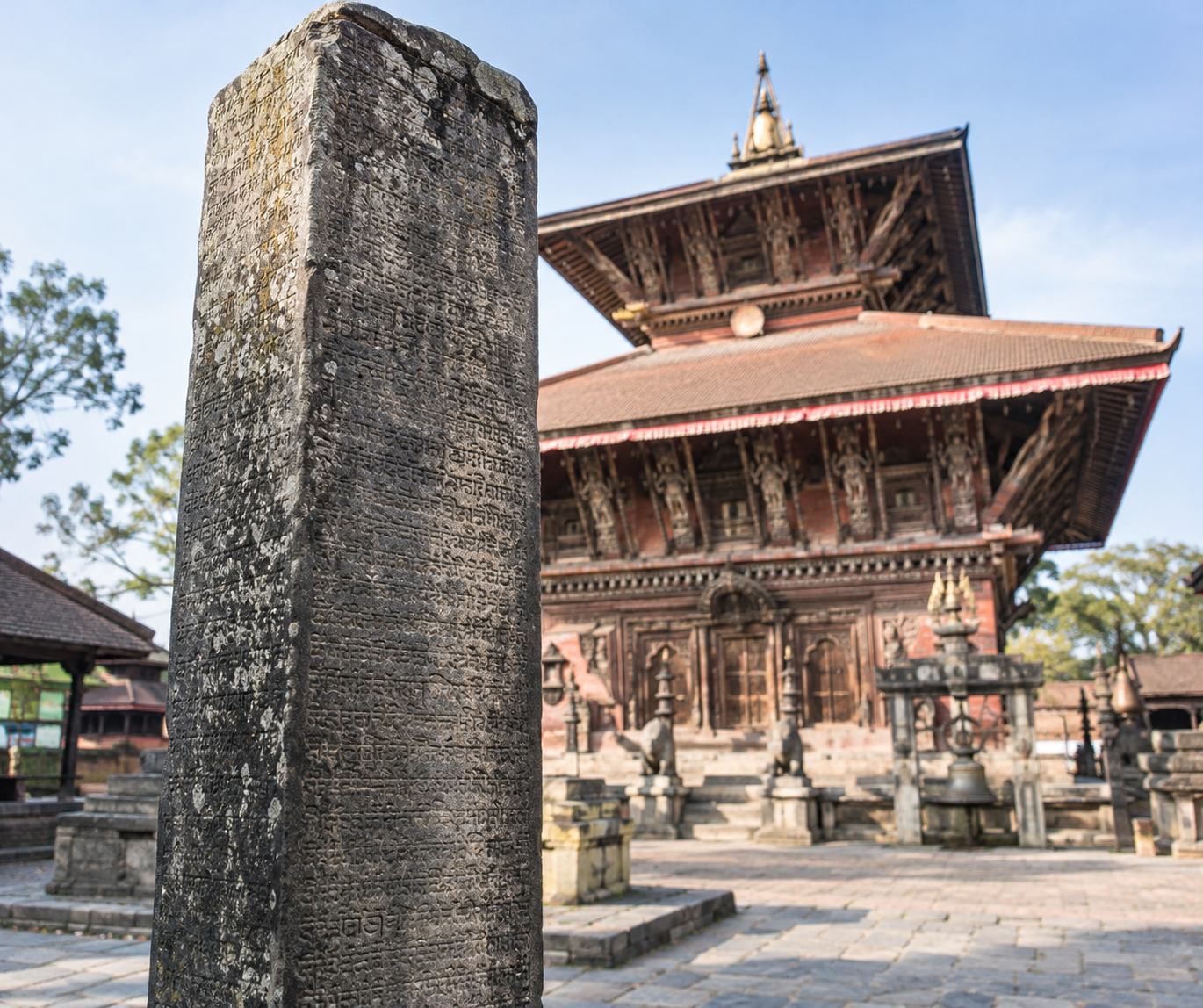
Changu Narayan’s Licchavi-era inscription offers a starting point for reading the relationship between royal authority, patronage and public memory. · AI-generated illustration
A king’s name can dominate the memory of an age. It appears in inscriptions, anchors accounts of the past and makes government seem like the work of a single ruler. Yet a royal command raises questions that a title alone cannot answer. Who advised the king? Who carried an order beyond the palace? Who collected revenue, managed land or persuaded a community to accept a decision? These questions offer a different way to understand the Licchavi dynasty in Nepal: not simply through its rulers, but through the relationships that made royal authority work.
The Kathmandu Valley provides the main setting for this story. Its fertile land, settlements, sacred places and routes linking neighbouring regions supported a political world more varied than a palace-centred account suggests. The valley was not merely a backdrop for kings. It was a lived landscape in which farming, religious patronage and access to resources shaped influence. Nor should the modern map of Nepal be projected neatly onto Licchavi government. The reach of a ruler’s claims and the practical exercise of authority were not necessarily the same thing.
To explore that world, historians rely chiefly on inscriptions, many written in Sanskrit and preserved on stone. These records can name rulers, identify officials, announce grants and set out privileges or obligations. Their locations also matter: an inscription beside a shrine or within a settlement connects a written statement to a particular place. Read carefully, such evidence allows us to look beyond royal names and notice the people and institutions involved in carrying out decisions.
But an inscription is not a transcript of an open political discussion. It usually preserves a formal statement made by, or for, someone with authority and the means to have it recorded. Praise of a ruler may tell us how kingship was presented rather than how widely that presentation was accepted. A grant can explain what its issuer intended without revealing every negotiation behind it. The concerns of cultivators, labourers and other people outside powerful circles are often much harder to recover directly.
This uneven evidence calls for curiosity and restraint. A named office does not always reveal its holder’s exact duties. A royal order does not, by itself, prove smooth enforcement. Equally, the presence of influential officials or local institutions does not mean that kings were merely ceremonial. Government could involve overlapping forms of authority, with royal power depending on cooperation while still carrying real weight. The task is to distinguish what a record states from what we can reasonably infer.
The “untold” story, then, is an overlooked perspective, not a claim of new discovery. Scholars have long examined these inscriptions and the political arrangements they reveal. For readers, the useful shift is to ask not only who occupied the throne, but how decisions moved through society. Looking at the Licchavi dynasty in Nepal this way brings advisers, intermediaries and communities into view without pretending that their voices survive equally. It also changes the central question: rather than asking whether the king held power, we can ask how that power was shared, supported, negotiated and put into practice. That question guides the discussion ahead, while keeping the limits of the surviving evidence in sight.
Inside the Court: Advisers, Officials and Powerful Intermediaries
Power within the Licchavi dynasty in Nepal depended on more than possession of the throne. Royal inscriptions present kings as sources of authority, but they also name influential figures who stood between the ruler and the people expected to carry out his commands. These records reveal a court where rank, personal access and delegated responsibility mattered. They do not, however, provide a complete organisational chart. A title might signal prestige or political standing without defining a permanent set of duties.
Reading Power Behind Royal Orders
Senior figures could influence government by helping shape decisions, conveying instructions or overseeing their implementation. Yet inscriptions usually preserve the outcome of a decision, not the discussion that produced it. We should therefore distinguish between a person explicitly associated with a royal order and someone whose advisory influence is only inferred. Proximity to the king could create opportunities for influence, but an impressive title alone does not prove control over a particular branch of government.
Some records identify a dutaka, a person entrusted with communicating or helping give effect to an order. Translating this simply as “messenger” can understate the importance of the responsibility; treating its holder as a modern minister goes too far. The significance lies in the named connection between royal authority and execution. Such references help historians trace who was trusted with a command, even when the precise limits of that person’s authority remain unclear.
Amshuvarman: From Great Feudatory to Sovereign
Amshuvarman’s relationship with King Shivadeva I offers a particularly revealing example. In inscriptions from the period when Shivadeva remained king, Amshuvarman appears with the title mahasamanta, commonly translated as “great feudatory.” This was a designation of high political rank, not a securely defined equivalent of prime minister. His prominence in records issued under Shivadeva indicates substantial authority within a political order that still formally recognised the king.
That distinction matters. Calling Amshuvarman sovereign throughout this earlier phase would erase the changing relationship recorded in the inscriptions. Equally, describing him as merely a subordinate official would obscure his exceptional position. Scholars read the documentary sequence as evidence of his growing command of government. However, the surviving material does not let us reconstruct every negotiation, alliance or personal understanding through which Shivadeva and Amshuvarman shared or redistributed power.
In the later phase, Amshuvarman exercised sovereign authority in his own right, rather than simply acting as Shivadeva’s mahasamanta. His independent records and royal presentation mark a different political position. The transition illustrates how a powerful intermediary could become the central ruler himself. It should not be flattened into a timeless story of “king and prime minister,” nor should the earlier title be treated as proof that its holder already possessed the sovereignty he exercised later.
Authority Was Negotiated, Not Standardised
Amshuvarman’s career shows why court connections deserve attention alongside royal genealogy. Access, recognised rank and responsibility for orders could reinforce one another, allowing an influential figure to turn delegated authority into a stronger political position. But his trajectory was exceptional, not a template for every reign. To understand who governed, we must ask which ruler issued a record, which other people it named, and what authority its wording actually assigned them.
Beyond the Palace: Revenue, Local Bodies and Land Grants
Royal authority reached Nepal’s settlements through demands on produce, grants of income and rules about who could intervene in local affairs. For the Licchavi dynasty in Nepal, government outside the palace was not simply a chain of royal tax collectors. Inscriptions reveal arrangements involving residents, local representatives and religious institutions. Their rights overlapped, but collecting a payment did not automatically give someone authority to judge disputes or govern a village.
Revenue Was a Bundle of Obligations
Licchavi records use revenue terms including bhaga, bhoga and kara. These are often explained as a share of produce, supplies or dues, and taxation more broadly. Their meanings depended on context; they should not be turned into a neat modern tax schedule. The important questions are what a particular inscription required, who owed it and who was entitled to receive it.
Amshuvarman’s Hadigaon inscription of 608 CE offers a concrete example of revenue being organised through written allocations. It records provisions for religious establishments and other recognised recipients. This was more than an expression of royal devotion: assigning resources made beneficiaries part of the machinery through which income was distributed. Yet an allocation of revenue was not necessarily a transfer of ownership over the land producing it.
Local Bodies Had Recognised Responsibilities
The Lele inscription of 604 CE, also associated with Amshuvarman, brings local organisation into view. It names panchalis and gosthis, showing that collective bodies mattered alongside individual officeholders. Panchalis are generally understood as local bodies, while gosthis were associations organised around particular purposes, including religious and charitable activities. Neither term should automatically be equated with an elected village council.
Such evidence helps identify the people between the ruler and ordinary households. Local representatives could communicate obligations and help sustain arrangements that required continuing cooperation. Associations could maintain services or religious observances supported by dedicated resources. However, an inscription naming a body does not, by itself, establish its membership, selection process or authority over every resident. The surviving record is more precise about recognised duties than about everyday participation.
Grants Could Also Restrain Officials
Land grants and exemptions must be read clause by clause. A grant might assign income from a field, release beneficiaries from specified obligations or restrict intervention by particular officials. These were different concessions. Where an inscription prohibited an official’s entry or interference, that restriction protected a defined privilege; it did not necessarily create a settlement beyond royal authority.
Three distinctions are especially useful:
- Collecting revenue: receiving a specified payment or share of production.
- Managing endowed property: maintaining resources dedicated to worship, charity or another stated purpose.
- Exercising jurisdiction: hearing disputes, imposing penalties or enforcing decisions.
The Hadigaon allocations and the bodies named at Lele illuminate the first two fields more readily than they establish unrestricted judicial power. Religious beneficiaries could have secure claims on resources without becoming rulers of the surrounding population. Likewise, local notables might carry considerable practical influence without possessing every power exercised by royal officers. Read this way, the inscriptions reveal negotiated boundaries: not merely who received land or income, but which obligations continued, which privileges were protected and where an official’s reach could stop.
Conclusion: Royal Titles Were Only Part of Government
The story of the Licchavi dynasty in Nepal cannot be understood through royal names and titles alone. Kingship provided a central source of legitimacy, but royal status was not the same as effective control. A ruler’s command depended on people who could communicate it, resources that could sustain it, and communities that would put it into practice. The distinction matters: authority claimed at court and authority exercised beyond it were connected, but they were not identical.
Delegation was therefore more than a practical detail. Advisers, officials and intermediaries helped turn royal decisions into action. Their importance came partly from their positions, but also from their ability to connect the palace with people and institutions beyond it. This did not necessarily make them rivals to the king. It does mean that government relied on relationships that a royal title, by itself, could neither create nor fully explain.
Resources gave those relationships substance. Rights over revenue and land helped determine who could support institutions, maintain obligations and exercise influence. A grant was not simply a statement of royal generosity: it could also rearrange claims and responsibilities. Yet a recorded entitlement should not automatically be read as proof that every demand was met or every boundary accepted. Written authority established a claim; its practical force depended on how that claim was understood, enforced and accommodated.
Local cooperation was part of this process, not merely its final stage. Local bodies and communities were involved in making obligations workable. Their participation reminds us that government did not operate only through instructions moving outward from the palace. Knowledge of land, established practices and relationships also mattered. Royal authority could be powerful while still depending on arrangements that were rooted in particular places.
This makes uneven and negotiated power a more useful idea than either complete royal control or complete local independence. Different responsibilities could rest with different actors, and their room for action could vary. Negotiation need not mean bargaining between equals; it could take place within sharp differences of status and access to resources. Nor does local participation imply a modern democracy. Cooperation, representation and consent cannot be assumed simply because people outside the court had administrative roles.
For the same reason, the surviving record does not justify imagining one uniform administrative system operating everywhere in exactly the same way. Official language may present an orderly framework without revealing how consistently it worked. The safest conclusion is that kingship supplied an important centre of authority, while its effectiveness depended on delegated responsibilities, material resources and local relationships. None of these elements makes sense in isolation.
The evidence also sets a firm limit on this reconstruction. Surviving inscriptions and grants reveal formal claims and selected decisions more securely than private discussions, personal loyalties or informal pressure. They rarely allow us to measure who actually persuaded whom. Still less can elite records securely recover the experiences of people whose labour supported these arrangements but whose voices were not preserved. Their compliance, resistance, hardship or expectations cannot simply be inferred from official statements. The untold story is therefore not a hidden government we can confidently name, but a field of relationships whose workings remain only partly visible.