Culture
Etymology on Safari: The Hidden Word Histories Behind ‘Jungle’ and ‘Safari’
EverestBlog AI · Nov 1, 2026 · 16 min read
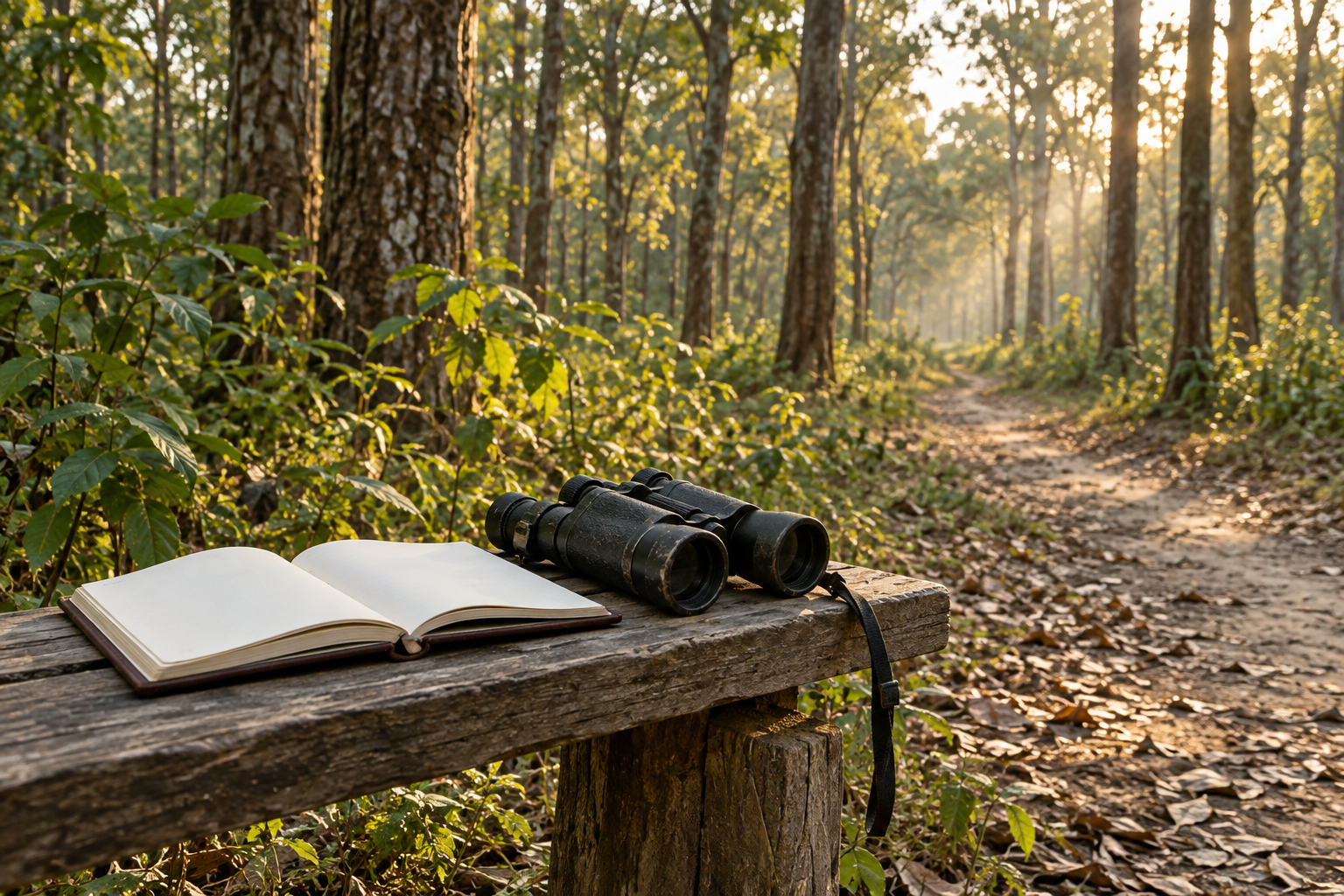
A forest setting in Nepal’s Terai frames two familiar travel words with very different linguistic journeys. · AI-generated illustration
In EverestBlog’s Nepal coverage, jungle and safari are natural companions. Together, they suggest a journey into the lowland Terai: a forest track, a riverbank, perhaps the sudden sight of a rhinoceros beyond tall grass. They are useful, familiar words, easy to place in a headline or a traveller’s question. Yet their familiarity hides something interesting. Neither word began with exactly the meaning that many English-speaking visitors now bring to it, and their histories lead well beyond Nepal’s protected areas.
This feature follows those histories rather than a wildlife itinerary. We will not be comparing jeep routes, planning lodge stays or promising animal encounters. Instead, we will ask how two words reached English, what they meant along the way, and why their meanings changed. Investigating the jungle word origin opens a wider question: how does language turn a description of land into a powerful image of wilderness? Following safari raises a related puzzle: how does an ordinary journey become associated with a particular kind of travel?
Nepal is a useful place to begin because the pairing can seem so straightforward here. Visitors encounter “jungle safari” in descriptions of wildlife experiences around places such as Chitwan and Bardia. In that setting, the phrase usually points towards travel undertaken to see animals and their habitats. But the landscape itself is not one continuous wall of trees. These protected areas include combinations of forest, grassland and river habitats. Even before consulting a dictionary, we can see a gap between the picture a word suggests and the variety it describes.
That gap does not make the word wrong. Everyday language groups complicated things into manageable categories. A visitor may use jungle broadly, while a naturalist needs more precise terms for the vegetation or habitat under discussion. Both can be communicating sensibly, but at different levels of detail. Word history adds another layer. It asks not only what speakers mean now, but also what earlier speakers meant, in which language, and under what circumstances.
The essential distinction is between a word’s ancestry and its present meaning. Ancestry concerns the earlier forms and senses from which a word developed. Present meaning concerns how people actually use and understand it today. These two stories are connected, but they are not interchangeable. Discovering an older sense does not cancel a newer one. Nor does it reveal a secret definition that every modern speaker is obliged to follow. Languages change because people carry words into new settings and put them to new uses.
Borrowing makes that process especially visible. When a word moves between languages, it may arrive through conversation, administration, trade, literature or travel writing. Its spelling and pronunciation may shift. One part of its meaning may become prominent while another fades. English has absorbed words through many such encounters, sometimes across unequal relationships of political power. Understanding those settings can illuminate a word’s journey, but a neat origin story should never stand in for the full history of the people or places involved.
We also need to separate evidence from an appealing tale. A resemblance between two words is not enough to prove a relationship, and a memorable explanation is not necessarily a documented one. Historical dictionaries and dated examples of use help establish firmer ground. Even then, the earliest surviving written example is not automatically the first time anyone spoke a word.
Read this, then, as an invitation to look more closely at familiar travel language. The words will remain useful after their histories are unpacked. You can still enjoy a jungle safari without giving a lesson in linguistics. But knowing how those labels travelled can sharpen your attention: to the landscapes they describe, to the assumptions they carry, and to the difference between where a word came from and what it means here and now.
Jungle: From Dry, Uncultivated Land to Dense Forest
The jungle word origin begins with a landscape that may surprise anyone picturing dripping leaves and tangled vines. English borrowed jungle through Hindi and Urdu jangal, with roots in Sanskrit jāṅgala. That Sanskrit ancestor was associated with dry, rough or uncultivated land—not simply the tropical rainforest that the English word often brings to mind today.
This is not a story of one exact meaning passing unchanged between languages. It is a story of people describing land, and of a word gaining different associations as it travelled. The important thread is land outside cultivation: ground that was not regularly ploughed, planted or managed as fields. Depending on the place, such land could be open and dry, covered in scrub, or wooded.
Following the dictionary trail
Authoritative dictionaries support this borrowing route. The Oxford English Dictionary traces English jungle through Hindi jangal to Sanskrit jāṅgala. Merriam-Webster gives a closely matching history, identifying Hindi as the immediate source and describing the Sanskrit ancestor in terms of rough, waterless country. Urdu also uses jangal, part of the shared vocabulary through which the word circulated in northern South Asia.
The Sanskrit evidence helps prevent a common misunderstanding. Monier-Williams’s Sanskrit-English Dictionary records meanings connected with dryness and a lack of abundant water or vegetation. These are not descriptions of a lush rainforest. Yet it would also be misleading to replace every historical use with “desert.” Dry or uncultivated country can include several kinds of terrain, and dictionary glosses are guides to meaning, not precise ecological classifications.
The safest summary is therefore a route, not a rigid equation: English jungle came through Hindi and Urdu jangal, ultimately from Sanskrit jāṅgala. Along that history, associations with uncultivated country developed toward woodland, thickets and dense vegetation. The meanings overlapped; they did not necessarily replace one another neatly.
How uncultivated land became thick forest
The bridge between these meanings is easier to understand when we stop treating “uncultivated” as a description of plant density. It describes a relationship between land and farming. A rocky stretch of scrub and a heavily wooded patch can both lie beyond cultivated fields. In South Asian usage, jangal could refer to forest or wild country without requiring the particular wet, tangled environment suggested by many modern English uses.
English speakers increasingly associated the borrowed word with the wooded and thickly vegetated landscapes they encountered or read about in South Asia. Dense growth became especially prominent in its English meaning. Today, jungle commonly suggests tropical vegetation, tangled undergrowth or forest that feels difficult to penetrate. That familiar image is a later emphasis, not a faithful snapshot of the Sanskrit ancestor.
A borrowing shaped by colonial encounters
The word entered English in the context of British colonial involvement in South Asia. British travellers, officials and writers adopted local landscape vocabulary as they described unfamiliar surroundings for English-speaking readers. Their descriptions helped carry jungle beyond the region and establish it in English. This setting matters: the word reached English through encounters shaped by unequal political power, not through a neutral exchange between dictionaries.
Colonial descriptions could also present land as wild or empty while overlooking how local people used it. Forests and scrublands might provide grazing, fuel, food or routes between settlements even when they were not cultivated fields. Calling a place “jungle” did not prove that it lacked inhabitants, knowledge or management. Nor does the word’s history tell us exactly what vegetation covered any particular location.
For travellers in Nepal, this distinction is useful. A “jungle walk” is a familiar tourism phrase, but it is not a botanical classification. Ask what habitat the walk actually visits: woodland, riverine forest, grassland edges or a mixture. The word offers a vivid invitation; the landscape deserves a more precise look.
Safari: A Journey Before It Was a Wildlife Outing
Before a safari became something travellers booked to see lions, elephants or rhinos, it was simply a journey. English borrowed safari from Swahili, where the word means a journey or expedition. Swahili, in turn, borrowed it from Arabic safar, meaning travel or a journey. That short chain carries a much wider history: movement between languages, contact across the Indian Ocean, and changing ideas about what travel involves.
The distinction matters because the English image is narrower than the Swahili meaning. In Swahili, safari does not inherently require wildlife, wilderness, a guide or a particular vehicle. It can describe travel for ordinary purposes, not just an adventure arranged for visitors. The expression safari njema, commonly translated as “have a good journey,” makes that breadth easy to understand. It is a wish for someone’s travels, not necessarily for their animal sightings.
A Word Shaped by East African Connections
Swahili is a Bantu language, not a form of Arabic. Its grammar and core linguistic structure belong to the Bantu language family. However, its vocabulary includes many Arabic loans, reflecting longstanding connections between East Africa and Arabic-speaking communities. Traders, sailors, settlers, scholars and religious networks helped sustain those connections across generations, especially along the coast and on nearby islands.
Indian Ocean trade was important to this exchange, but commerce alone does not explain every borrowed word. People also shared religious learning, built households and maintained social relationships across language boundaries. Arabic had a significant role in Islamic scholarship and worship, while Swahili developed as a language of coastal communities and wider communication. Within that setting, a word connected with travel had ample opportunity to circulate.
It would nevertheless be too neat to imagine one merchant introducing safar on one memorable voyage. The accepted borrowing relationship does not identify a single speaker or crossing. Nor does it make Swahili merely a stop along an Arabic-to-English route. English received safari through a living East African language in which the word already had its own everyday uses.
How English Narrowed the Picture
In English, safari became closely associated with organised expeditions in East Africa. Such journeys could involve substantial planning, supplies, guides and porters. European accounts often presented them through the experiences of explorers and hunters, sometimes pushing the knowledge and labour of African participants into the background. The word’s English associations therefore reflect not only travel itself, but also whose travel stories circulated widely.
Big-game hunting became a particularly strong part of that picture. For many English readers, a safari suggested an expedition to pursue and kill large wild animals. Yet hunting was never the underlying meaning of the Swahili word, and it should not be read backwards into the Arabic source. The activity attached to a borrowed word is not necessarily the meaning it had before borrowing.
Wildlife viewing and photography later became prominent English associations, especially within tourism. Today, a holiday described as a safari often centres on watching animals rather than hunting them. That does not mean photographic travel completely replaced hunting usage. Hunting safaris still exist, while walking safaris, vehicle safaris and other wildlife experiences broaden the range further. These meanings overlap rather than forming a tidy sequence in which each new use erases the last.
For readers planning wildlife travel in Nepal, this distinction is practical. A “jungle safari” may suggest an outing in search of wildlife, but the label alone does not specify how the trip operates. Check locally whether it involves a vehicle, a guided walk or another permitted activity, and ask about wildlife-watching rules. A modern tourism label describes an experience only loosely. Its word history explains how that label travelled; it does not guarantee what any particular operator will provide, or which animals a visitor will encounter.
Checking the Stories: What Word Origins Can—and Cannot—Prove
A convincing word history needs more than a neat story. When checking a jungle word origin claim, ask three questions: What evidence supports it? Which stage of the word’s journey does it describe? And does the explanation separate recorded facts from reasonable uncertainty? These questions help turn an appealing travel anecdote into something a reader can trust.
Start with a historical dictionary, such as the Oxford English Dictionary, rather than a search summary or an unattributed travel page. Historical dictionaries trace forms and meanings through time, usually with quotations from identifiable texts. Read the etymology alongside the numbered senses: the first explains linguistic relationships, while the second shows how people have used the word. Neither should be reduced to a single translation.
Next, examine the dated examples. Note the spelling, the sentence around the word, the author and the kind of document. A traveller’s account may introduce an unfamiliar term with an explanation; a later newspaper may use it without one. That contrast can suggest growing familiarity, but a handful of quotations cannot establish how widely everyone understood the word.
Dates also need checking. Is the date attached to the original composition, a later printed edition or a translation? If an online archive supplies a searchable transcription, compare it with the scanned page where possible. Optical character recognition can misread letters, and catalogue records can describe a reprint rather than its original. A surprisingly early search result is a lead, not automatic proof.
Distinguish the immediate source from the deeper ancestry. An English dictionary may identify Hindi as the source of “jungle” while tracing that Hindi word further back to Sanskrit. These are different steps, not competing answers. Likewise, English “safari” came through Swahili, with an earlier connection to Arabic. Saying only “it comes from Arabic” leaves out the language through which English received it.
For those earlier steps, consult specialist references: dictionaries of the relevant languages, scholarly etymological works and studies of historical language contact. Check whether a reference describes a direct borrowing, an inherited form or merely a related word. Similar sound alone does not establish descent. A careful account should also preserve qualifications such as “probably” rather than converting them into certainty.
The earliest surviving example is not a birth certificate. A dictionary’s earliest quotation marks the oldest written evidence its editors have identified for a particular word or sense. People may have spoken it earlier, and older writing may have disappeared or remain unsearched. New archival discoveries can move that date backwards. Write “recorded by” or “the earliest known example” when that is what the evidence actually supports.
Geography can mislead, too. A word does not have to originate wherever its modern activity takes place. Wildlife outings in Nepal may be called safaris, but that usage does not make “safari” a Nepali-origin word. Words move with travellers, trade, administration, books and tourism. The place where you encounter a term today is evidence of its current reach, not necessarily its birthplace.
Nor does the oldest recorded meaning own the word forever. An earlier sense can explain a surprising historical connection without making later meanings wrong. This mistake is often called the etymological fallacy: judging present usage solely by ancestry. To understand what “jungle” means in a modern wildlife article, consider current dictionaries, context and established usage, not just its oldest recoverable sense.
Finally, resist colourful explanations without reliable documentation. If a source records an origin legend, identify it as a legend unless stronger evidence supports it. If no reliable source records it, leave it out. When references disagree, compare their evidence and scope rather than choosing the liveliest account. The best word histories are engaging because they reveal change, contact and uncertainty—not because every gap has been filled with a story.
Conclusion: Familiar Travel Words, Longer Histories
The jungle word origin offers more than a surprising detail about a familiar landscape. It reminds us that words do not travel with their meanings sealed inside them. People borrow them, adapt them and use them to describe what matters in a new setting. Over time, a word can become so comfortable in its adopted home that speakers rarely think of it as borrowed at all. Its history remains, but its everyday purpose belongs to the people using it now.
Borrowing is therefore not simply the transfer of a label from one language to another. It can also involve a change of emphasis. A broad expression may become associated with one particular activity; an ordinary term may acquire a sense of adventure. Travel writing, conversation, advertising and translation all help shape those associations. None of these settings has complete control over meaning. Together, however, they influence what readers picture before they have seen a place for themselves.
In Nepal’s travel vocabulary, this process is easy to notice. English-language descriptions sit alongside Nepali expressions and words from the country’s many other languages. A guide, a lodge owner, a visitor and a local resident may use the same term while placing different things at its centre. For one person, “jungle” might suggest wildlife and thick vegetation. For another, the relevant landscape may also be a place of work, local knowledge, conservation rules or community relationships. The word connects these viewpoints without making them identical.
That difference matters because travel language helps frame what seems worth noticing. Calling a place a wildlife destination directs attention towards animals and encounters. Describing it as a habitat encourages questions about vegetation, water and ecological relationships. Speaking of it as someone’s home brings people and responsibilities into view. These descriptions need not compete, but none is complete on its own. A familiar word is often a useful doorway into a place, provided we do not mistake the doorway for the whole landscape.
Words can also move between everyday speech and specialist or promotional uses. In a travel description, “safari” may work as a convenient name for a wildlife outing, yet the label alone tells us little about the experience or its relationship with the surrounding environment. Recognising this gap makes us more attentive readers. Rather than treating an evocative word as a full description, we can look at the more precise language around it: what landscape is being described, whose perspective is represented and what has been left unnamed.
Language preserves traces of cultural contact, not a complete record of it. A borrowed word can point towards connections between communities, but it cannot tell every story of the people involved. Nor does an older meaning cancel a newer one. Present-day speakers are not using language incorrectly simply because their understanding differs from an earlier usage. Change is part of how language remains useful. The historical interest lies in seeing both the continuity and the adjustment, without insisting that one moment in a word’s life must define all the others.
This perspective also encourages humility when writing about Nepal. A term familiar to an international audience may be useful, but it should not crowd out local distinctions or imply that everyone understands a landscape in the same way. Clear writing can keep accessible vocabulary while making room for specific habitats, community names and individual perspectives. The aim is not to replace every common travel expression with an explanation. It is to recognise when an easy label needs a little more context to do justice to the place.
The next time a familiar travel word catches your eye, pause over it. What picture does it create? Who is using it, and what might another speaker hear differently? Notice those small choices: they can open a richer conversation about language, people and place.