Wildlife
The Mysterious Life of Nepal’s Gharial: What Happens Between Riverbank Sightings?
EverestBlog AI · Nov 1, 2026 · 21 min read
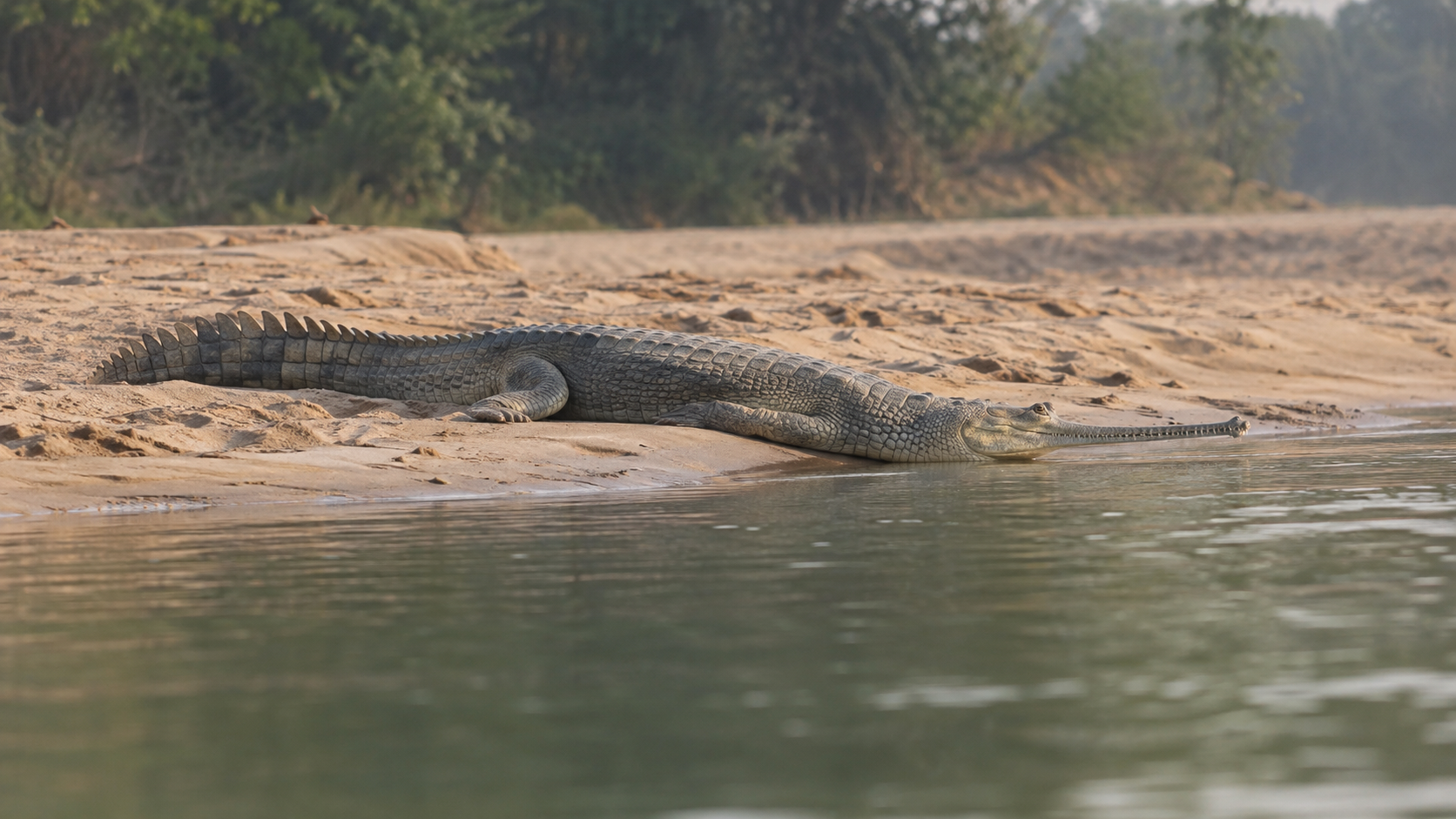
A riverbank sighting captures one visible moment in a gharial’s day—not its full routine. · AI-generated illustration
Picture a quiet bend on Nepal’s Rapti River. This is an illustrative scene, not a record of a particular encounter. A gharial lies at the edge of a sandbank, its outline clear against the pale ground. Then it lifts itself, slides forward and enters the water. For a moment, its back remains visible. A ripple spreads, the surface settles, and the animal disappears. From the bank, the scene seems to have ended. For the gharial, it is simply another part of the day.
What happened next? It is tempting to supply a story: the gharial went hunting, escaped a disturbance or moved towards deeper water. Each explanation might be possible, but the disappearance alone does not establish any of them. It tells us that the animal entered the river and passed out of view. The central question is therefore not just what gharials do underwater. It is how much of a day we can reasonably reconstruct from the moments we manage to see.
This is the challenge at the heart of understanding gharial behavior. A riverbank sighting offers unusually clear access to an animal whose activities are otherwise difficult to follow. Yet that clarity can be misleading. We may watch a gharial remain almost motionless for a long stretch and remember stillness as its defining habit. Meanwhile, movements before our arrival, activity beneath the surface and events beyond the next bend remain absent from our account. What is easiest to observe is not necessarily what occupies most of its time.
Nepal’s rivers make that gap especially important. Along the Rapti and Narayani, the setting is not a fixed stage with one bank and one stretch of water. Sandbanks, channels and water levels change, particularly with the monsoon cycle. A place where an animal is easy to see under one set of conditions may offer little visibility under another. Surface glare, muddy water and the shape of a bank also affect what an observer can detect. Sometimes the missing animal has moved; sometimes our window into its surroundings has narrowed.
Even the phrase “between sightings” hides an uncertainty. If a gharial disappears and one appears nearby later, was it the same individual? Without reliable identifying features or other evidence, we should not assume so. Nor does a return to the same visible spot prove that the animal stayed close throughout the interval. Two observations give us two points in a sequence, not an uninterrupted account. The unseen interval could contain a short movement, a longer journey or little change in location.
A useful starting point is to separate three things: what was observed, what it suggests and what remains unknown. “The gharial entered the water after a boat passed” records a sequence. “The boat caused it to leave” adds an explanation that needs more support. This distinction does not make a sighting less interesting. It makes the questions sharper. How close was the boat? Had the animal already begun moving? Did similar departures happen when no boat was present? Careful curiosity leaves room for more than one answer.
The riverbank moment, then, is best treated as an opening rather than a complete story. It places one animal somewhere, doing something, under particular conditions. Repeated observations and research can extend that view, but gaps still deserve to be acknowledged rather than filled with confident guesses. To explore the hidden hours of Nepal’s gharials is to look beyond the striking shape on the sand and ask what evidence connects one glimpse to the next. The mystery lies partly in the animal’s submerged life—and partly in the limits of our own view.
On the Bank: What Basking Can Tell Us
A gharial stretched across a sandy bank may look as though it is doing nothing. Yet this quiet scene offers clues to gharial behavior, especially how the animal manages its body temperature. Gharials are ectotherms: their body heat depends largely on their surroundings rather than on heat produced internally. Coming ashore can help them warm up, while shifting position or returning to the river can change their exposure to heat. The bank is therefore more than a resting place, although a single sighting cannot tell us exactly why an animal chose it.
Read the Posture Before Explaining It
Start with what you can actually see. Is the gharial lying fully out of the water, or are its tail and rear body still submerged? Is its belly resting on dry sand or a damp strip beside the river? Note the position of its head, limbs and long snout. These details describe the animal’s contact with the bank and exposure to sunlight, without assuming what it feels or intends.
An open mouth also deserves careful interpretation. In crocodilians, holding the mouth open can contribute to heat exchange, but a gaping gharial is not a thermometer. Mouth position alone does not establish whether the animal is too hot, comfortable or responding to something nearby. Record the gape alongside sunlight, shade, posture and any subsequent movement. Avoid automatically labelling it aggression, hunger or a request to be left alone.
Position Matters as Much as Stillness
A bank contains different conditions within a small area. Exposed sand, shaded edges and wet ground can offer different thermal environments. A gharial’s distance from the water also affects how easily it can leave the bank. When watching along Nepal’s gharial rivers, such as the Rapti and Narayani, notice the setting around the animal rather than treating every patch of sand as equivalent.
Useful observations include:
- Sun exposure: whether the whole body is in sunlight, partly shaded or under cloud cover.
- Contact with water: whether the animal is fully ashore, at the waterline or partly immersed.
- Body orientation: how the head and trunk lie relative to the shoreline and sun.
- Small adjustments: whether it turns, raises its head, shifts its limbs or moves to another patch.
Such details can support an interpretation of temperature regulation, especially when changes are observed over time. They do not prove that every adjustment serves that purpose. A passing boat, a nearby person or an unstable patch of bank may also influence where a gharial rests.
Watch the Transition, Not Just the Pose
The sequence around a sighting is often more informative than a photograph. A gharial that emerges, settles in sunlight, changes position and later slips back into the river provides a record of bank use. Its movements are consistent with adjusting exposure to different temperatures, but the strength of that explanation depends on accompanying evidence. Sunlight, air conditions and water temperature all matter; appearance alone cannot reveal body temperature.
Keep recorded behavior separate from inferred purpose. “The gharial moved from dry sand into shallow water” is an observation. “It entered the water to cool down” is an interpretation. Both can be useful, provided the distinction remains clear. If a boat approached immediately before the movement, that context belongs in the record too.
Finally, resist turning one peaceful encounter into a timetable. A gharial resting on a bank in late morning does not establish that it basks there every morning. Weather, season, river level and disturbance can alter opportunities to come ashore. Observe quietly from a responsible distance, follow local guide advice and never approach to provoke movement. An undisturbed animal offers better clues than one forced to abandon its resting place.
Below the Surface: Feeding Beyond Our View
A gharial slipping beneath a Nepal river leaves an unanswered question: is it looking for fish, or simply moving out of sight? Feeding is one part of gharial behavior, but a dive alone does not reveal its purpose. Understanding what happens underwater means separating the animal’s known feeding mechanics from the details that a riverbank observer cannot confirm.
A Snout Built for Catching Fish
Gharials feed mainly on fish. Their long, narrow jaws carry numerous slender, pointed teeth that help catch and hold slippery prey. Unlike the broad jaws of crocodilians that tackle large, struggling animals, this shape is well suited to snapping at fish in water. The teeth work chiefly as a gripping system, not as tools for chewing a meal into small pieces.
Documented feeding movements include quick sideways sweeps or snaps of the head and jaws. A fish must come within reach, and the gharial must coordinate the movement of its head with the opening and closing of its mouth. Its narrow snout presents less resistance to sideways movement through water than a broad one would. That advantage does not make every strike successful: fish can escape, and contact does not always produce a secure grip.
After capture, a gharial may adjust a fish’s position before swallowing it whole. Depending on the prey’s size and orientation, handling can involve further jaw movements and changes in head position. Some handling may become visible at the surface, but much of the sequence can remain hidden. Seeing a fish between the teeth confirms a capture; it does not necessarily reveal where or how that fish was caught.
What the Riverbank Hides
From shore, the most important action may be the hardest to see. Suspended sediment, reflected light, depth and surface ripples can conceal both predator and prey. Even in clear water, the viewing angle may hide the moment the jaws close. A brief splash could accompany prey capture, but it could also result from an ordinary turn or another animal’s movement.
A useful observation therefore describes visible actions before assigning a purpose. “The head moved sharply sideways underwater” is stronger evidence than “the gharial caught lunch” when no fish was seen. Equally, an animal surfacing without visible prey has not necessarily failed. It may have swallowed a fish out of view, made no feeding attempt, or been doing something unrelated to feeding.
- A dive: evidence of submergence, not proof of hunting.
- A rapid head movement: potentially consistent with a feeding strike, but difficult to interpret without context.
- A fish held in the jaws: direct evidence of capture, though not necessarily of the preceding strike.
- Visible swallowing: stronger evidence of consumption than a splash or brief glimpse alone.
Mechanics Are Not a Meal Schedule
Knowing how gharials catch fish does not establish when wild gharials in Nepal usually hunt, how often they eat, or what proportion of attempts succeed. Those questions require observations that account for hidden activity. Feeding seen during a visitor’s morning outing cannot establish a morning hunting preference. Likewise, a keeper’s feeding schedule is not evidence of a wild animal’s natural meal frequency.
Claims that gharials eat a fixed number of times each day, hunt only after dark, or almost always catch their target need specific supporting evidence. Findings from captive animals or another river may offer useful clues, but should not automatically be presented as facts about Nepal’s populations. The careful conclusion is narrower: gharials have specialised fish-catching anatomy and documented rapid capture movements, while the timing, frequency and outcome of an unseen feeding attempt remain unknown.
Between Sightings: Movement and Habitat Use
A gharial that slips off a sandbank leaves a question behind: where does it go next? It may settle in nearby water, move along the same river reach, or travel farther. Understanding gharial behavior between sightings means considering these possibilities without treating any one of them as certain. The visible bank is only one part of an animal’s habitat; much of the space it uses is hidden beneath the surface.
A River Is a Changing Set of Places
Resting places and underwater habitat work together. A sandbank offers somewhere to bask, while adjoining water provides an escape route and access to other parts of the river. A site’s usefulness therefore depends not just on the exposed sand, but also on the depth, current, and connections around it. A bank that looks ideal to a visitor may have a shallow approach or frequent disturbance.
Depth affects where a gharial can remain submerged and how easily it can move between places. Flow matters too: a river channel contains currents of different strengths, including relatively sheltered areas beside stronger water. Moving a short distance may allow an animal to change its exposure to current without leaving the reach. However, an observer on the bank usually cannot tell whether a submerged gharial is resting, passing through, or doing something else.
Seasonal Water Levels Redraw the Map
As water levels fall, sandbanks emerge and channels may become shallower or less connected. Rising water can cover familiar resting sites and open routes across areas that were previously dry. During Nepal’s monsoon, river conditions can change substantially, altering both the places available to gharials and the observer’s ability to find them. A missing bank does not mean its former user has abandoned the wider area.
These changes make seasonal comparisons tricky. More sightings on exposed banks during one period could reflect better visibility rather than more animals occupying the river. Fewer sightings during high water could result from submerged banks, difficult survey conditions, redistribution, or some combination of these. Without supporting observations, it is not possible to assign a single cause.
Disappearance Is Not a Distance Measurement
If a gharial vanishes from a familiar viewpoint, the safest conclusion is simply that it is no longer visible there. It could be underwater nearby, behind a bend, beside another bank, or beyond the observer’s field of view. Even repeated absence from one resting site establishes only that the animal was not detected there during those checks—not how far it travelled.
This distinction matters when interpreting reports from Nepal’s gharial rivers, including the Narayani and Rapti. A sighting upstream and another downstream may suggest a possible connection, but they do not establish a journey by one animal. Claims about particular routes, distances, or seasonal movements in Nepal need a traceable study or monitoring record, not an inference based only on where gharials were seen.
Link Places Only When Identity Is Reliable
To connect two sightings, researchers first need confidence that both involved the same individual. Similar size or appearance is rarely enough. Documented marks, tags, tracking devices, or photographs showing validated distinguishing features can support identification. Each method has limits: marks may be hard to read, photographs may hide key features, and tracking records may contain gaps.
- Record the location and conditions: note the bank, channel, water level, and observation point.
- Separate identity from resemblance: “a similar-sized gharial” is not a confirmed returning individual.
- Keep the unseen interval explicit: two confirmed locations show endpoints, not every stop or the exact route between them.
The useful question is therefore not just “Where did it go?” but “What evidence connects this animal to another place?”
When Other Gharials Shape the Day
A gharial resting alone may look like a solitary animal, but one riverbank sighting tells us little about its encounters with others. Gharial behavior changes with the breeding season, when spacing, displays, courtship and nest attendance can bring animals together—or make them less tolerant of a neighbour. These interactions may be brief, underwater or easy to mistake for ordinary resting.
Sharing a Bank Does Not Prove a Bond
Several gharials may gather on a suitable sandbank because it offers warmth, easy access to water and room to rest. That is evidence of shared habitat use, not necessarily friendship, a stable group or cooperation. When good basking places are limited, animals that would otherwise spread out may lie close together.
To interpret their spacing, watch what happens when another gharial approaches. Does the resting animal stay, turn towards it, shift position or enter the water? Repeated displacement may suggest unequal access to a preferred spot. Yet one departure proves little: disturbance, changing sunlight or an unrelated movement could explain it. Body size, sex and breeding condition may matter, but observers should not assign dominance from a single encounter.
Breeding Makes Some Signals More Visible
Mature male gharials develop the ghara, the rounded swelling at the tip of the snout that gives the species its name. This structure is associated with sound production and breeding displays. Descriptions of gharial courtship include buzzing or hissing sounds, bubbles and conspicuous postures or movements. Such signals can make the reproductive season quite different from the quiet scene visitors usually photograph.
Adult males may display towards females and challenge other males. Female responses also matter: remaining nearby, approaching or moving away helps shape an encounter. Courtship can include close following and contact around the head and snout, with mating taking place in water. However, two animals swimming together are not automatically courting. A convincing interpretation needs a sequence of behaviour, reliable sex identification and seasonal context.
Evidence from elsewhere needs a location label. Detailed accounts from Indian rivers or captive breeding groups help explain what gharials can do; they do not establish how often Nepal’s wild gharials do it. River conditions, population structure and disturbance differ. In Nepal, breeding timing and the meaning of a particular display should be checked against local monitoring records rather than assumed from another population.
Nesting Changes a Female’s Priorities
Females excavate nests in sandy riverbanks, lay eggs and cover them. A nesting female’s repeated use of one stretch of bank may therefore reflect reproduction rather than a general preference for company. Several females using the same nesting area may be responding to suitable sand and bank conditions, not forming a cooperative nesting group.
Female nest attendance and guarding are documented in gharials. Around hatching, females may open the nest, helping young emerge. These activities make access between the nesting bank and water especially important. A female need not remain visibly beside the buried eggs throughout incubation for the nest to receive attention.
Do not extend that role automatically to males. Adult males have been documented attending groups of hatchlings in some Indian populations, but that does not establish routine paternal care in Nepal. Nor should gharials be assigned every parental behaviour reported in other crocodilians. Each claim needs species-specific evidence and, where possible, observations from the river concerned.
For visitors, the practical lesson is restraint. Keep away from suspected nests and avoid blocking an animal’s route to water. Watch from an established viewing place and follow local guides’ instructions. The useful question is not simply whether gharials are together, but what each animal does before, during and after another arrives.
How Researchers Test the Missing Hours
To understand gharial behavior between sightings, researchers need more than a memorable encounter. They need observations that can be compared: where an animal was, when it appeared, what it was doing, and what conditions surrounded it. In Nepal, river surveys, repeated observations of basking animals, and radio-tracking of released gharials have contributed evidence. These methods answer different questions, however, and none provides a complete record of an animal’s day.
Repeated observations can reveal whether a river stretch is used regularly, whether basking changes with weather, and whether animals gather or spread out as river conditions change. Surveys along Nepal’s gharial rivers, including the Rapti and Narayani, document visible animals and their distribution. Recording survey time, water level, weather, and effort makes comparisons more useful. A lower count on one visit does not necessarily mean gharials have left: some may be submerged, hidden behind a bank, or simply harder to detect.
This is visibility bias: the animals researchers see are not necessarily a fair sample of everything happening. A sunny bank makes a resting gharial conspicuous; deep or cloudy water conceals an active one. Counts made mainly during good basking conditions are useful for monitoring, but cannot establish how the whole day is divided between resting, swimming, and feeding. Researchers must separate “not seen” from “not present,” and distinguish a change in behavior from a change in detectability.
Individual identification helps turn separate sightings into a history. Nepal’s captive-rearing and release work has used marked gharials, allowing some later encounters to be linked to released individuals. Where marks can be read, researchers can establish that a particular animal survived until a later observation or returned to a known location. Photographs may also help compare distinctive features, but reliable identification requires clear images and checks against mistaken matches. A large male’s visible snout swelling can help distinguish sex and maturity; it does not, by itself, prove identity.
Cameras can extend observation without keeping a person beside the river. A fixed camera overlooking a basking bank could record arrival times, departures, and responses to passing boats. Suitable equipment could also improve coverage after dark. Yet a camera watches only its frame, and a departure does not reveal the animal’s destination. Camera monitoring should not be presented as an established, comprehensive record of Nepal’s underwater gharial life. Its potential is different from evidence that a particular Nepal study has actually collected.
Radio telemetry has been documented in Nepal, including work following released gharials in the Chitwan river system. Locating a tagged animal repeatedly can establish movements between river sections and use of particular areas, even when ordinary sightings are scarce. But locations are not direct observations of feeding or social activity. Fixes taken hours apart leave the route between them uncertain. Results from released, tagged animals also need care before being extended to wild-born gharials of every age.
Night-time coverage remains uneven, so daytime records cannot settle how much feeding or travel occurs after dark. Disturbance adds another complication: people approaching a bank or boats passing nearby may prompt a gharial to enter the water, changing the behavior being measured. Recording distance, approach, boat activity, and the animal’s response helps test that possibility; entering water alone does not prove disturbance. Important questions remain about nocturnal activity, seasonal journeys, and differences between individuals. Strong studies combine methods and state their gaps clearly. No recorded behavior is not the same as no behavior: sometimes the missing hours are still genuinely missing.
Conclusion: A Sighting Is a Fragment, Not a Full Day
The gharial slips beneath the river, and the sighting ends. What happens next is the question that has carried us from the bank into the less visible parts of its day. Yet the disappearance itself gives us only a small piece of evidence: an animal that was visible is now out of view. It does not, on its own, tell us where the gharial goes, what it does there, or why it leaves.
That distinction is central to understanding gharial behavior. A clear view can feel like a complete story, especially when an animal remains still long enough for us to study it. But clarity is not completeness. We may see a posture, a movement, or an encounter in detail while knowing little about what came before it. Once the animal disappears, the limits of that knowledge become harder to ignore.
The strongest account keeps three kinds of statement separate: what was directly observed, what the evidence reasonably supports, and what remains uncertain. These are not competing ways of describing wildlife. Together, they allow us to build an explanation without making it sound more settled than it is.
Direct observation provides the anchor. A record can establish that a particular action occurred at a particular place and time, within the observer’s view. Its value lies in that precision, not in how dramatic the action appears. Even then, the description needs boundaries. Seeing an animal enter the water establishes an entry; it does not establish the purpose of the movement or reveal the rest of the animal’s route.
Supported interpretation takes the next step. Repeated observations, environmental measurements, or tracking records may make one explanation more convincing than another. The important word is supported. An interpretation should explain how the evidence leads to the conclusion, while leaving room for alternatives that have not been ruled out. “Consistent with” is often more accurate than “proves,” particularly when the behavior itself remains hidden.
Uncertainty marks what those records cannot yet resolve. It may concern the activity between two recorded locations, the reason for a departure, or whether a pattern seen in a few observations holds more widely. Naming such gaps is not a failure to tell the story. It is how a careful account avoids turning missing information into an imagined sequence of events.
This standard also changes how we read the evidence together. A bank observation and a tracking record may each be useful without answering the same question. One can describe a visible action; another can help establish location or movement. Agreement between different records can strengthen an explanation, but combining them does not automatically reveal intention. The conclusion must still fit what the methods actually measured.
Returning to the opening disappearance, then, we need not replace mystery with certainty to have learned something. We can ask better questions: What was recorded before the gharial vanished? What information exists afterward? How large is the gap between those records? Which explanation fits, and what additional evidence would help distinguish it from another? These questions make the unseen hours a subject for investigation rather than a blank space for storytelling.
The value of patient, non-intrusive research lies here: not in forcing every hidden moment into view, but in gathering reliable evidence while minimizing disturbance. Careful watching, transparent methods, and honest limits allow understanding to grow without pretending it is finished. The river closes over the gharial, and our view ends. A responsible account ends its certainty there too, carrying the question forward rather than supplying an answer the evidence cannot yet give.