Wildlife
Chitwan’s Termite Mounds: What Can They Tell Us About Life Beneath the Forest?
EverestBlog AI · Nov 1, 2026 · 11 min read
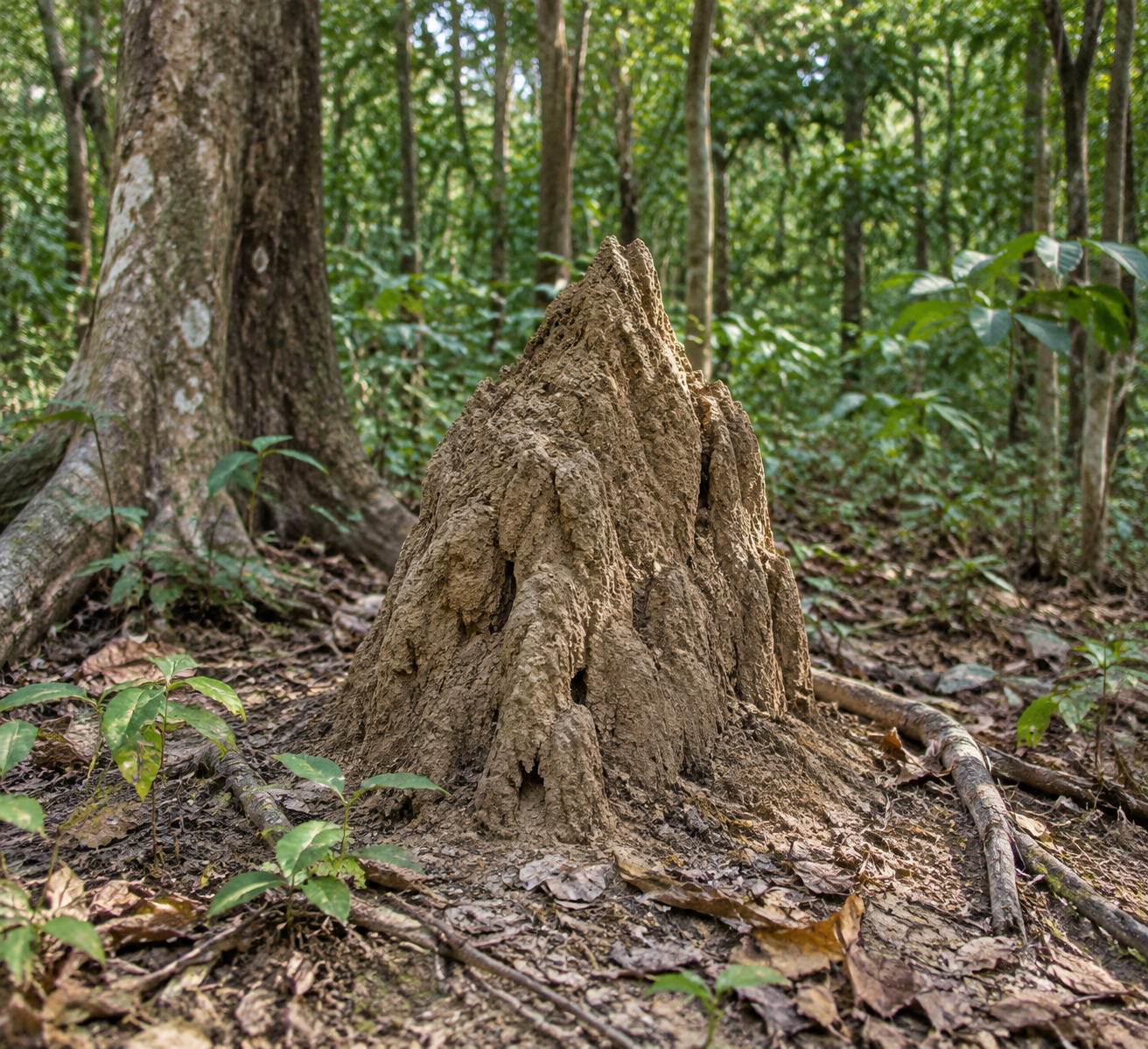
An earthen mound raises questions about the forest below it; confirming its builders and current occupants requires field evidence. · AI-generated illustration
A ground-level encounter with a termite mound in Chitwan should begin with what was actually seen, not with an imagined journey into the colony. No field notes or photographs accompany this section, so a particular mound’s shape, surface, setting or animal visitors cannot honestly be presented as a documented sighting. That reporting limit matters: an above-ground structure invites questions about hidden life, but it does not supply all the answers.
The central question is still compelling: what can a structure above the forest floor reveal about life beneath it? For anyone interested in termites in Chitwan, a mound offers a starting point for understanding how small animals can reshape soil. Its visible walls may be only one part of a system that includes covered passages, underground galleries and chambers. The arrangement varies among termite species, and not every termite colony builds a conspicuous mound.
Here, the focus is soil engineering: the excavation, transport and rearrangement of earth. Termites can carry particles between soil layers and use soil, saliva and other materials to construct protected spaces. In doing so, they change the physical organisation of their surroundings. A mound is therefore more than an object standing on the ground. It can be evidence of work that has moved material and created new boundaries between open air, enclosed passages and the soil below.
This is a different lens from following the breakdown of a fallen branch. Deadwood decomposition asks how woody material is consumed and transformed, and how its nutrients return to the wider ecosystem. A dung food web follows animal droppings through the organisms that feed on, bury or break them down. Both subjects connect with soil life, but neither is the main story here. Our question concerns what termite construction does to the ground itself.
That distinction helps keep the discussion precise. Feeding and building are connected activities, yet the presence of a mound does not identify the colony’s food. Nor does its outward appearance reveal the depth of every tunnel or the location of the queen. Even a striking structure cannot, by itself, tell us which species made it. Those are separate questions requiring closer observation, appropriate identification or research beyond a surface view.
Why does this engineering matter? Pores and passages can influence how air and water move through soil. Transported particles can alter the texture and distribution of material around a nest. Construction may also concentrate some soil components in particular places. These effects are not identical everywhere: soil type, termite species, vegetation and weather all matter. Findings from another forest should not automatically become claims about a mound in Chitwan.
The useful perspective is neither to dismiss the mound as a heap of earth nor to treat it as a transparent window into a colony. It is a visible trace of biological construction, with a hidden history that needs evidence. Looking at termites in Chitwan through this lens shifts attention from the size of the insects to the scale of their work—and asks how much of that work the forest floor allows us to see. It also makes uncertainty part of the story rather than a gap to fill with confident guesses.
Reading a Mound Without Assuming It Is Active
A raised patch of earth can catch the eye on a Chitwan forest walk, but its appearance is only a starting point. Before calling it a termite mound, work with researchers familiar with Chitwan’s insects and soils. Ask what evidence distinguishes termite construction from an eroded bank, soil around roots, or material moved by other animals. Then separate two questions: was this structure built by termites, and is there evidence that termites use it now?
Build a record before drawing conclusions
For each selected structure, make a clear field record from an approved path or observation point. Photographs taken from consistent angles, with a scale where it can be placed without disturbance, help researchers compare observations. Record the observation date and recent weather if known: rain can soften surfaces, while dry conditions may make cracks more noticeable. Neither change proves that a colony has arrived or disappeared.
- Shape: Describe the outline, approximate dimensions, and whether the structure stands alone, surrounds wood, or merges into a bank. Use plain descriptions rather than assigning a species name.
- Surface texture: Note whether the outer layer looks smooth, crumbly, cracked, or pellet-like. Record visible differences between patches without assuming that darker or wetter soil is fresh termite work.
- Location: Describe shade, nearby trees, fallen wood, slope, and the surrounding ground. Follow local advice about recording or sharing precise locations in protected areas.
- Possible activity: Photograph any covered passages, exposed insects, or apparent repairs visible without interference. Distinguish what you directly observed from what you inferred.
Look for evidence of use, not just a familiar silhouette
Covered passages—soil-lined routes sometimes called shelter tubes—may allow termites to travel while remaining protected. Their presence can support an interpretation of termite activity, but an intact passage may persist after use has stopped. Likewise, a patch that looks recently repaired is a clue, not proof. Stronger evidence might include termites observed working on an existing damaged area, with their identity assessed by a specialist. Do not create a hole to see whether insects repair it.
Where permitted, repeat visits can show whether a passage extends or a surface changes. Ask the researcher how confidently those changes can be attributed to termites rather than weather or another animal. A brief visit with no visible insects should be recorded as “no activity observed,” not “abandoned.” Termites may remain concealed, and visible activity can vary with conditions.
Understanding termites in Chitwan also means looking beyond prominent mounds. Not all termites build visible above-ground structures; colonies may occupy soil or wood without producing a conspicuous landmark. Mound shape alone may not identify a species, either. Ask what additional evidence a reliable identification would require, and leave uncertain structures unnamed.
Check records and permission first
Seek relevant local records through park staff, researchers, and institutions holding surveys or specimens. Check whether a record concerns the same locality and habitat; a regional species list does not identify the builder of a particular mound. For access, repeat visits, photography arrangements, and any research permissions, check locally. Reporting is not permission to sample. Do not break mounds open, remove material, or disturb covered passages: document the evidence that can be gathered without damaging the structure.
Tracing Soil Movement and the Hidden Colony
Once termites are confirmed as the mound’s builders, the structure becomes a record of soil movement. Workers excavate material from underground or nearby ground, carry small loads, and place them along passages, walls and repair sites. They can bind particles with saliva and, depending on the species, other materials such as faecal matter. Repeated construction turns loose earth into a structure whose properties may differ from the surrounding forest floor.
For termites in Chitwan, the next question is not simply how much soil has moved, but where it came from. A mound’s colour or fine texture may suggest a different source layer, yet appearance alone cannot establish excavation depth. Researchers would need to compare mound material with samples from nearby soil horizons. Differences in particle size, mineral composition or other measured properties could help trace that movement, while allowing for changes caused by building and weathering.
Following the passages, carefully
Galleries provide routes through which workers move soil, food and colony members. In mound-building species, these passages can connect the visible structure with underground routes and nesting spaces. However, a mound is not necessarily a simple shell around one central chamber. Its relationship to the nest depends on the termite species and the structure’s condition. A passage exposed by erosion shows only a fragment of that arrangement; it does not reveal the colony’s full extent.
Ask researchers how they established those connections. Were termites collected and identified? Were passages mapped through permitted excavation, imaging or another method? Could roots, abandoned channels or the burrows of other animals explain some openings? Visitors should not break into mounds to investigate. Destructive sampling can disturb colonies and other occupants, and research within protected areas requires appropriate permission.
What local measurements could reveal
Useful comparisons need more than one handful of mound soil and one sample beside it. Ask whether a study included several mounds, matched sampling depths, and accounted for vegetation, slope, season and nearby ground already influenced by termites. Four groups of measurements are especially informative:
- Soil texture: Do mound samples contain different proportions of sand, silt and clay? Particle-size analysis can test whether workers selected or concentrated particular materials.
- Pore space: Measurements of bulk density and porosity can examine how tightly soil is packed. Hard walls and open galleries may occur together, so one measurement may miss important variation.
- Water movement: Infiltration tests and moisture measurements can show whether water enters, drains or remains differently. Results may vary between mound surfaces, passages and surrounding soil.
- Nutrients: Tests for organic carbon, nitrogen, phosphorus and pH can establish differences. Higher concentrations alone do not prove greater nutrient availability to plants.
Keep Chitwan evidence separate from broader research. Studies elsewhere show that termites can alter soil structure and chemistry, but they do not establish the direction or size of those changes here. Ask for the local study site, species identification, sampling method and actual results before making a Chitwan-specific claim.
The same caution applies inside the colony. Visible holes do not demonstrate a particular ventilation system, and mound height cannot establish nest depth. Some termites cultivate fungi, but that behaviour should be attributed to a Chitwan colony only when identification and direct evidence support it.
Conclusion: What the Evidence Reveals—and Leaves Hidden
A termite mound is evidence of work, but not a full account of the workers or their lives. For anyone observing termites in Chitwan, that distinction is the most useful conclusion to carry away. A visible structure shows that termites have gathered and arranged soil into something different from the surrounding ground. It does not, by itself, reveal whether the colony is still present, how far its passages extend, or what is happening beneath your feet.
Calling termites soil engineers recognises their role in moving and organising earth. Their building activity can leave a lasting physical record, even when the insects remain out of sight. Yet the strength of any interpretation depends on the evidence available. A mound’s shape, surface texture and condition can support careful description. They cannot reliably supply a colony’s age, population or identity. The clearest account separates what an observer can see from what requires closer study.
That separation also keeps the wider forest story in proportion. A mound is a useful place to notice soil movement, but it is not a measure of everything termites contribute to a particular patch of forest. Nor should one conspicuous mound stand for all termite activity in Chitwan. What is visible offers a starting point for questions, not a shortcut to conclusions about the entire landscape.
Several important questions therefore remain open during an ordinary visit:
- Is the structure occupied now? Its presence alone cannot establish current activity, and a brief watch may miss signs that appear at another time.
- How much of the colony lies beyond the visible mound? The above-ground outline does not provide a dependable boundary for underground passages or occupied spaces.
- What has changed, and why? A worn surface or altered opening may be noticeable, but its cause is not always clear from appearance alone.
- How representative is this example? Observations from one mound cannot establish a general pattern without comparison with other sites and conditions.
Repeated observation matters because it adds a time dimension to evidence that otherwise remains a snapshot. Returning to the same viewpoint, where access is permitted, can help distinguish a persistent feature from a recent change. Notes or photographs taken without disturbing the structure can make those comparisons more reliable than memory. Even then, a visible change should be recorded before it is explained. Seeing that something happened is not the same as knowing what caused it.
Further research is valuable where observation reaches its limits. Establishing which termites are involved, whether a structure is occupied, or how visible features relate to underground spaces may require specialist methods and appropriate permission. These gaps are not failures of attention. They are reminders that a mound preserves only part of the evidence, and that confident answers need methods suited to the question.
The best visitor response is curiosity with restraint. Follow local guidance, stay on permitted routes and observe from places your guide considers appropriate. Leave mounds and associated structures intact: do not break surfaces, widen openings or dig to seek proof of activity. Chitwan’s visible mounds are worth noticing precisely because they offer clues to a largely hidden world. Treat them as clues—not complete maps of underground life.