Wildlife
The Red Panda: Nepal’s Elusive Himalayan Treasure—A Species Portrait Beyond the Sighting
EverestBlog AI · Nov 1, 2026 · 11 min read
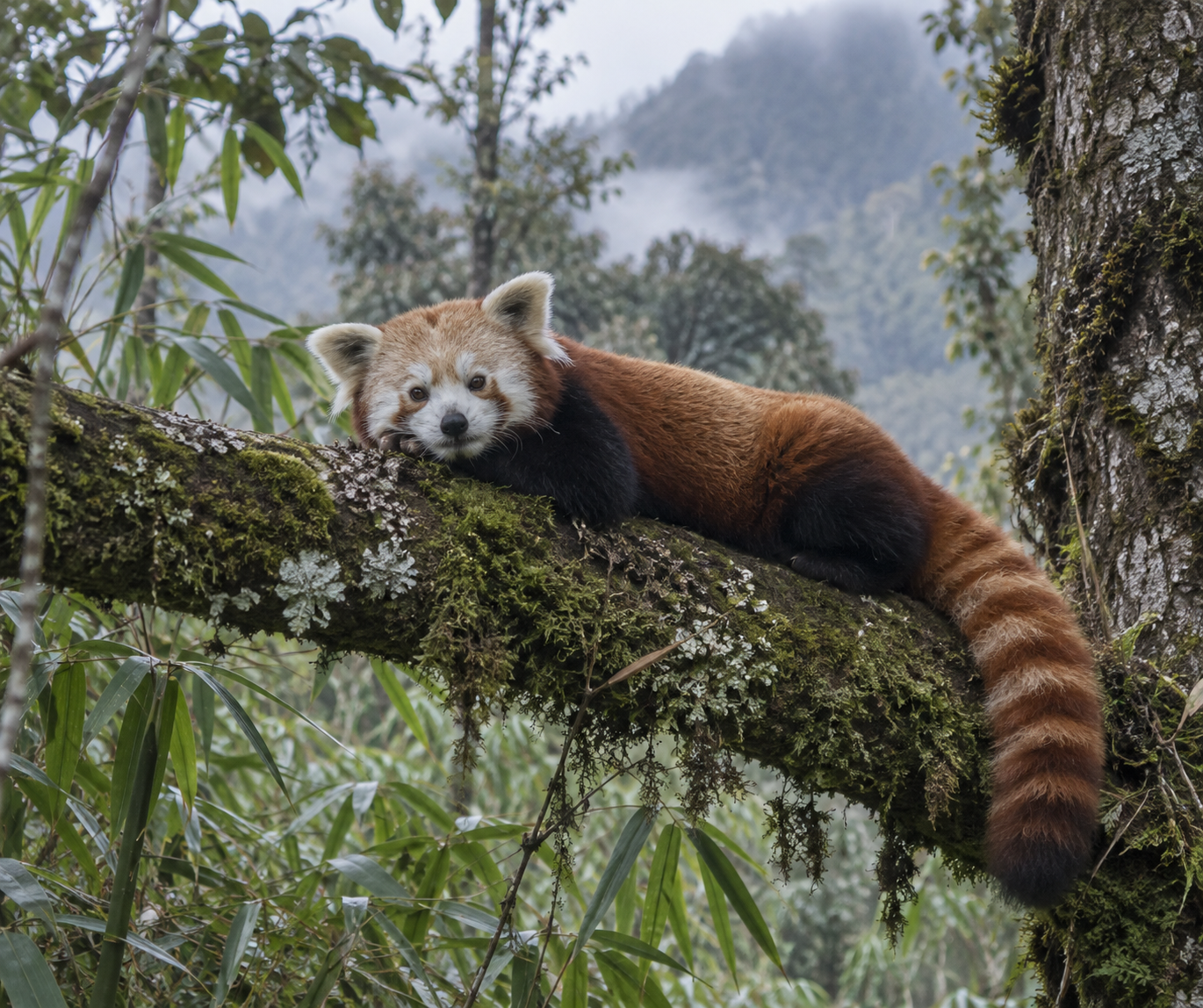
Built for life among branches, the red panda depends on forest habitat that offers both shelter and bamboo. · AI-generated illustration
The red panda in Nepal deserves more than a tick beside its name on a wildlife list. Its appeal is immediate: an expressive face, a rich coat and a presence that seems almost made for a photograph. Yet a photograph offers only a narrow introduction. To understand this animal, we need to look beyond the moment of discovery and ask how its appearance, daily choices and forest home fit together.
That shift matters because much of the excitement surrounding rare wildlife centres on whether we will see it. Travel stories often move quickly from the search to the reward, leaving the animal itself strangely unexplored. A species portrait takes a different route. It asks not just where a red panda might appear, but what kind of life it leads when no visitor is watching. The animal is the subject, rather than the proof of a successful journey.
Nepal provides an important setting for that portrait. Its mountain landscapes are often described through summits, trekking routes and sweeping views. Forests can become background scenery in those descriptions, something to pass through on the way to an open ridge. For a red panda, however, the forest is not a backdrop. It is the setting in which the practical work of living takes place. Seeing Nepal from that perspective brings attention away from the distant skyline and towards the living detail beneath it.
Understanding begins with careful questions. What can an animal’s shape tell us about the demands of its surroundings? How should we interpret a period of rest, a movement through vegetation or an apparent pause? Which features of a forest matter to an animal, even when they escape a traveller’s notice? These questions give form, behaviour and habitat a shared purpose. Rather than collecting isolated curiosities, we can consider the red panda as a whole animal responding to the conditions around it.
Care is needed in the language we use, too. Calling a red panda “cute” describes our reaction, not its experience. Calling it “shy” may turn a limited observation into a claim about personality. Even “elusive” is best understood partly as a description of the human search: an animal can be difficult for us to find while going about an entirely ordinary day. None of this removes the pleasure of watching wildlife. It makes that pleasure more attentive, and less dependent on imagining that an animal exists to engage with us.
A responsible portrait also recognises the limits of a sighting. One visible individual, watched briefly, cannot reveal every aspect of a species’ life. Nor does a missed sighting make a forest empty or a visit worthless. Field research, patient observation and the knowledge of people who work in these landscapes help build a fuller picture than any single encounter can provide. Keeping those sources distinct from assumption is essential when writing about an animal that many readers may never see in the wild.
This is the spirit in which to meet Nepal’s red panda: with curiosity rather than a demand for an appearance. Its value does not depend on how clearly it poses or how easily it can be found. The deeper reward is understanding a wild life on its own terms.
Recognising the Red Panda: Form and Adaptation
A red panda in Nepal is easier to recognise once you look beyond its fox-like face. Its russet coat, pale facial markings, dark limbs and long, ringed tail form a distinctive pattern. Yet these features are more than attractive details: together with specialised feet and a useful wrist bone, they help a small mountain mammal move, feed and rest among branches.
A Coat That Blends into the Canopy
The back and sides are reddish-brown, while the belly and legs are much darker, often nearly black. Against reddish mosses, lichens and shaded branches, this colouring can make a resting animal surprisingly difficult to notice. Dense fur provides insulation in cool mountain forests, and fur covering the soles adds protection from cold surfaces.
Pale fur frames the muzzle, cheeks and upright ears. Reddish markings run down from the eyes, giving the face its familiar masked appearance. Individual markings vary, so a photograph may show a whiter or more strongly coloured face than expected. The dark nose and eyes stand out against this lighter fur, while the rounded head and short muzzle distinguish it from a fox.
Built for Life Above the Ground
Red pandas have short, sturdy limbs, but they are accomplished climbers. Their flexible ankles allow the hind feet to rotate, helping them grip a trunk when descending headfirst. Sharp, curved, partly retractable claws provide purchase on bark and branches. This combination allows controlled movement through a three-dimensional world where a secure foothold matters more than speed.
The bushy tail, marked with alternating reddish and paler rings, acts as a counterbalance along narrow supports. It is not a grasping tail: a red panda cannot hang from a branch by it. When resting in cold weather, the animal can curl up and wrap the tail around its body and face, using it as an insulating cover.
Another adaptation is less obvious. An enlarged wrist bone, usually called a “false thumb,” works against the digits to help hold bamboo and other food. It is not a true extra finger. Instead, this modified bone gives the forepaw a useful grasp, allowing the animal to bring stems and leaves towards its mouth while feeding.
Its Own Branch of the Family Tree
Despite its name, the red panda does not belong to the bear family, Ursidae. It belongs to Ailuridae, a separate family within the mammalian order Carnivora. Giant pandas are bears; red pandas are not. Their shared name and bamboo-focused diets do not make them close relatives, and their false thumbs represent independently evolved adaptations rather than evidence that they belong together.
Identification within Ailuridae needs a little care because taxonomic treatments differ. Genetic research supports separating red pandas into the Himalayan red panda, Ailurus fulgens, and the Chinese red panda, Ailurus styani. Some conservation references still treat them as one species with two subspecies. Under the two-species treatment, Nepal’s animals are Himalayan red pandas; under the subspecies treatment, they are Ailurus fulgens fulgens.
Himalayan red pandas generally have paler faces than their Chinese counterparts, but coat differences overlap. For a wild animal in Nepal, geographic range is a more dependable guide than facial colour alone. A single photograph should not be treated as a genetic identification.
A Life Shaped by Bamboo and Mountain Forests
To understand the red panda in Nepal, look beyond the animal to the forest that sustains it. Its day revolves around finding bamboo, conserving energy and moving between sheltered feeding and resting places. These activities shift with weather, food availability and reproductive needs; a fixed timetable of morning feeding and afternoon sleep would hide a more flexible life.
Red pandas belong to the mammalian order Carnivora, but their diet is dominated by bamboo leaves and tender shoots. Their digestive system remains relatively simple rather than specialised like that of a grazing animal. Because they extract limited energy from fibrous food, they must spend substantial time feeding and avoid unnecessary exertion. Depending on availability, they also eat fruits, acorns, insects and occasionally eggs or small animals. These extras do not remove their dependence on bamboo.
Rest is therefore part of their survival strategy, not simply inactivity. A red panda may curl up on a branch, shelter in a tree hollow or stretch along a limb. Its thick fur and bushy tail help conserve warmth, while shade offers relief during warmer conditions. Feeding and movement can occur by day or night, often around dawn and dusk. Temperature, disturbance and season can alter that pattern.
Nepal-specific field studies describe seasonal differences in habitat use and activity, but findings from one study area should not become rules for every forest. Snow cover, access to fresh bamboo and breeding demands can change where animals travel and how they divide feeding and rest. Camera traps, direct observations and movement tracking also capture different parts of the picture. For current conditions at a particular site, check locally with park researchers, community forest teams or Red Panda Network field specialists.
Usually solitary, adults maintain contact without travelling together. Urine, droppings and glandular scent marks leave information along routes and at repeatedly used places. These signals help neighbours recognise one another and advertise reproductive condition. Solitary does not mean completely isolated: animals meet to mate, and mothers remain with dependent young. A female raises her cubs without routine care from the male.
Across the species’ range, mating generally occurs in winter, followed by births in late spring or summer. However, much detailed reproductive knowledge comes from managed populations and studies outside Nepal. It should not be presented as a precise Nepal-wide breeding calendar. Local timing needs confirmation through recent monitoring. Before giving birth, a female prepares a sheltered nest, often in a tree cavity, lining it with vegetation. Cubs initially depend on this refuge and their mother’s milk.
In Nepal, red pandas inhabit mountain forests from eastern districts such as Ilam, Panchthar and Taplejung to central and western landscapes, including Langtang and Rara. Distribution is patchy, not a continuous belt. Nepal studies commonly place habitat roughly between 2,200 and 4,000 metres, with records extending higher; elevation alone cannot identify suitable forest.
What matters is the combination: forest cover, a productive bamboo understory and mature trees with secure denning spaces. Nearby water and connected patches also support habitat use. A stand of bamboo without shelter is not equivalent to intact habitat, nor is a wooded slope with little food. Protecting these layers together safeguards feeding, resting, communication and the next generation—not merely a place where visitors might glimpse an animal.
Conclusion: Protecting More Than a Sighting
The future of the red panda in Nepal depends on more than whether a visitor manages to see one. It rests on connected forests, thoughtful land use and the people who share these mountain landscapes. A sighting can inspire affection, but conservation must also protect the places where red pandas remain unseen. Their absence from a traveller’s photographs does not make a forest less valuable—or its protection less urgent.
The red panda is classified as Endangered on the IUCN Red List, and Nepal lists it as a protected mammal under its national wildlife legislation. These are different forms of recognition: one assesses extinction risk, while the other provides legal protection within the country. Neither guarantees safety on the ground. The global assessment should not be treated as a current census of Nepal’s population; precise national totals remain difficult to establish for an elusive animal living across rugged terrain.
Research and conservation work in Nepal have documented several pressures, but they should not be bundled into a single vague claim of “human interference.” Habitat loss and fragmentation concern the removal or division of suitable forest. Roads, settlement expansion and changes in land use can leave forest patches less connected, making movement between them more difficult. Protecting an isolated patch is therefore not always enough: the connections between habitats matter too.
Disturbance is a related but distinct problem. Livestock grazing, forest-product collection and human activity can put pressure on habitat that still appears forested. Their effects depend on intensity, location and management; not every person entering a forest causes the same harm. Conservation works best when it recognises local needs and supports workable arrangements for grazing, resource use and forest protection, rather than treating neighbouring communities as outsiders to the solution.
Dog-related risks also deserve separate attention. Attacks by free-ranging dogs have been documented in Nepal’s red panda landscapes. Dogs may also carry diseases that threaten wildlife, although possible disease exposure should not be presented as proof of a confirmed outbreak in red pandas. Responsible dog management, including vaccination and preventing dogs from roaming in sensitive habitat, can complement forest protection. Visitors should not bring dogs into red panda habitat.
Illegal exploitation is another documented concern. Nepalese enforcement records include seizures of red panda skins, supporting concern about poaching and illegal trade. However, skin seizures do not by themselves demonstrate widespread capture for the live-pet trade, nor do they reveal the full scale or motivation of killing. Claims about illegal live capture need their own evidence. Careful reporting matters: sensational stories can obscure the threats that local conservation teams are actually addressing.
For travellers, responsibility begins before any encounter. Choose guides who respect wildlife, keep sensitive locations off public posts and support conservation without promising sightings. Never bait, crowd or pursue wildlife, and leave an animal a clear route away. A guide’s willingness to stop an approach is a sign of professionalism, not poor service. Before travelling, check locally for current access rules, permissions and reputable community-led conservation opportunities. Ask who leads the work, how local people benefit and what your contribution supports. The most meaningful souvenir may be knowing that your visit helped keep a forest safe, whether or not a red panda appeared.